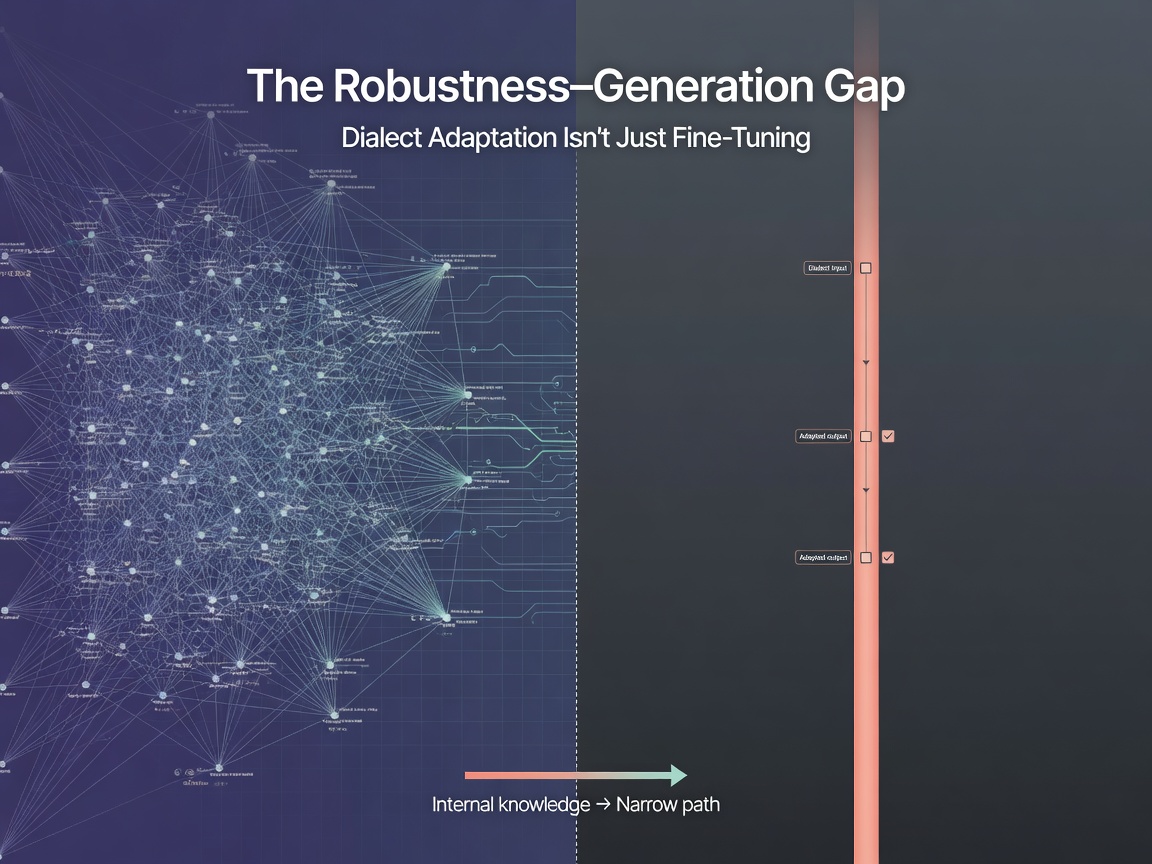
The Robustness-Generation Gap: Why Dialect Adaptation Isn't Just a Fine-Tuning Problem
Adapting large language models to specific English dialects is often sold as a straightforward fine-tuning task. The DiaLLM research proves that's a simplification. There is a fundamental "robustness-generation gap" wher
Automation needs a narrow first win
The best first AI workflow is usually a repeated task with a clear input, clear output, and a human approval step.
Adapting large language models to specific English dialects is often sold as a straightforward fine-tuning task. The DiaLLM research proves that's a simplification. There is a fundamental "robustness-generation gap" where a model's ability to understand a dialect (robustness) and its ability to actually produce it (generation) are governed by entirely different parts of the training pipeline. While pretraining and supervised fine-tuning (SFT) build the foundation for comprehension, alignment methods like DPO, GRPO, and GSPO are what actually shape the output. If you’re looking at a high benchmark score for dialectal understanding and assuming the model is ready for production, you’re likely missing the most difficult part of the work.
The Pretraining vs. Alignment Split
The DiaLLM framework tested three open-weight families—Llama 3.1-8B, Qwen 3-8B, and Gemma 3-4B—across 18 English varieties. The data shows a clear dissociation: continual pretraining and SFT are the heavy lifters for establishing a model's grasp of dialectal nuances. However, the actual generation of that dialect is significantly reshaped during the alignment phase. For practitioners, this is where most production deployments fail. If you rely solely on pretraining benchmarks to judge dialectal capability, you are looking at a model that knows what a dialect sounds like but lacks the specific "voice" required for the end user. You’ve built the library, but you haven't taught the model how to speak.
Worth a look
Phugialy Picks

The Agentic AI Bible: The Complete and Up-to-Date Guide to Design, Develop, and Scale Goal-Driven, LLM-Powered Agents that Think, Execute...

LLM Systems Engineering: Training and Building Large Language Models – Engineering AI Models Through Fine-Tuning, Continued Pretraining, and From-Scratch Development (AI Engineering)

Plaud Note Pro AI Voice Recorder Transcribe & Summarize for Meetings Calls
Some Phugialy Picks use affiliate links. If you buy through one, Phugialy may earn a commission. It doesn't change what we recommend. Full disclosure →
The Diminishing Returns of Aggressive Rewards
One of the more nuanced findings involves the trade-off between explicit variety-targeted adaptation and broad alignment. Human and LLM judges consistently preferred specific, variety-targeted adaptation over broad alignment methods. But there is a ceiling. The study found that GRPO—the most aggressive reward optimization method tested—was actually not the preferred method by human evaluators. This is a classic trap in RLHF-style training: when you optimize too aggressively for a specific reward metric, you risk stripping away the organic flow that makes human speech coherent. It suggests that "more" optimization isn't always "better" optimization; at a certain point, the model starts to sound forced or artificial.
Engineering for Knowledge vs. Style
The takeaway for production is clear: we cannot treat dialect adaptation as a one-and-done fine-tuning step. Because robustness and generation are dissociated, a model that passes a dialectal comprehension test might still fail to produce the desired output in a real-world application until it undergoes specific, well-calibrated alignment. For developers, this means the "dialect problem" is actually two separate engineering hurdles: one of knowledge (solved by pretraining) and one of style (solved by alignment). If you only solve the first, you have a model that understands every variety but speaks only one—effectively hiding half of the work required to make the technology actually useful for diverse communities.
Got a question about how this applies to you? →
Keep reading
Follow the thread
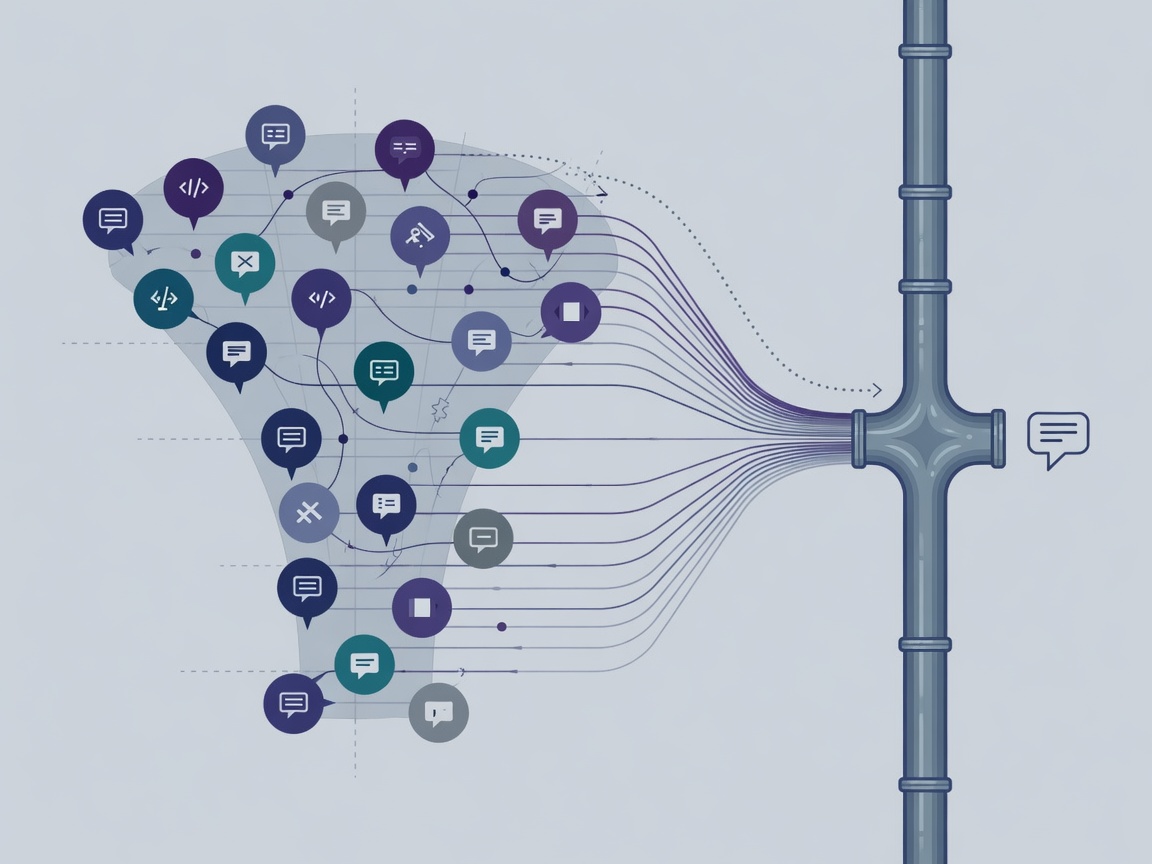
The Dialect Gap: Why Robustness Doesn't Mean Fluency in LLMs
Training a model to understand a dialect is not the same as teaching it to speak one. The DiaLLM study reveals a technical dissociation between dialectal robustness and generation—a gap that means your 'robust' model might still be failing your users.
Read this noteSame lane, different angle
LLM Heuristics For Planning Tasks Cut Expert Tuning Costs
Classical planning systems have always needed expensive hand-tuned heuristics to work well on your specific problems. A new method has LLMs write them automatically from code-level problem definitions — with state-of-the-art benchmark results.
Poverty Mapping With Multimodal AI: What Actually Works
Fusing satellite imagery with LLM text lifts household wealth prediction from R²=0.63 to 0.77 - but one part of that pipeline didn't earn its keep.