LLM Heuristics For Planning Tasks Cut Expert Tuning Costs
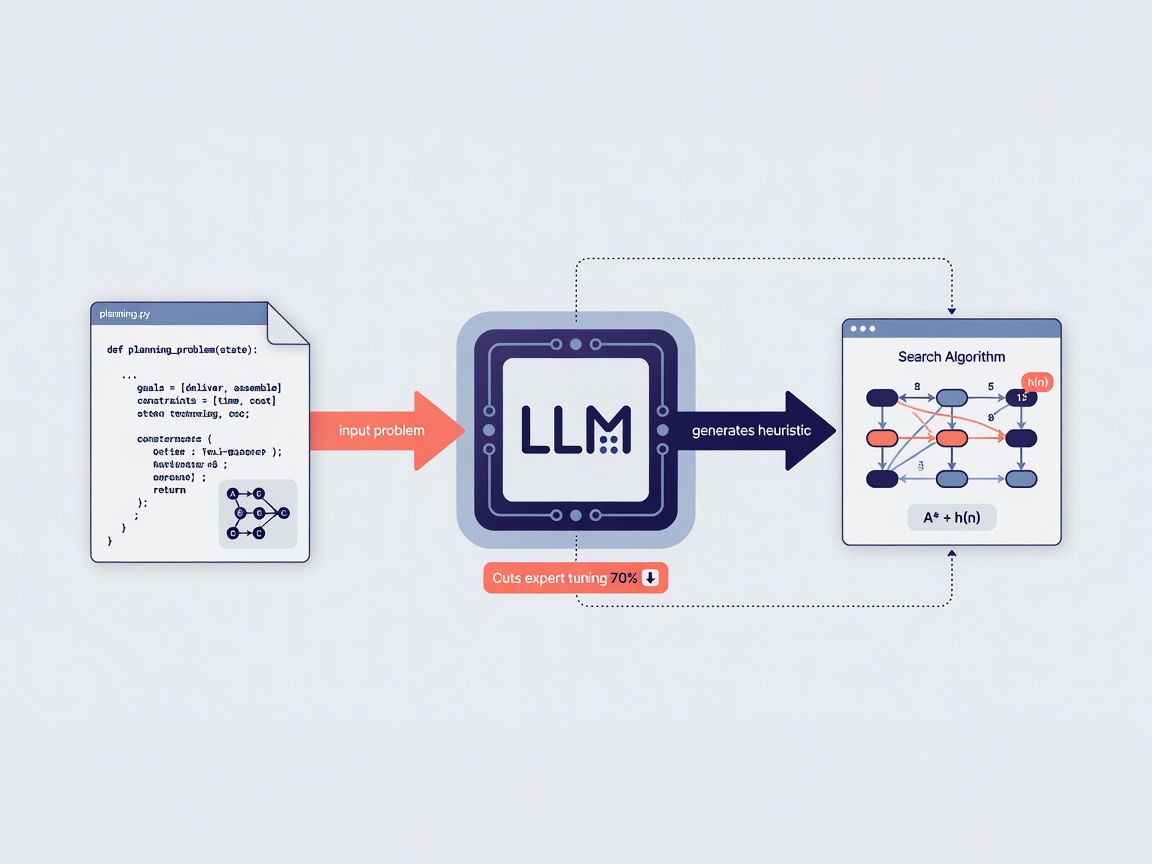
Classical planning systems have always needed expensive hand-tuned heuristics to work well on your specific problems. A new method has LLMs write them automatically from code-level problem definitions — with state-of-the-art benchmark results.
Automation needs a narrow first win
The best first AI workflow is usually a repeated task with a clear input, clear output, and a human approval step.
If your business runs on scheduling, routing, or resource-allocation problems, the cost line that matters isn't the software license — it's the consultant hours spent hand-tuning the rules that make those solvers work. A new research paper on LLM heuristics for planning tasks targets exactly that line, and it's worth understanding even if you'll never touch a search algorithm yourself.
The researchers behind the work (published on arXiv) describe a method where a large language model automatically writes problem-specific heuristic functions directly from a planning task's definition. In plain terms: classical planning systems have always needed a "rule of thumb" — a heuristic — to guide their search toward a solution efficiently. Traditionally, those heuristics were built by hand, by people who understood both the domain and the formalism. This approach has the LLM generate them instead, then compiles the results into standard heuristic search algorithms like greedy best-first search.
What LLM Heuristics For Planning Tasks Actually Deliver
The claims in the paper are measured, which is refreshing. On established planning benchmarks, the approach achieves competitive performance and, in many cases, state-of-the-art results. That's not a demo video; it's performance across a broad range of standard test problems that the field already uses to grade itself.
But the more interesting claim for anyone thinking about real operations is what this unlocks beyond benchmarks: problems that are difficult to express in traditional planning formalisms at all — including ones with complex numeric constraints or custom transition dynamics. Traditional planners speak a specific formal language; if your real-world problem doesn't fit neatly into that language, you either distort it to fit or write custom machinery. Here, tasks are specified through successor generators, goal tests, and initial states written in a general-purpose programming language — meaning if you can describe your problem in code you already understand, you may not need to translate it into a planner's dialect first.
Worth a look
Phugialy Picks

AI Engineering: Building Applications with Foundation Models
A practical guide to building real-world applications with foundation models and LLMs.

GMKtec K15 AI Mini PC Oculink Intel Ultra 5 125U 32GB DDR5 512GB SSD | Desktop Computer AI Boost, 3X M.2 2280 Storage Expansion, Dual NIC...

AI: Understand the Revolution: From Basics and Buzzwords to Tech Giants, Governments, and Your Future
Some Phugialy Picks use affiliate links. If you buy through one, Phugialy may earn a commission. It doesn't change what we recommend. Full disclosure →
Where The Real Savings Show Up
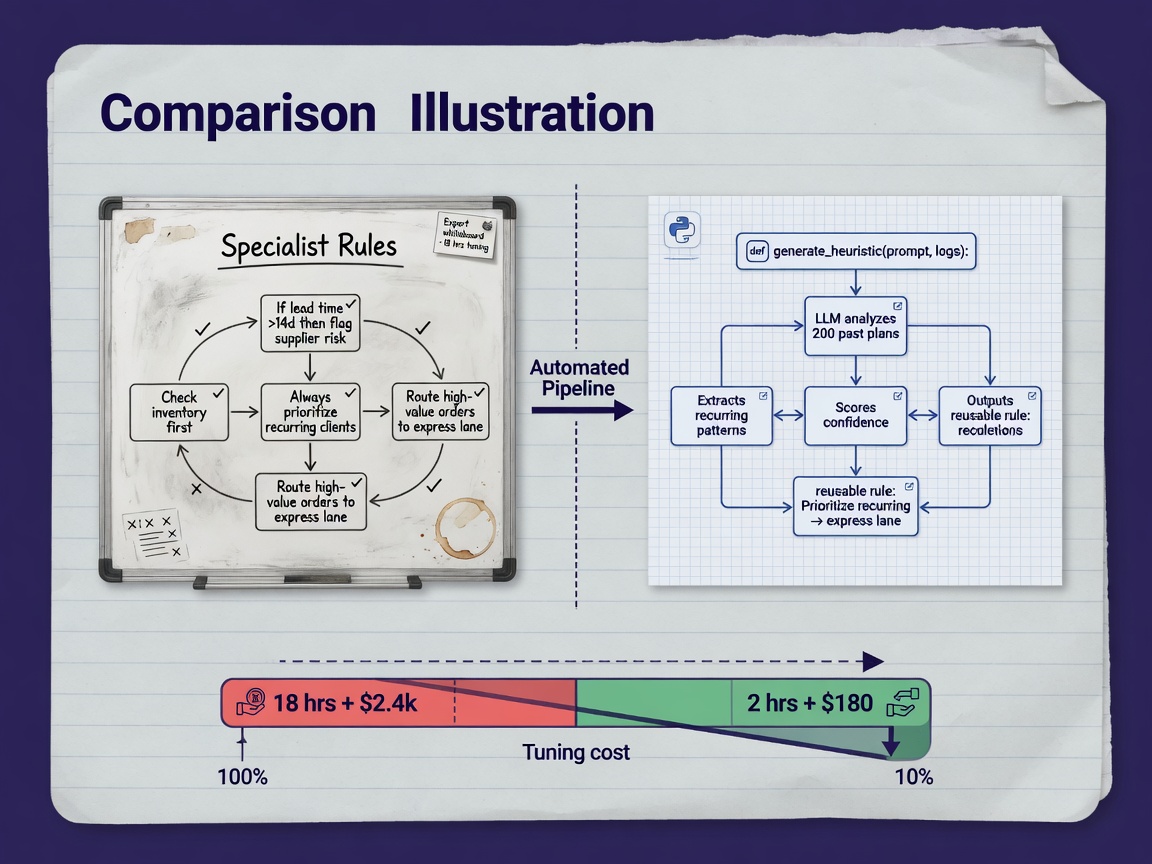
The background section of the paper makes the economics explicit without using business language: domain-independent planning deliberately prioritizes general applicability over task-specific tuning. That trade-off exists because tuning costs human expertise. Automatic synthesis of heuristics from problem definitions bypasses the need for that handcrafted domain knowledge entirely.
That's the ROI story. The expensive part of deploying classical planning at most companies was never running the solver — solvers are fast and cheap once configured. The expensive part was the specialist who wrote and maintained the heuristics that made the solver behave well on your specific problems. If an LLM can synthesize those from a problem definition, the specialist hours shrink and iteration gets cheaper: change your constraints in code, regenerate, re-run.
Two caveats before anyone budgets for this. First, this is research with an extensive empirical evaluation characterizing strengths and limitations across diverse settings — not a product with an SLA. The paper itself documents where the approach works well and where it doesn't; you'd want to know which side of that line your problems fall on before committing anything operational. Second, generated heuristics compiled into search algorithms still require someone on staff who understands both sides of that pipeline — someone who can read code and reason about search behavior. The tooling reduces expertise requirements; it doesn't eliminate them.
Who This Actually Changes Things For
The obvious read is "AI replaces planning engineers." What this actually points to is narrower and more useful: it shifts where human effort goes in optimization work — away from writing domain-specific guidance by hand and toward specifying problems correctly and validating outputs. The teams best positioned to benefit aren't AI labs; they're operations groups who already describe their constraints in code but have never been able to afford bespoke heuristic development.
My take, reading this as someone who has priced out optimization projects before: this is worth adopting once your team can express its planning problems as executable code with clear goal tests — not before. If your constraints live in spreadsheets and tribal knowledge, no heuristic generator will save you from doing that specification work first. And if your problems already fit comfortably inside an existing planner's formalism with off-the-shelf heuristics performing acceptably, this buys you little today; its edge shows up precisely where traditional formalisms strain.
The forward signal to watch: whether follow-up work demonstrates reliability on problems with heavy numeric constraints outside benchmark conditions. Benchmarks prove capability; production traffic proves dependability.
Got a question about how this applies to you? →
Keep reading
Follow the thread

Poverty Mapping With Multimodal AI: What Actually Works
Fusing satellite imagery with LLM text lifts household wealth prediction from R²=0.63 to 0.77 - but one part of that pipeline didn't earn its keep.
Read this noteSame lane, different angle
LLMs in Cybersecurity: Reading Past the 50% Malware Claim
A new survey claims LLM-generated malware will account for 50% of detected threats in 2025, up from just 2% in 2021 — and that projection is doing more work than any evidence behind it. The paper, a synthesis of over 70
The Maintenance Debt of AI-Generated Code
The Linux distribution Debian is currently voting on whether to ban AI-assisted contributions. This isn't a Luddite reaction to new technology; it’s a response to a fundamental shift in the economics of open-source maint