Predicting LLM Accuracy Before the Model Finishes Talking
LLMs are notoriously bad at knowing what they don't know. They often present hallucinations with the same poise as factual data, which makes reliability a massive hurdle for production. If you're building a system where
Automation needs a narrow first win
The best first AI workflow is usually a repeated task with a clear input, clear output, and a human approval step.
LLMs are notoriously bad at knowing what they don't know. They often present hallucinations with the same poise as factual data, which makes reliability a massive hurdle for production. If you're building a system where 'vibes' aren't a substitute for accuracy, you know the problem isn't just a lack of confidence—it’s a timing issue in how that confidence is processed.
The Gap Between Feeling and Knowing
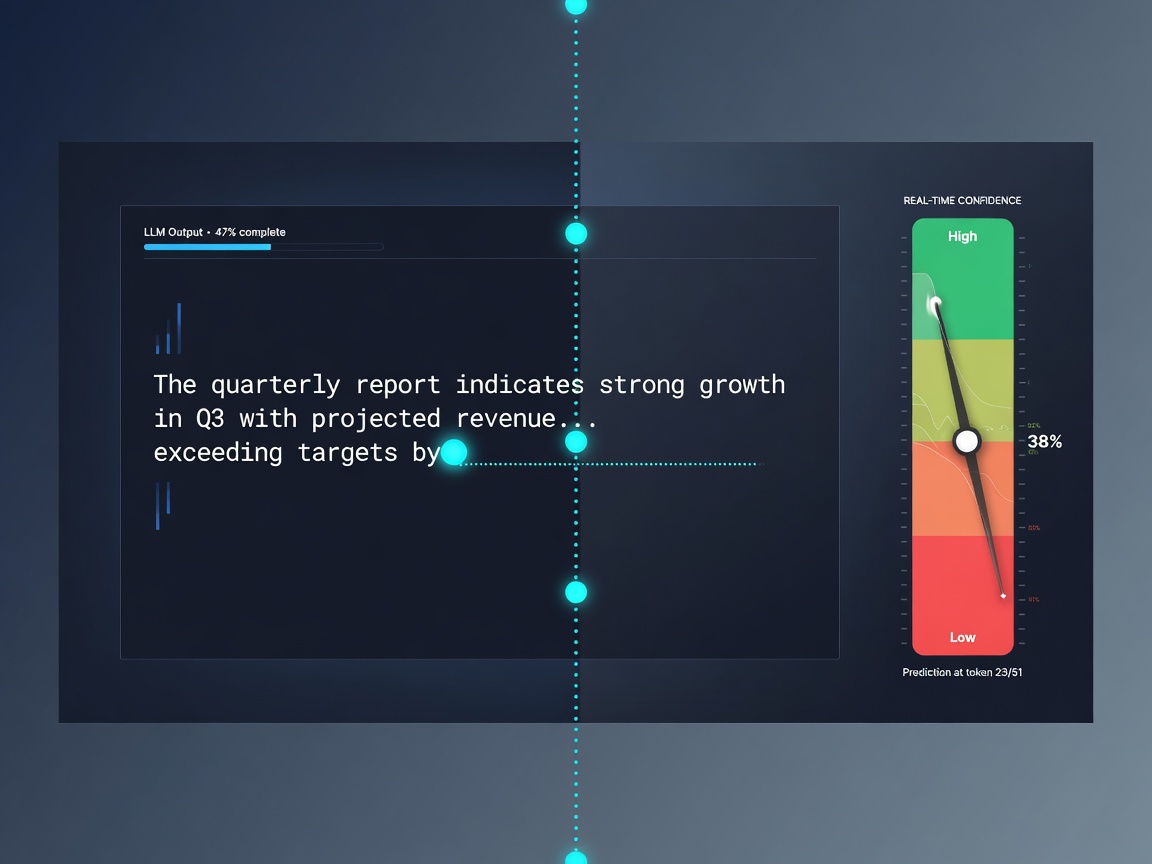
The research in "Temporal Confidence Estimation in Large Language Models" highlights a critical distinction between two types of confidence: Feeling-of-Knowing (FOK) and Judgement-of-Learning (JOL). FOK is the model's internal state before it completes an answer, while JOL is the confidence it assigns after the fact.
In almost every case, JOL is better calibrated—it actually correlates with correctness. However, for anyone building real-time systems, JOL is practically useless for gating responses because you have to wait for the model to finish generating the entire sequence before you can act on it. You're stuck with FOK, which is often noisy and unreliable. The research suggests we need a way to bridge this gap without the latency penalty.
Worth a look
Phugialy Picks

AI Engineering: Building Applications with Foundation Models
A practical guide to building real-world applications with foundation models and LLMs.

INIU 10000mAh 45W Fast Charging Portable Power Bank
We'd buy this if: You've been caught with a dead phone/laptop away from an outlet more than once.
We'd skip this if: You're always near a charger anyway.
OMOTON C2 Adjustable Aluminum Phone Stand
We'd buy this if: You want your phone upright on your desk for calls/notifications without a cable getting in the way.
We'd skip this if: You never keep your phone on your desk.
Some Phugialy Picks use affiliate links. If you buy through one, Phugialy may earn a commission. It doesn't change what we recommend. Full disclosure →
Distilling the "Hidden" Truth
The study finds that a model’s internal hidden representations are significantly richer than its verbal outputs. Even when a model doesn't "say" it's unsure, its internal layers are often already processing that uncertainty.
The researchers exploit this using "future confidence distillation." They use post-solution correctness (the ground truth) as a teacher signal to train predictors that look specifically at pre-solution hidden states. Essentially, they are training a secondary system to map the "hidden math" of the thinking phase to the likely success of the final output.
This is a significant win for efficiency. Because these distilled predictors are sample efficient and transferable across datasets within a domain, you don't need to retrain the entire base model. You just need a specialized predictor that knows how to interpret those hidden states more accurately.
The Latency vs. Precision Trade-off
The real story here isn't that we've solved hallucination; it's that we've found a way to move the "uncertainty check" earlier in the pipeline. But as a practitioner, you have to look at the nuance: the distilled predictors recover "much" of the calibration improvement of post-solution confidence, not all of it.
This creates a clear trade-off between latency and precision. If you're running a low-stakes chatbot, an early, slightly less-accurate confidence check is likely enough to filter out the most egregious errors while saving on compute. But for high-stakes applications—like medical or legal advice—the gap between "distilled" confidence and "post-solution" confidence might still be too wide to ignore. The research proves the information is there; the engineering challenge now is deciding exactly how much of that information is enough for your specific risk tolerance.
Got a question about how this applies to you? →
Keep reading
Follow the thread

The Math Phase Transition: Moving Beyond Pattern Recognition
OpenAI recently demonstrated that AI models are moving beyond simple pattern recognition and into the territory of novel mathematical discovery. An internal model successfully provided a counterexample to the 'unit dista
Read this noteSame lane, different angle
Google’s AI Power Shuffle: Consolidation vs. Research Independence
The draft was slightly under the word count floor. I expanded the analysis on the Public Benefit Corporation and the production-scale implications to ensure it hit the 400-700 word range while sharpening the 'Practitioner' persona's opinionated tone.
Moving Beyond Confidence Scores: Measuring AI Metacognition
LLMs frequently fail not because they lack information, but because they lack the metacognitive ability to recognize when their own internal 'certainty' is misplaced. The research into "Assessing Metacognitive Abilities