The Branding of Human Labor: Ohio State Fair’s AI Policy Shift
The Ohio State Fair is moving to formalize a "human-only" barrier for its poster contests by 2027. While the fair allowed AI-assisted work in 2024 provided it was disclosed, the upcoming policy shift marks a pivot from e
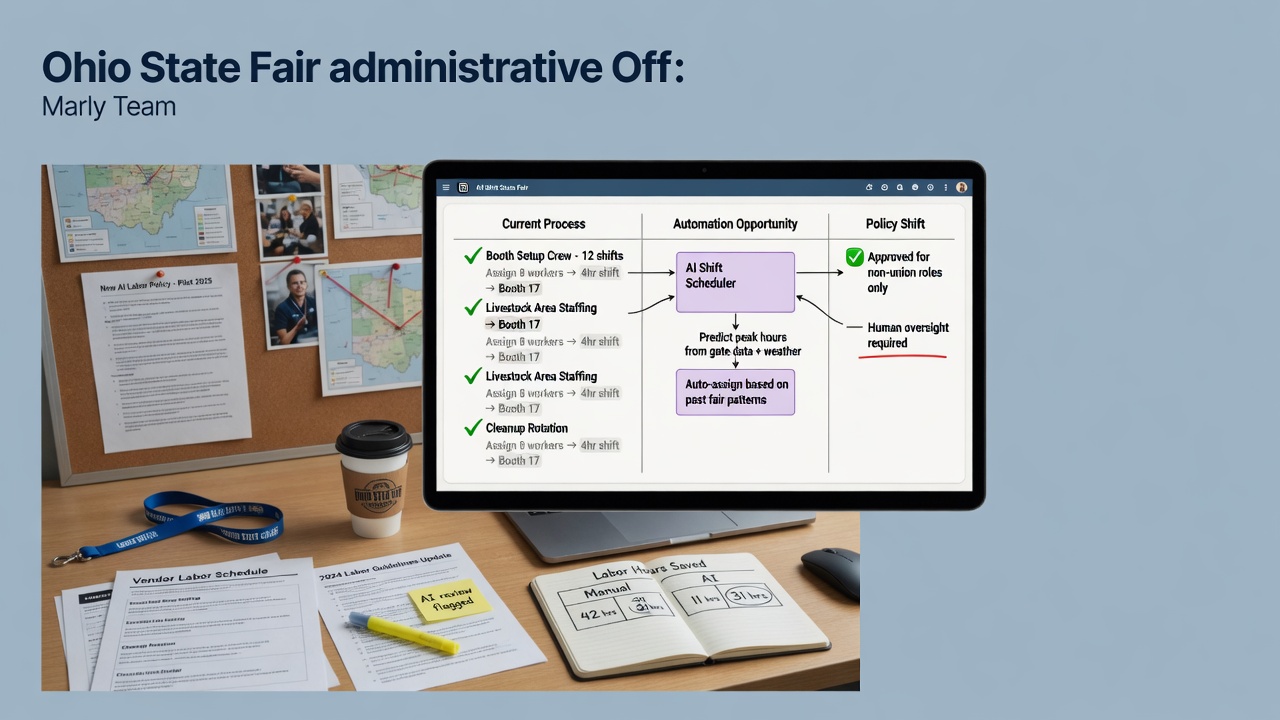
Automation needs a narrow first win
The best first AI workflow is usually a repeated task with a clear input, clear output, and a human approval step.
The Ohio State Fair is moving to formalize a "human-only" barrier for its poster contests by 2027. While the fair allowed AI-assisted work in 2024 provided it was disclosed, the upcoming policy shift marks a pivot from experimentation to exclusion. This isn't just a rule change for a single contest; it is a deliberate calibration of what constitutes "authentic" creative output in a public-facing, high-visibility venue.
The Transition from Disclosure to Prohibition
In 2024, the fair adopted a permissive stance, requiring only that AI usage be explained during the application process. This suggests a period of observation—a "wait and see" approach to determine how AI tools would impact the volume and quality of entries. However, the planned 2027 prohibition signals that the fair has reached a conclusion: for certain types of competitive art, the tool is indistinguishable from the transgression.
By contrast, several other categories—including fine arts, creative arts, mural contests, and plein air painting—have never permitted AI. By bringing the poster contest into this "no-AI" zone, the fair is standardizing its definition of craft. This creates a bifurcated landscape where some categories might remain open to technological augmentation while others are cordoned off as protected human domains. This distinction is critical for creators who operate in the gray area between "tool" and "author." If a mural contest allows digital brushes but forbids AI, the fair is essentially defining the "soul" of the work as the intentionality of a human hand, rather than the aesthetic output of a machine.
Worth a look
Phugialy Picks

The Agentic AI Bible: The Complete and Up-to-Date Guide to Design, Develop, and Scale Goal-Driven, LLM-Powered Agents that Think, Execute...

Screen Mom Screen Cleaner Spray (16oz)
We'd buy this if: You've been wiping your monitor with your shirt sleeve.
We'd skip this if: You already have a cleaning routine sorted.
Anker USB-C to USB-C 60W Fast Charging Cable (2-Pack)
We'd buy this if: You need a reliable spare charging cable that won't fray in a month.
We'd skip this if: You already have enough cables lying around.
Some Phugialy Picks use affiliate links. If you buy through one, Phugialy may earn a commission. It doesn't change what we recommend. Full disclosure →
The Commercial Branding of Human Labor
This policy shift highlights a broader trend: the branding of "humanity" as a premium commodity. As AI-generated content becomes cheaper and more ubiquitous, the commercial value of art shifts from the result to the provenance. By 2027, the Ohio State Fair is effectively creating a "certified human" standard for its winners.
This move suggests that for traditional institutions, the competitive advantage lies in the labor-intensive process rather than the final image. For creators, this creates a new friction: if the goal is to win a prestigious state-sanctioned prize, the path of least resistance (AI generation) is being systematically removed. This may increase the barrier to entry for new artists who lack traditional tools but possess high creative vision, while simultaneously protecting the market share of established artists whose value is tied to manual skill. The question is whether this protectionism will actually foster new talent or simply entrench existing workflows.
Implications for Institutional Gatekeeping
What this actually points to is a move toward "cultural protectionism." As AI tools lower the cost of production to near zero, the only way to maintain the prestige of a contest is to artificially re-introduce scarcity—specifically, the scarcity of human time. If this trend holds, we can expect more public and state-funded institutions to follow suit, creating a "walled garden" for human-made art.
The interesting competitive question this raises is whether this will lead to a "Human-Made" certification market. If the Ohio State Fair sets the precedent, other regional fairs and state arts councils may see it as a necessary step to preserve the "authenticity" of their programs. For businesses and artists alike, the 2027 deadline serves as a warning: in the public sphere, "human-made" is becoming a specific, protected category with its own set of rules and gatekeepers.
Got a question about how this applies to you? →
Keep reading
Follow the thread
AI Regulation Now Depends on the Companies It Regulates
The most uncomfortable line in a recent analysis on AI's institutional power: a government may end up trying to regulate an AI provider whose technology it simultaneously depends on. That's the vendor lock-in problem every developer knows, scaled until the dependent party writes the rules — and with a footprint of more than a billion devices, the dependency is already shipping.
Read this noteSame lane, different angle
When AI Labs Counterbalance Government, Who Checks Them?
OpenAI's new Head of Strategic Futures argued frontier AI labs could become a "counterbalance to government." The sharper question is what happens when AI providers embedded in hospitals and agencies start looking like critical infrastructure — with no elections, courts, or FOIA laws to hold them accountable.
Frontier AI Labs Want Government Power - Who Audits Them?
At some point, a government may find itself trying to regulate an AI provider whose technology it simultaneously depends on. That line, from an argument making the rounds about OpenAI strategists and the future of fronti