When AI Labs Counterbalance Government, Who Checks Them?
OpenAI's new Head of Strategic Futures argued frontier AI labs could become a "counterbalance to government." The sharper question is what happens when AI providers embedded in hospitals and agencies start looking like critical infrastructure — with no elections, courts, or FOIA laws to hold them accountable.

Automation needs a narrow first win
The best first AI workflow is usually a repeated task with a clear input, clear output, and a human approval step.
OpenAI hired Dean Ball as Head of Strategic Futures after he argued that frontier AI labs could become a "counterbalance to government" and a "new kind of institution under the sun." That's the story on the surface. The more interesting part is what happens underneath it: AI is quietly becoming infrastructure for cognitive work itself, and nobody has worked out what that does to the old assumption that governments sit above corporations.
When Your AI Provider Becomes Critical Infrastructure
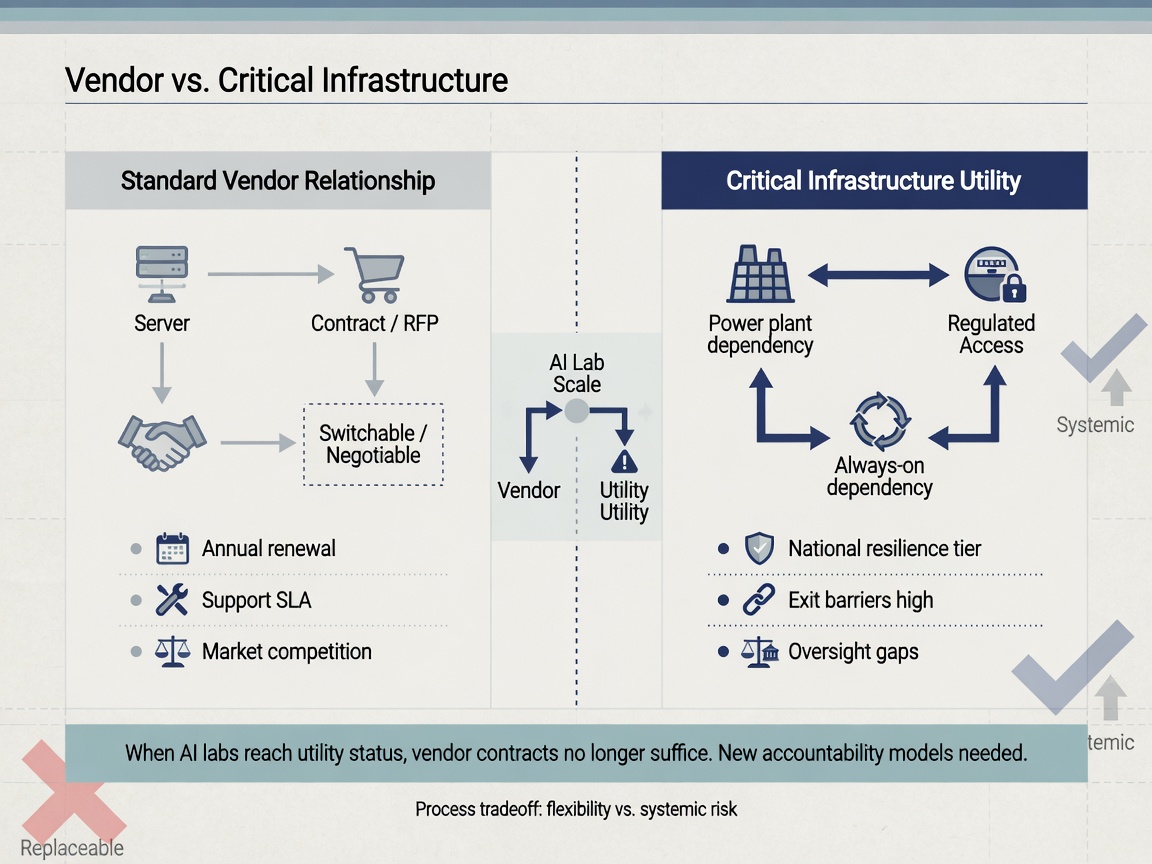
The source article walks through the scenario that actually matters once AI is embedded in hospitals, universities, and government agencies. At that point, an AI provider starts to resemble critical infrastructure — and critical infrastructure comes with obligations. Continuity requirements. Appeals processes when access gets terminated. Interoperability standards. Independent auditing.
Anyone who has integrated a third-party API into a production system knows the shape of this problem at small scale: your uptime is someone else's uptime, your termination terms are someone else's continuity plan. Now scale that to a hospital's diagnostic workflow or a government agency's case processing. "That is not a normal relationship between a company and a regulator," as the article puts it. The gap between a vendor relationship and a utility obligation is exactly where this gets messy.
Phugialy Picks

AI Engineering: Building Applications with Foundation Models
A practical guide to building real-world applications with foundation models and LLMs.

GMKtec K15 AI Mini PC Oculink Intel Ultra 5 125U 32GB DDR5 512GB SSD | Desktop Computer AI Boost, 3X M.2 2280 Storage Expansion, Dual NIC...

AI: Understand the Revolution: From Basics and Buzzwords to Tech Giants, Governments, and Your Future
Some Phugialy Picks use affiliate links. If you buy through one, Phugialy may earn a commission. It doesn't change what we recommend. Full disclosure →
The Accountability Gap Nobody Has Closed
Here's the asymmetry the article names directly: unlike governments, AI companies have no democratic accountability mechanisms. No elections, no courts with jurisdiction over their internal decisions, no freedom-of-information laws. If a frontier lab becomes powerful enough that the traditional hierarchy between state and corporation breaks down, there is no obvious answer to who checks the provider's power.
The source article's title frames this as an OpenAI strategist wanting labs to rival government power, but the underlying material is more careful than that. Ball's actual position is nuanced — he argues some dangerous AI capabilities cannot realistically be left in private hands and may require stronger state involvement. So this isn't a lobbying pitch dressed up as philosophy; it's someone at a frontier lab acknowledging that the boundary between private and state power may need to be redrawn, without having an answer for who plays the counterbalancing role on the other side.
What This Actually Points To
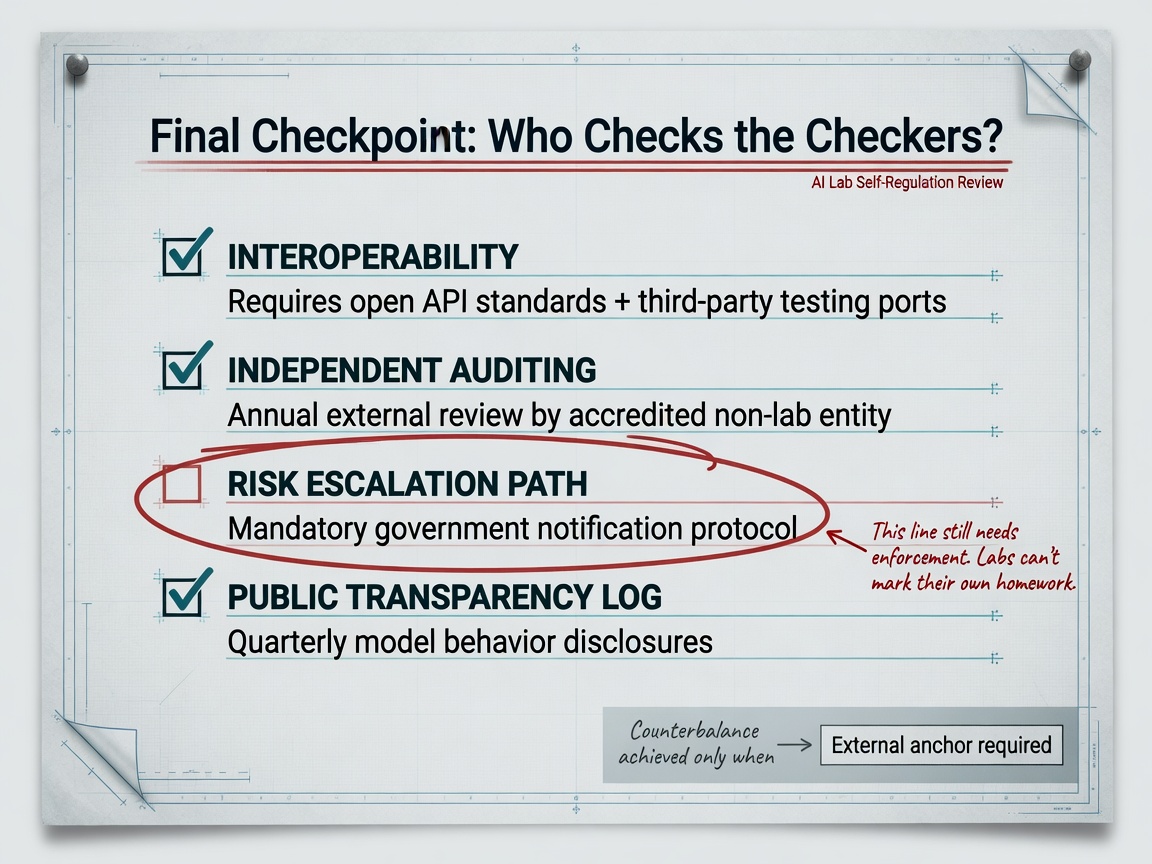
My read: the "counterbalance" framing is less interesting than the infrastructure framing. Whether or not labs should rival governments, the embedding of AI providers into critical cognitive workflows is already creating utility-like dependencies, and the accountability machinery hasn't been built. The article's list — continuity requirements, appeal mechanisms, interoperability, independent audits — reads like a requirements doc for regulating AI as infrastructure, and that's the practical conversation worth having now, before the dependencies harden.
The open question the article leaves hanging is the right one: if AI companies do become a counterweight to the state, who counterbalances them? Until someone answers that with an actual mechanism rather than a market-share argument, the infrastructure obligations are the concrete, buildable part of this debate — and the part companies should expect regulators to reach for first.
Got a question about how this applies to you? →
For a concrete look at what happens when AI companies scale physical and compute infrastructure faster than governance can follow, see "The Infrastructure Debt of xAI's Colossus Build."
Keep reading
Follow the thread

Frontier AI Labs Want Government Power - Who Audits Them?
At some point, a government may find itself trying to regulate an AI provider whose technology it simultaneously depends on. That line, from an argument making the rounds about OpenAI strategists and the future of fronti
Read this noteSame lane, different angle
AI Regulation Now Depends on the Companies It Regulates
The most uncomfortable line in a recent analysis on AI's institutional power: a government may end up trying to regulate an AI provider whose technology it simultaneously depends on. That's the vendor lock-in problem every developer knows, scaled until the dependent party writes the rules — and with a footprint of more than a billion devices, the dependency is already shipping.
Architecting AI Inference Infrastructure for Data Movement
Moving data from one place to another and making sure we can use it effectively is the primary technical hurdle in modern AI deployments. While training models captures the spotlight, the shift toward AI inference infras