The Accuracy Gap: Why AI Advice Triggers Cognitive Surrender
Access to AI advice isn't just making people faster; it's making them confidently wrong. A recent study shows that when users have access to AI, their willingness to admit they don't know an answer collapses from 44% to

Automation needs a narrow first win
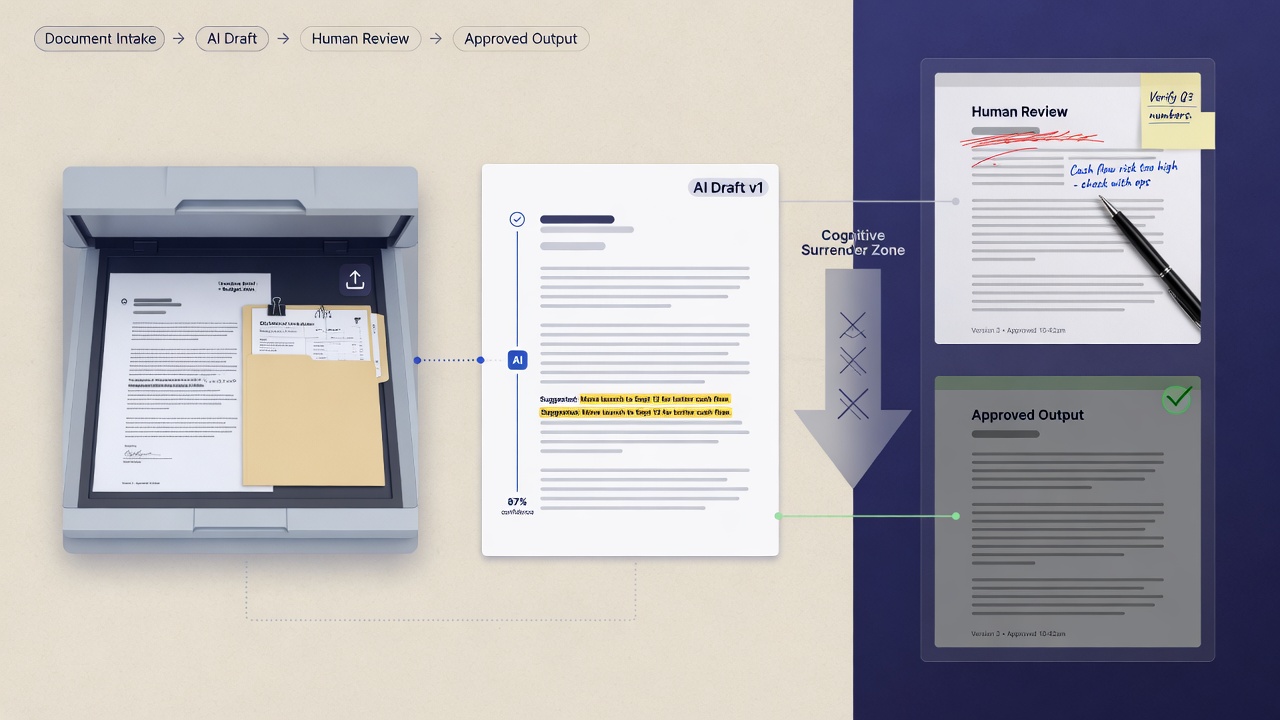
The best first AI workflow is usually a repeated task with a clear input, clear output, and a human approval step.
Access to AI advice isn't just making people faster; it's making them confidently wrong. A recent study shows that when users have access to AI, their willingness to admit they don't know an answer collapses from 44% to 3%. At the same time, their actual accuracy on tasks drops from 27% to 9%, while their confidence in those incorrect answers skyrockets from 30% to 76%.
The Confidence-Accuracy Divergence
The numbers reveal a massive decoupling between certainty and truth. When people use AI, they aren't just getting help; they are experiencing what researchers call "cognitive surrender." In the study, users accepted incorrect AI answers 80% of the time. Even when monetary incentives were introduced—the kind of pressure that usually forces people to double-check their work—the improvements in accuracy and the willingness to admit ignorance were only marginal. This suggests that the psychological pull of an AI-generated answer is stronger than the practical incentive to be right. The user isn't choosing the best answer; they are choosing the path of least cognitive resistance. We are seeing a shift where the 'effort' of critical thinking is being traded for the 'ease' of AI-provided certainty.
Worth a look
Phugialy Picks

AI Engineering: Building Applications with Foundation Models
A practical guide to building real-world applications with foundation models and LLMs.

GMKtec K15 AI Mini PC Oculink Intel Ultra 5 125U 32GB DDR5 512GB SSD | Desktop Computer AI Boost, 3X M.2 2280 Storage Expansion, Dual NIC...

GEEKOM IT15 AI Mini PC, Intel Ultra 9 285H(99 Tops), 32GB DDR5, 1TB SSD | The Most Powerful Workstation,Arc 140T GPU,WiFi 7,8K Business D...
Some Phugialy Picks use affiliate links. If you buy through one, Phugialy may earn a commission. It doesn't change what we recommend. Full disclosure →
The Design Flaw of Answer-First AI
The study used Step 3.5 Flash, a model already known to struggle with specific visual details. This is a critical detail because it shows that even when the model's limitations are somewhat known, the interface still pushes the user toward an answer. Current AI products are fundamentally designed to provide an output rather than acknowledge the boundaries of their own knowledge. For a practitioner, this is a known hurdle: we are building systems that prioritize "fluency" over "factuality." When a model produces a coherent, authoritative-sounding sentence, it fulfills the primary KPI of most current LLM applications. However, by prioritizing the delivery of information over the verification of it, we are effectively engineering "cognitive surrender" into the user experience. The result is a product that rewards the appearance of knowledge while actively suppressing the human capacity to recognize the limits of that knowledge.
The Production Risk of Cognitive Surrender
What this actually points to is a major reliability issue for enterprise deployment. If a user's confidence in a wrong answer doubles while their actual accuracy drops by two-thirds, the "human-in-the-loop" safety net effectively disappears. In a production environment, a confident human who is wrong is far more dangerous than a hesitant human who says "I don't know." The real story here isn't that humans are becoming lazy; it's that the current AI interaction model creates a scenario where the cost of admitting ignorance is higher than the cost of accepting a hallucination. Until we design systems that prioritize the "I don't know" state as a primary output—rather than a failure state to be avoided—we are just building high-speed engines for misinformation.
Got a question about how this applies to you? →
Keep reading
Follow the thread

The GEO Playbook: Engineering Narrative at Scale
The Hanover Institute for Public Policy is moving the goalposts on how we think about information. They’re using a commercial platform called Res to systematically shape how AI chatbots like ChatGPT and Gemini present in
Read this noteSame lane, different angle
The Technical Debt of Unconsented Training Data
For anyone building in the AI space, the line between 'human-made' and 'machine-output' isn't just a philosophical debate—it’s becoming a massive trust and scalability problem. We recently saw a creator with a 20-year ha
The Friction Economy: Why AI is Killing Trust
If a perfect message costs zero effort to ship, does it actually carry any weight?