Swahili Speech Recognition Needs Better Real-World Tests
A 3.24 percent word error rate sounds compelling, but it comes from prepared recordings. The harder test for Swahili voice AI is whether it can handle spontaneous, noisy, code-switched conversation—and get the details that matter right.
Automation needs a narrow first win
The best first AI workflow is usually a repeated task with a clear input, clear output, and a human approval step.
Swahili speech recognition has reached a striking 3.24 percent word error rate on prepared Mozilla Common Voice recordings. That is a real result, but it measures a cleaner task than many Kenyan conversations present: spontaneous speech, background noise, overlapping voices, and code-switching.
What the Swahili speech recognition score measures
A March 2026 preprint reports the 3.24 percent word error rate on Common Voice. It is evidence that a system can perform well on those recordings; it is not, by itself, evidence that the same accuracy will hold in everyday conversation. The distinction matters because prepared speech and spontaneous speech differ in exactly the ways that tend to make voice systems brittle.
A second 2026 preprint, covering 20 African languages, describes a broader generalization gap: performance can fall on speech that is noisy, spontaneous, or spoken by multiple people at once. The benchmark number and the gap are not contradictory. They answer different questions. One reports performance on a defined set of recordings; the other warns against treating that performance as a proxy for every setting.
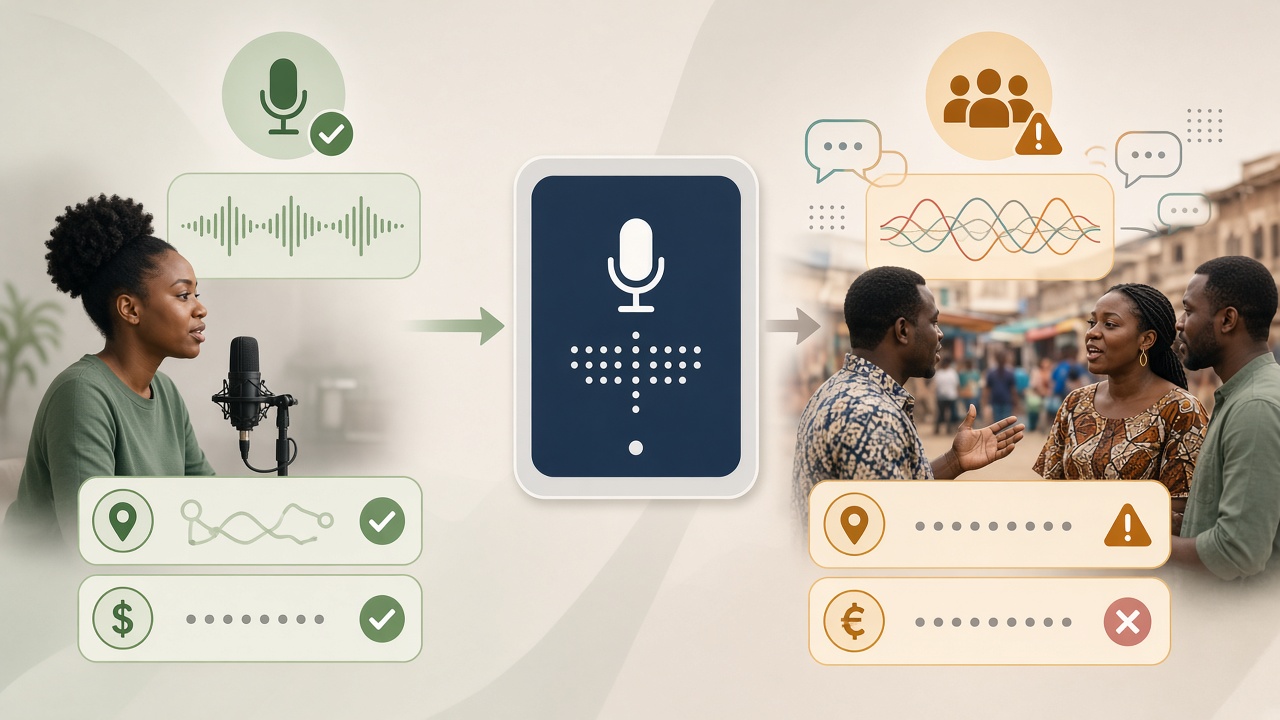
In practice, a low aggregate error rate can also hide the mistakes that matter most. The source article gives the example of a transcript that is mostly right but gets a farmer’s location or payment amount wrong. For a voice service, those are not interchangeable with a harmless misspelling.
Worth a look
Phugialy Picks

AI Engineering: Building Applications with Foundation Models
A practical guide to building real-world applications with foundation models and LLMs.

GMKtec K15 AI Mini PC Oculink Intel Ultra 5 125U 32GB DDR5 512GB SSD | Desktop Computer AI Boost, 3X M.2 2280 Storage Expansion, Dual NIC...

Agentic AI Engineering: Systems That Reason and Act Autonomously – Designing, Building, and Prompting LLM-Based Agents for Real-World Deployment
Some Phugialy Picks use affiliate links. If you buy through one, Phugialy may earn a commission. It doesn't change what we recommend. Full disclosure →
More speech data helps only if it captures variation
African Next Voices and Google’s WAXAL corpus are expanding recorded speech resources. Zabibu Technika is building the Fikra family of Swahili AI models, while MsingiAI has piloted its Nia Voice Agent with farmers in western Kenya. Together, these efforts show that both data collection and local product work are moving beyond a lab-only discussion.
But hours recorded are not the same as coverage. The analysis points out that dataset size does not guarantee diversity in speakers or recording conditions. That is the part worth keeping in view: a large corpus can still leave a system poorly tested on the accents, environments, and conversational patterns it will encounter in use.
Unscripted collection can capture everyday word use and natural code-switching. In my view, this is not a call to abandon clean benchmark data; it is a call to stop letting clean data carry claims it cannot support. Benchmarks make comparisons possible, while conversational samples expose whether those comparisons survive contact with actual use.
Test the task, dialect, and conditions that matter
The researchers’ recommendations are practical: collect unscripted conversational speech, then evaluate systems by task, dialect, and real-world conditions. That is a more useful standard than a single headline score because voice products are deployed for particular jobs, not for word error rate in the abstract.
For a farmer-facing agent, the evaluation should make consequential details visible, including whether the system captures locations and amounts correctly. The source material does not report such an evaluation for Nia, so the pilot should not be read as proof of production accuracy. It shows that a local voice-agent use case exists; performance under varied field conditions remains a separate question.
The hard part is keeping the data representative after launch. The source notes that Sheng datasets need to be living documents as the language evolves. That principle extends to evaluation: collect conversational speech, measure errors that affect the task, and revisit the test set as language and conditions change. Until those results are available, the 3.24 percent figure is encouraging evidence about prepared recordings—not a reliability guarantee for everyday Swahili voice AI.
Holiday picks
Black Friday: big-ticket buys
The big-ticket day: computers, screens, audio and home upgrades worth waiting for.
 Trending now
AI Hardware
Big purchaseGEEKOM IT15 AI Mini PC, Intel Ultra 9 285H(99 Tops), 32GB DDR5, 1TB SSD | The Most Powerful Workstation,Arc 140T GPU,WiFi 7,8K Business D...
View on Amazon (opens in a new tab): GEEKOM IT15 AI Mini PC, Intel Ultra 9 285H(99 Tops), 32GB DDR5, 1TB SSD | The Most Powerful Workstation,Arc 140T GPU,WiFi 7,8K Business D...Prices change daily. Check today's price on Amazon.

Home & Kitchen
eufy C28 Robot Vacuum Cleaner and Mop for pet hair, 15,000 Pa
View on Amazon (opens in a new tab): eufy C28 Robot Vacuum Cleaner and Mop for pet hair, 15,000 PaPrices change daily. Check today's price on Amazon.

Home & Kitchen
Keurig K-Elite Single Serve K-Cup Pod Coffee Maker, Brushed Silver
View on Amazon (opens in a new tab): Keurig K-Elite Single Serve K-Cup Pod Coffee Maker, Brushed SilverPrices change daily. Check today's price on Amazon.
We earn from qualifying purchases made through these links, at no extra cost to you, as an Amazon Associate and through other affiliate programs. Disclosure. See all Black Friday picks
Got a question about how this applies to you? →
Keep reading
Follow the thread
Coding Agents Now Handle More Everyday Development
Coding agents have crossed an important threshold: one developer says newer models became reliable for many everyday coding tasks. The more interesting test is whether goal-driven models can keep improving a result when the target is subjective, as in making a game more fun.
Read this noteSame lane, different angle
Clay’s Agent Platform Rebuild Targets Real CRM Work
Clay rebuilt Sculptor from a limited tool loop into a coding agent with access to its CLI and CRM data. The harder test now is whether its routing and workload controls hold up when providers fail and demand spikes.
AI Coding Agents: What iFood’s Platform Actually Shows
iFood’s results make a stronger case for an internal agent service than for a particular model. Its platform has completed more than 25,000 tasks, but the most useful result is the reported improvement in security fixes—and the limits of what that proves.