Single-Rollout Asynchronous Optimization: Why One Sample Beats Groups
Most RL training for language models generates a whole group of responses per prompt and compares them. A new method called SAO uses just one — and trains stably for over a thousand steps anyway.
Automation needs a narrow first win
The best first AI workflow is usually a repeated task with a clear input, clear output, and a human approval step.
Single-rollout Asynchronous Optimization (SAO) is a new method for training large language models with reinforcement learning that swaps the standard practice of sampling many responses per prompt for just one — and, according to the paper introducing it, that one change makes training dramatically more stable.
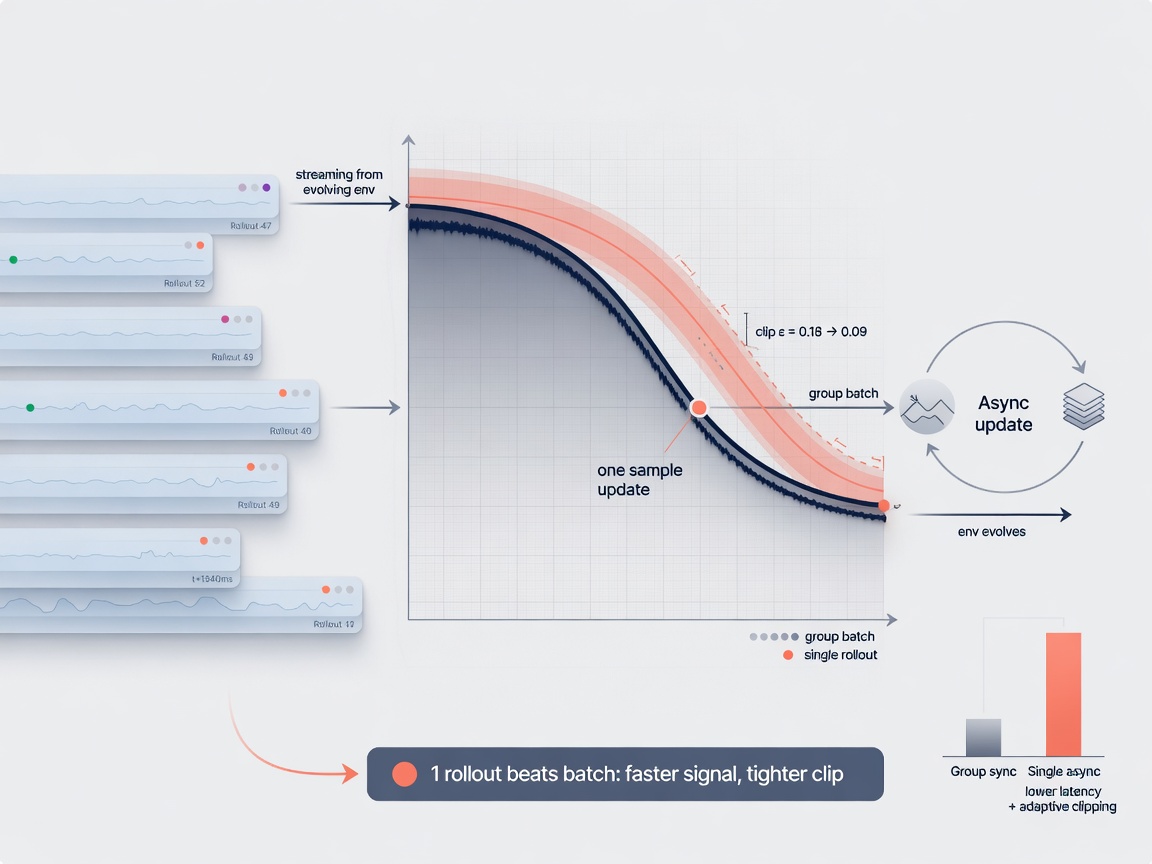
To see why that's surprising, it helps to know how agentic RL usually works. When a model is trained on tasks like writing code or solving problems, most methods (GRPO and its variants being the common ones) generate a whole group of responses to each prompt, then compare them against each other to figure out which behaviors to reinforce. SAO throws that away: one rollout per prompt. The paper reports this improves stability and generalization in asynchronous reinforcement learning, addressing off-policy effects — the mismatch between data the model collected earlier and what it's currently optimizing against.
Why One Rollout Per Prompt Beats a Whole Group
Group-wise sampling feels safer — more samples, more signal, right? But in asynchronous settings, where rollouts are generated while training continues in parallel, those groups come from slightly older versions of the model. That's where off-policy effects creep in: you're reinforcing decisions made by a model that no longer quite exists. SAO's answer is to stop leaning on group comparisons at all and instead train from single rollouts paired with a strict double-side token-level clipping strategy — a guardrail that constrains how far the optimization can push individual tokens on both sides of the update, keeping training from lurching.
The results back this up: stable training over one thousand steps (a meaningful run length in this regime), outperforming GRPO variants on agentic coding and reasoning benchmarks. It was also deployed in an actual agentic RL pipeline to train an open GLM-5.2 model at 750B-A40B scale — so this isn't just a benchmark curiosity; it survived contact with production-scale training.
Worth a look
Phugialy Picks

livho Blue Light Blocking Computer Glasses
We'd buy this if: You spend most of your day staring at a screen and haven't tried blue light glasses yet.
We'd skip this if: You already wear prescription glasses with a blue light coating, or don't notice eye strain.
INIU 10000mAh 45W Fast Charging Portable Power Bank
We'd buy this if: You've been caught with a dead phone/laptop away from an outlet more than once.
We'd skip this if: You're always near a charger anyway.
OMOTON C2 Adjustable Aluminum Phone Stand
We'd buy this if: You want your phone upright on your desk for calls/notifications without a cable getting in the way.
We'd skip this if: You never keep your phone on your desk.
Some Phugialy Picks use affiliate links. If you buy through one, Phugialy may earn a commission. It doesn't change what we recommend. Full disclosure →
The Detail Most Coverage Skips
It's easy to conflate two things here: the single-rollout choice and the clipping strategy. Most summaries stop at "they sample less," but that alone wouldn't stabilize anything — dropping group comparisons removes your relative signal between responses, which is exactly why you'd need something like double-side token-level clipping to keep updates controlled. The real story is that these two pieces are a package deal: one removes the dependency on stale group data, the other replaces the stability that grouping was implicitly providing.
There's also the simulated online learning setting with evolving environments worth noting. Training an agent against an environment that changes underneath it is much closer to how these systems will actually be used than static test sets are — and SAO demonstrating effectiveness there suggests it was built for conditions where data staleness isn't an edge case but the norm.
What This Actually Points To
My read (and this is interpretation, not something the paper states): group-wise sampling has been treated as foundational when it may just be legacy scaffolding from synchronous training days. If single-rollout methods hold up as asynchronous pipelines become standard — and GLM-5.2's deployment suggests they can — then a lot of compute currently spent generating redundant groups per prompt could be redirected. For anyone building or evaluating agentic RL pipelines right now, the practical question isn't "is SAO better?" but "how much of my pipeline assumes groups exist?" Because if they're optional after all, that assumption is worth auditing.
Got a question about how this applies to you? →
Keep reading
Follow the thread
The Orchestration Layer: Agentic AI's Biggest Efficiency Lever
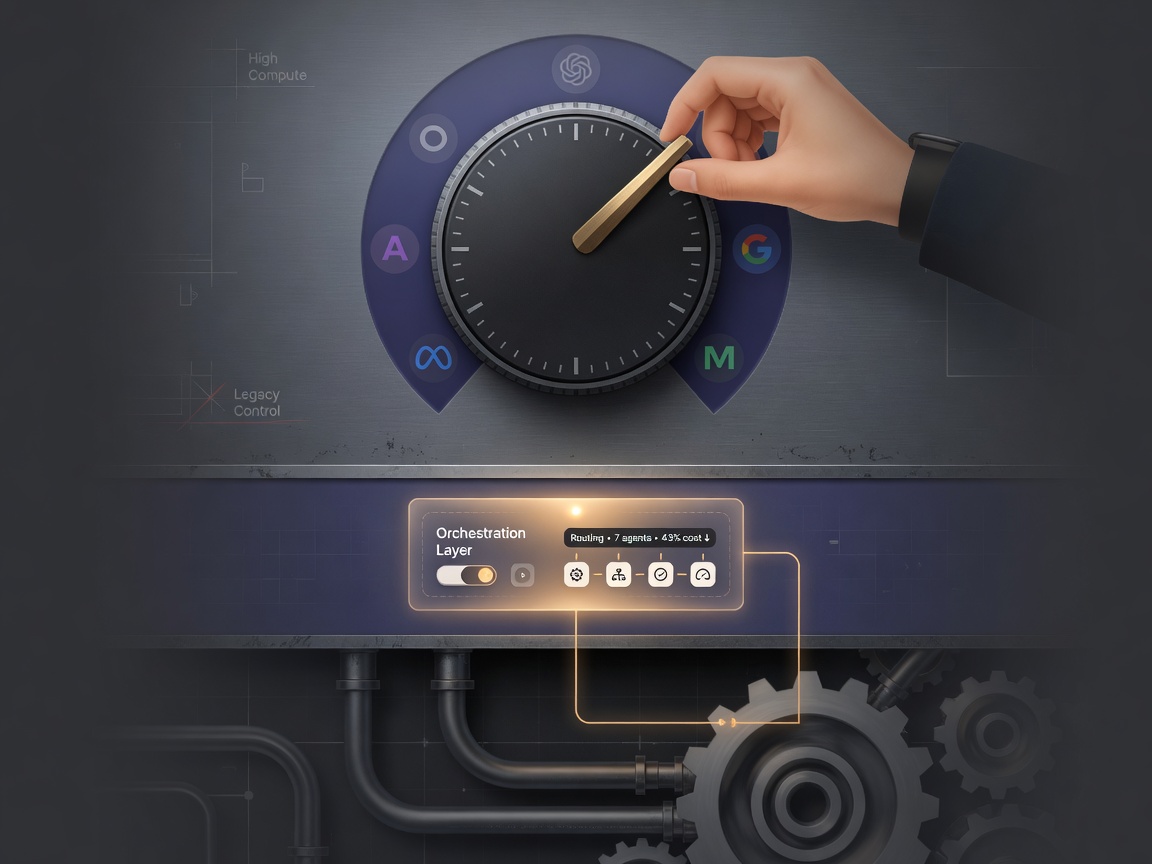
What if the biggest lever for making AI agents cheaper and faster isn't the model you pick at all? A new study says it's the layer wrapped around the model - the orchestration layer, or "harness" - and the numbers behind
Read this noteSame lane, different angle
Terminus-4B: A Small Language Model That Outcodes Its Size
A four-billion-parameter model just matched frontier AI systems on real coding benchmarks while using roughly 30% fewer tokens. The interesting part isn't the leaderboard — it's what the training recipe says about where agent costs come from.
AI Coding Agent Memory That Survives Switching Tools
Switching between Claude Code, Cursor, and Antigravity on the same project usually means re-explaining your architecture every time. engrim compresses 153,000 tokens of work history into a memory pack under 1,000 tokens - and keeps it entirely on your machine.