RWGBench: Why Citation Decisions Beat Text Similarity
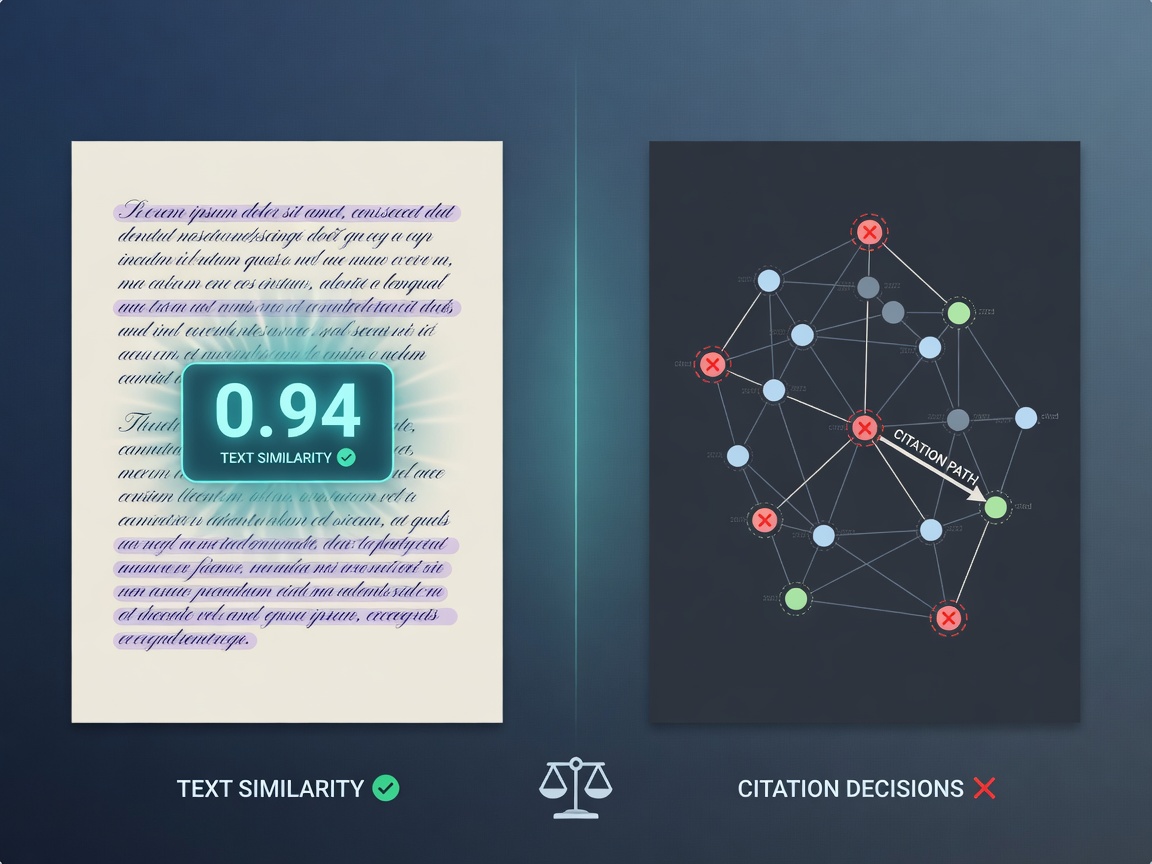
A model can write a fluent related work section with near-perfect similarity scores while citing all the wrong papers. RWGBench evaluates citation decisions instead of text overlap — and finds failures standard metrics never see.
Automation needs a narrow first win
The best first AI workflow is usually a repeated task with a clear input, clear output, and a human approval step.
Most benchmarks that score LLMs on writing related work sections are measuring the wrong thing. They inherit metrics from summarization — lexical overlap, semantic similarity to a human-written reference section — and a model can ace them while citing papers that don't fit, omitting central prior work, or dumping citations into contexts that misrepresent what those papers actually say. RWGBench, described in a recent arXiv paper, is built around a different premise: related work generation is a citation decision-making task, not a text-similarity task, and evaluation should target the decisions.
Why Text Similarity Rewards The Wrong Output
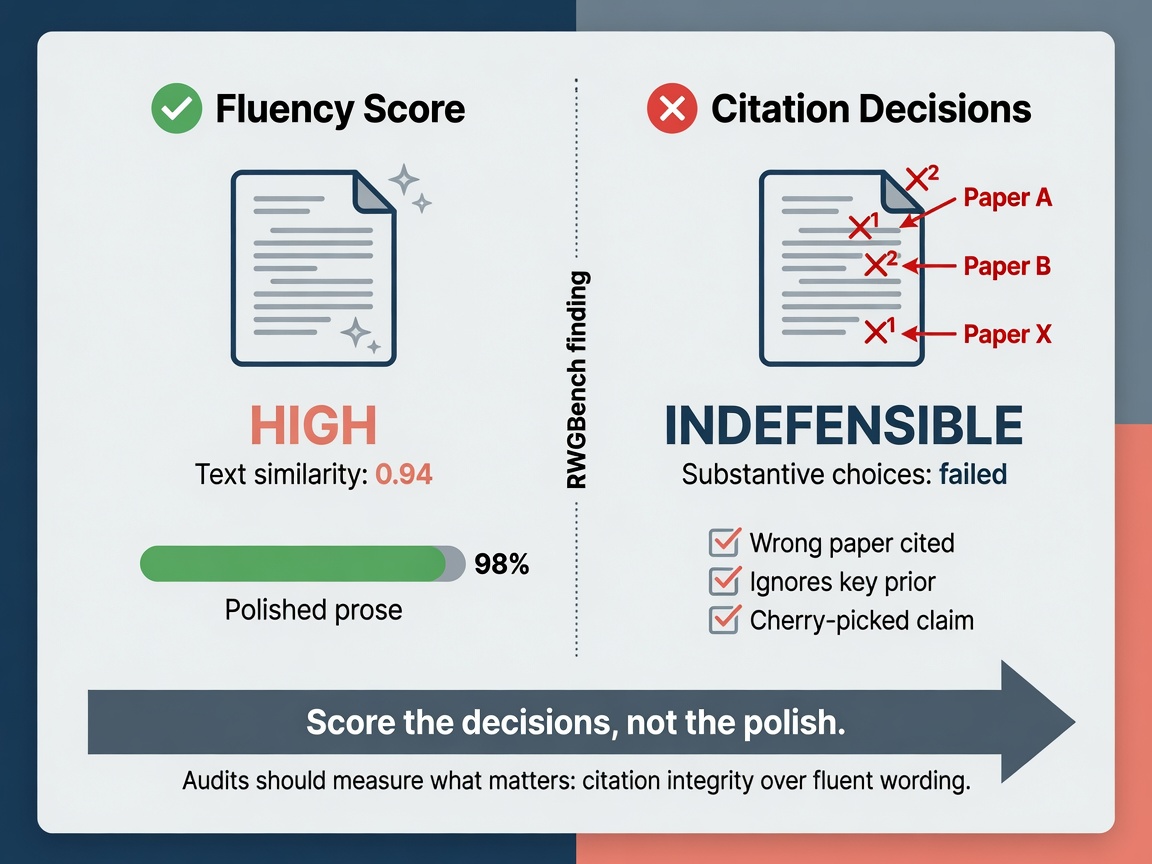
The core problem the researchers identify is that conventional metrics reward outputs that resemble the reference text while failing to detect academically critical errors in citation behavior. A generated section can be fluent and semantically close to the real thing while over-relying on a narrow subset of citations, skipping foundational work entirely, or placing references where they distort their relevance. None of those failures show up in an n-gram or embedding score.
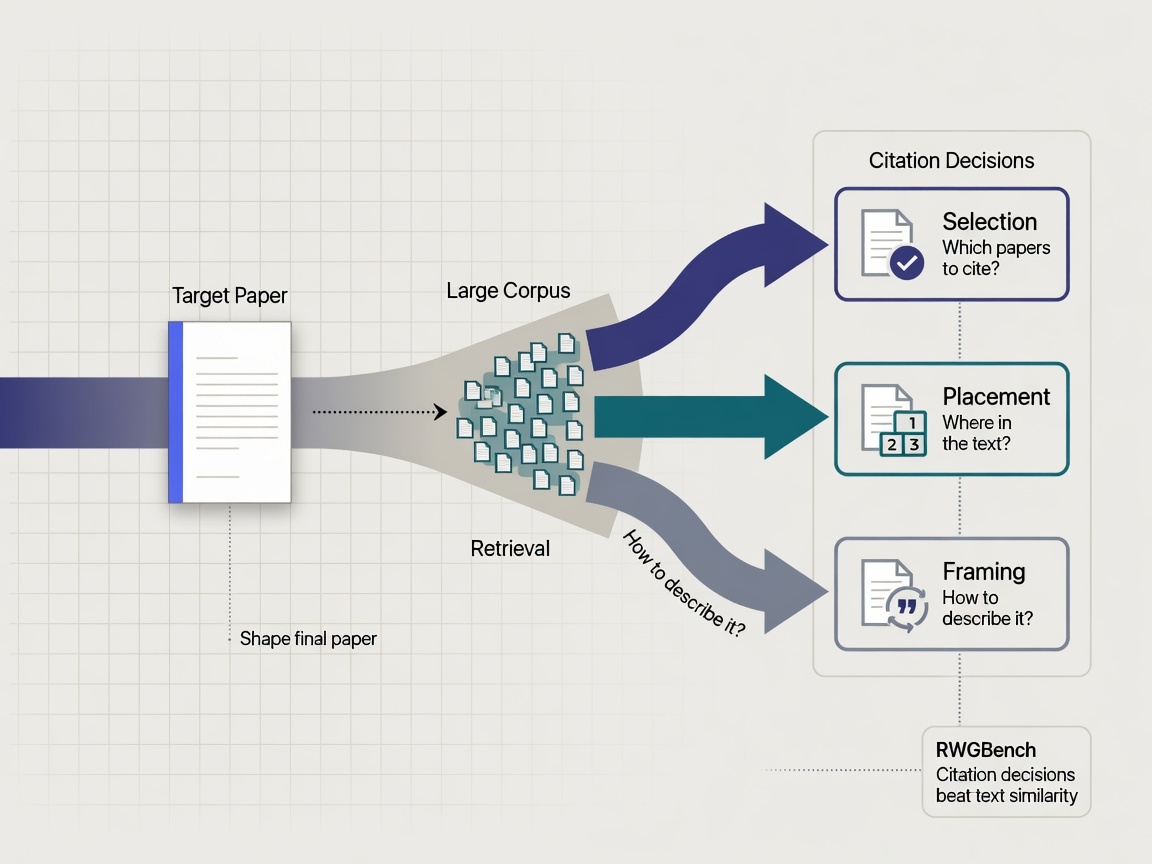
RWGBench reframes the task explicitly. Related work generation is anchored to a specific target paper — its title, abstract, and optionally introduction — and requires retrieving a relevant subset of papers from a large corpus, then organizing them into a narrative that positions the target paper against prior research. That's rhetorically different from survey generation, which aims for broad topic-level coverage; RWG has one job: situate this paper. The benchmark decomposes that job into three interdependent dimensions: citation selection (which works to cite given the paper's context and contributions), strategic placement (where citations sit in the discourse structure), and rhetorical framing (whether cited work is framed as building on or contrasting with the target).
Worth a look
Phugialy Picks

AI Engineering: Building Applications with Foundation Models
A practical guide to building real-world applications with foundation models and LLMs.

GMKtec K15 AI Mini PC Oculink Intel Ultra 5 125U 32GB DDR5 512GB SSD | Desktop Computer AI Boost, 3X M.2 2280 Storage Expansion, Dual NIC...

AI: Understand the Revolution: From Basics and Buzzwords to Tech Giants, Governments, and Your Future
Some Phugialy Picks use affiliate links. If you buy through one, Phugialy may earn a commission. It doesn't change what we recommend. Full disclosure →
What's Actually In The Benchmark
The construction is concrete rather than aspirational. It draws on 40,108 computer science papers pulled from arXiv between 2020 and 2025, with metadata, citation lists, and related work sections successfully extracted. The retrieval corpus contains 1.09 million candidate documents — built by aligning extracted citations with entries in the SurGE corpus and querying the arXiv API for gaps. The test set is small but deliberately high-fidelity: 100 papers accepted at ICLR, NeurIPS, or ICML whose author-written related work sections have all their citations covered by the retrieval corpus.
That last detail matters more than it looks. A benchmark where the ground-truth citations can't be found in the candidate pool would penalize models for retrieval failures that aren't their fault. By restricting to papers whose full reference sets are retrievable, RWGBench separates retrieval bottlenecks from generation-level positioning failures — which is exactly what experiments across representative and frontier generation settings reportedly expose as systematic limitations hidden by standard evaluations.
A blinded human study provides supplementary support for the diagnostic metrics. That's thin but appropriate; it's corroboration of construct validity rather than headline evidence.
What This Actually Points To
My read: this benchmark matters less as a leaderboard than as a diagnostic instrument — and its real value depends on adoption outside its own test set.
The 100-paper test set is peer-reviewed and carefully constructed, but it's small and confined to top-venue machine learning papers written between 2020 and 2025. A model could score well here and still fail on dense subfields where positioning conventions differ, or on older literatures where key prior work predates the corpus window entirely (the corpus covers 2020–2025). If you're evaluating an RWG system for your own domain, treat RWGBench as proof that citation-decision metrics are feasible — not as evidence any particular model handles your field's citation norms.
There's also an unaddressed gap worth naming: everything here assumes automated evaluation of citation decisions can be trusted at scale. The human study supports it directionally, but anyone who has shipped LLM-assisted writing tools knows that judges drift too — especially on judgment calls like whether a citation was framed fairly versus merely placed nearby. I'd want to see how stable these diagnostic scores are across evaluator models before treating single-point differences as signal.
What this actually points to is a shift in how we should audit writing assistants generally: stop scoring fluency against reference text and start scoring whether the substantive decisions underneath are defensible. That principle extends well beyond related work sections — to literature reviews generated by agents (a theme close to earlier coverage of AI-driven scientific discovery) or any pipeline where an LLM chooses sources rather than just summarizing them. The interesting failure mode isn't bad prose; it's confidently wrong scholarship that looks fine at first read.
For teams building RWG features now: run your system through both kinds of evaluation — similarity metrics for polish, citation-decision metrics for correctness — because they'll disagree more often than you'd expect.
Got a question about how this applies to you? →
Keep reading
Follow the thread
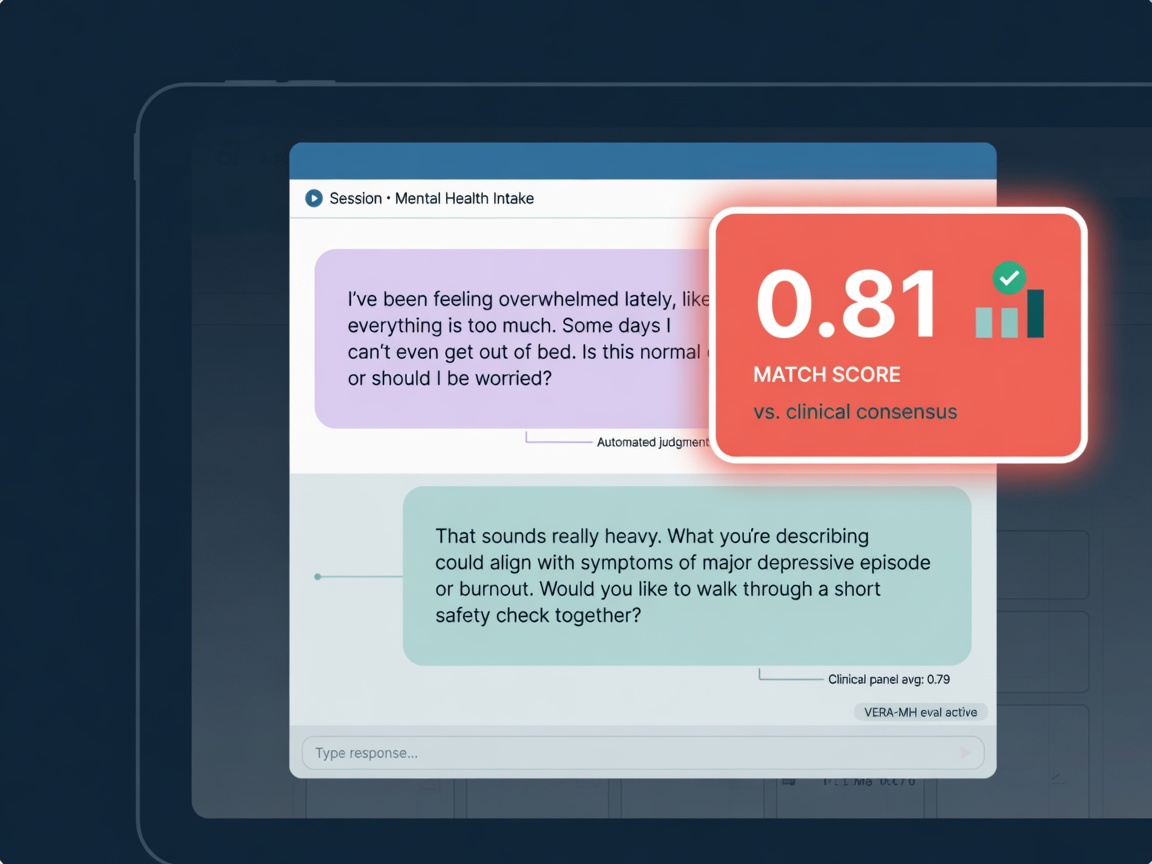
VERA-MH Benchmark: Validating AI Chatbot Safety Testing
An automated benchmark for AI chatbot safety in mental health sounds like exactly what the field needs — but a benchmark is only as good as the domain it covers, and this one covers one narrow slice of it. The VERA-MH be
Read this noteSame lane, different angle
MADB: Where Music AI Actually Stands on Human Judgment
Models asked to judge music like humans do fall substantially short — and for once we know because someone built the benchmark first instead of shipping demos.
RoboDojo Tests Robot Manipulation Policies Where It Counts
A new benchmark finally tests robot manipulation policies in both simulation and the real world - 42 sim tasks, 18 physical ones, and 30 policies already ranked under identical conditions. Here's what that changes about every robotics result you've seen so far.