Pricing Synthetic Tasks in RLVR Training: What Holds Up
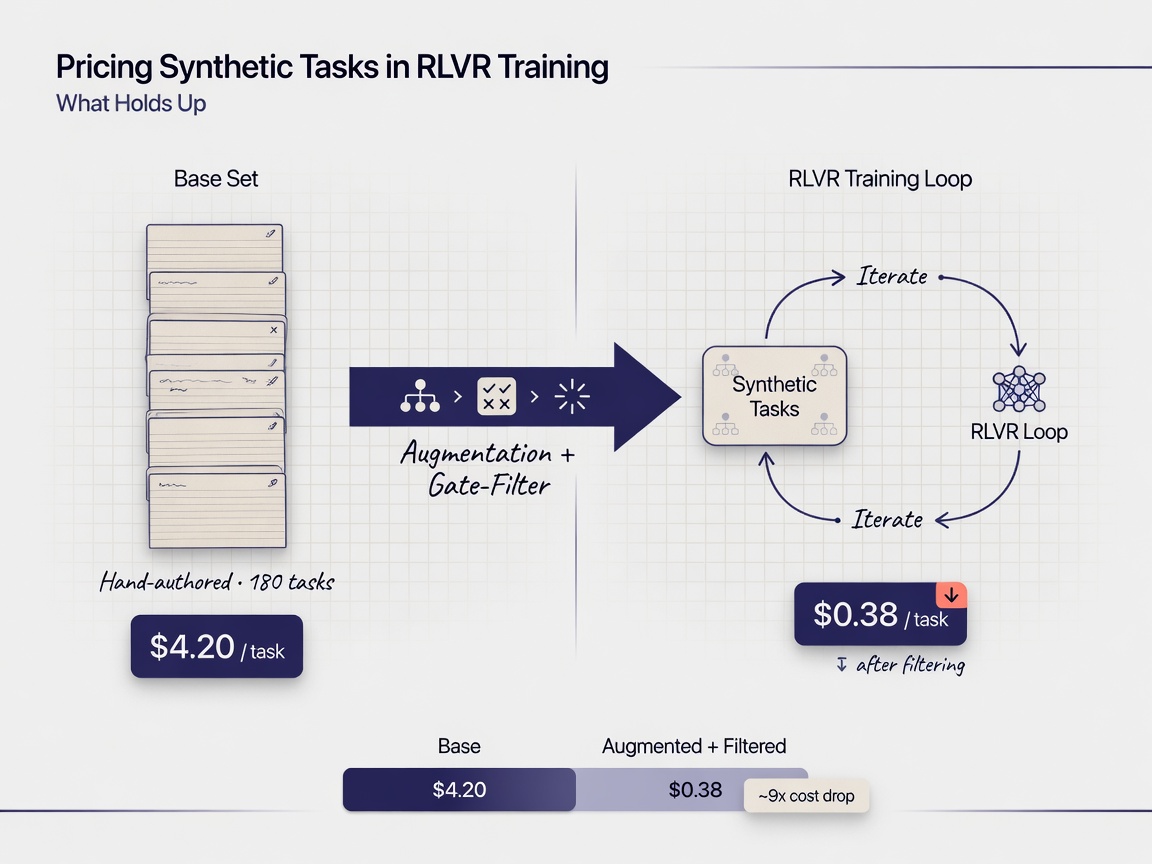
Synthetic augmentations can replace human-authored RLVR tasks at somewhere between 1.4x and 11.6x the cost ratio — held-out generalization holds across ten benchmarks. The interesting part isn't that it works; it's that someone finally priced the tradeoff.
Automation needs a narrow first win
The best first AI workflow is usually a repeated task with a clear input, clear output, and a human approval step.
Synthetic augmentations of hand-authored RLVR tasks can substitute for additional human-written ones at a cost ratio between 1.4x and 11.6x, depending on where your curation costs actually land. That's the core finding of a new study on reinforcement learning from verifiable rewards (RLVR), and it's more useful than most scaling papers because it puts a number on something practitioners usually have to guess at.
The Problem It's Actually Solving
Anyone who has run an RLVR pipeline knows the bottleneck isn't compute — it's tasks. Effective RL training requires task counts that hand-curation at a real quality bar simply doesn't scale to economically. You can write a few hundred good verifiable tasks; you cannot write tens of thousands of them without either dropping the bar or burning money.
The researchers behind this study formalized the alternative: take a small hand-authored base set, apply pre-specified augmentations, and gate-filter the results before they enter training. The question they asked is the right one — not "can synthetic tasks work?" but "how many synthetic tasks equal one human-authored task, once you price in the actual costs of both?"
Worth a look
Phugialy Picks

AI Engineering: Building Applications with Foundation Models
A practical guide to building real-world applications with foundation models and LLMs.

GMKtec K15 AI Mini PC Oculink Intel Ultra 5 125U 32GB DDR5 512GB SSD | Desktop Computer AI Boost, 3X M.2 2280 Storage Expansion, Dual NIC...

AI: Understand the Revolution: From Basics and Buzzwords to Tech Giants, Governments, and Your Future
Some Phugialy Picks use affiliate links. If you buy through one, Phugialy may earn a commission. It doesn't change what we recommend. Full disclosure →
What The Numbers Actually Show
The headline result is that substituting gated synthetic content for additional human-authored tasks retains aggregate held-out generalization across a ten-benchmark suite. That's the good news: generalization doesn't collapse when you lean on augmentation.
The cost-adjusted trade rate is where this gets interesting. Across plausible cost ranges, it stays between 1.4x and 11.6x — meaning one human-authored task is worth somewhere between roughly one and twelve augmented ones, depending entirely on what your curation actually costs per task. That's a wide band, and it's honest about being wide. If your human tasks are cheap to author at quality, augmentation barely pays for itself at 11.6x. If curation is expensive and slow, 1.4x is a bargain.
What I'd be skeptical of here: the ten-benchmark suite measures aggregate held-out generalization, which is exactly the right metric to report — but "aggregate" can hide distributional effects where augmentation helps some task types and quietly hurts others. The paper characterizes the end-to-end economics of the augmentation pipeline, which suggests they've thought about this, but anyone adopting this should check whether their task distribution resembles theirs before trusting the trade rate as-is.
Where This Actually Points
The real story here isn't "synthetic data works." We've known that in various forms for a while. It's that someone finally priced it — turned an intuition ("augmentation is cheaper than curation") into a formalized trade rate with a stated range instead of a vibes-based claim.
In practice this means teams running RLVR pipelines now have a concrete decision framework rather than an ideology fight: measure your per-task curation cost honestly, place yourself in that 1.4x–11.6x band, and decide whether an augmentation pipeline clears your bar. It connects to something I keep coming back to — building systems where quality comes from process design rather than raw human effort, which is also what separates genuinely useful AI tooling from chatbot theater.
The part worth watching is whether gated augmentation holds up outside controlled benchmark suites, on task distributions nobody pre-specified.
Got a question about how this applies to you? →
Keep reading
Follow the thread
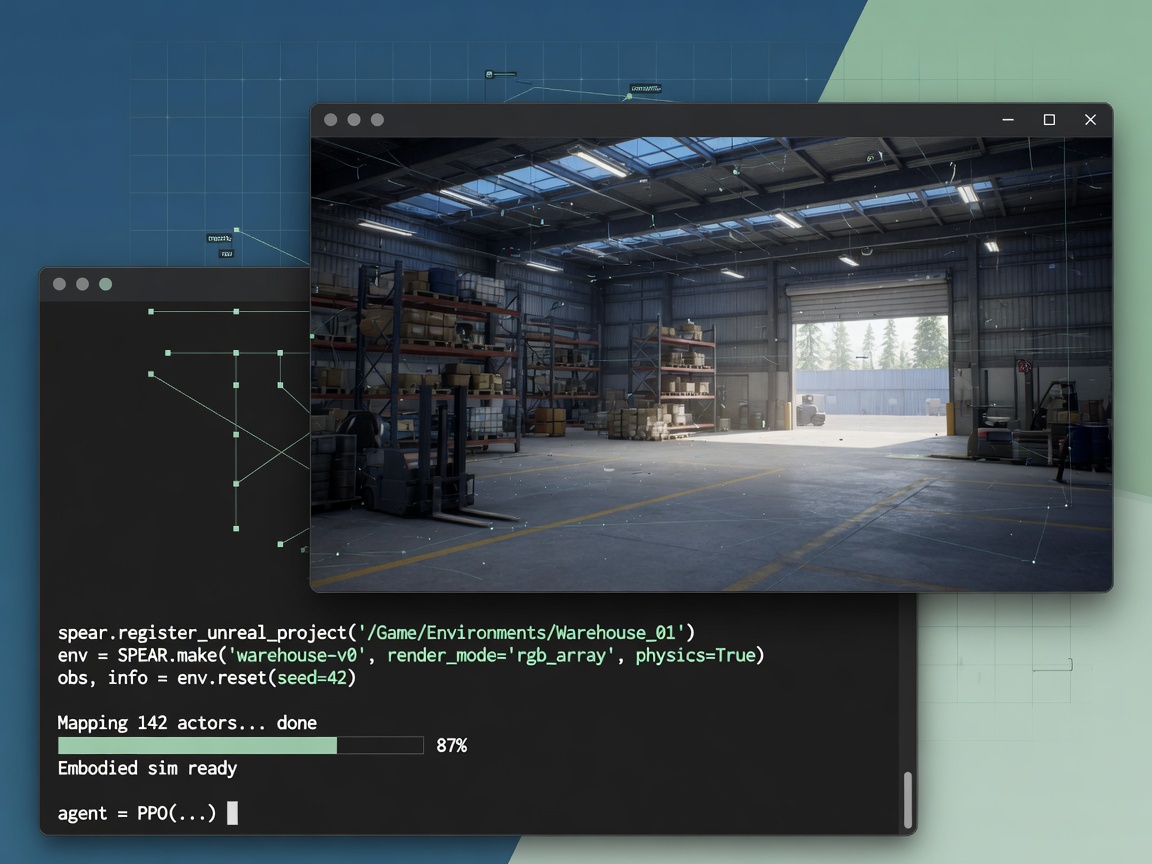
SPEAR Turns Any Unreal Project Into an Embodied AI Simulator
A new open-source library exposes over 14,000 Unreal Engine functions to Python at no wrapper cost — turning any UE project into candidate training infrastructure for embodied AI at 73 fps photorealistic rendering.
Read this noteSame lane, different angle
TimEE: Time Series Classification With Zero Real Training Data
A time series is just a list of numbers measured over time - heartbeats, sensor readings, stock prices - and classifying one usually means training a new model from scratch for every single dataset. TimEE, a new 4.5M-par
Agon: Two Models Grading Each Other Replace Process Labels
Two models grade each other's work and double GRPO's pass@1 on math and coding benchmarks — with zero process labels and no reward model. The catch shows up when you try to ship it.