How AI Public-Records Requests Strain Government Offices
AI can make a public-records request easier to write—but the agency still has to process it. Meanwhile, data startups are turning government records into sales tools, creating a second, distinct story about who benefits from public information.

Automation needs a narrow first win
The best first AI workflow is usually a repeated task with a clear input, clear output, and a human approval step.
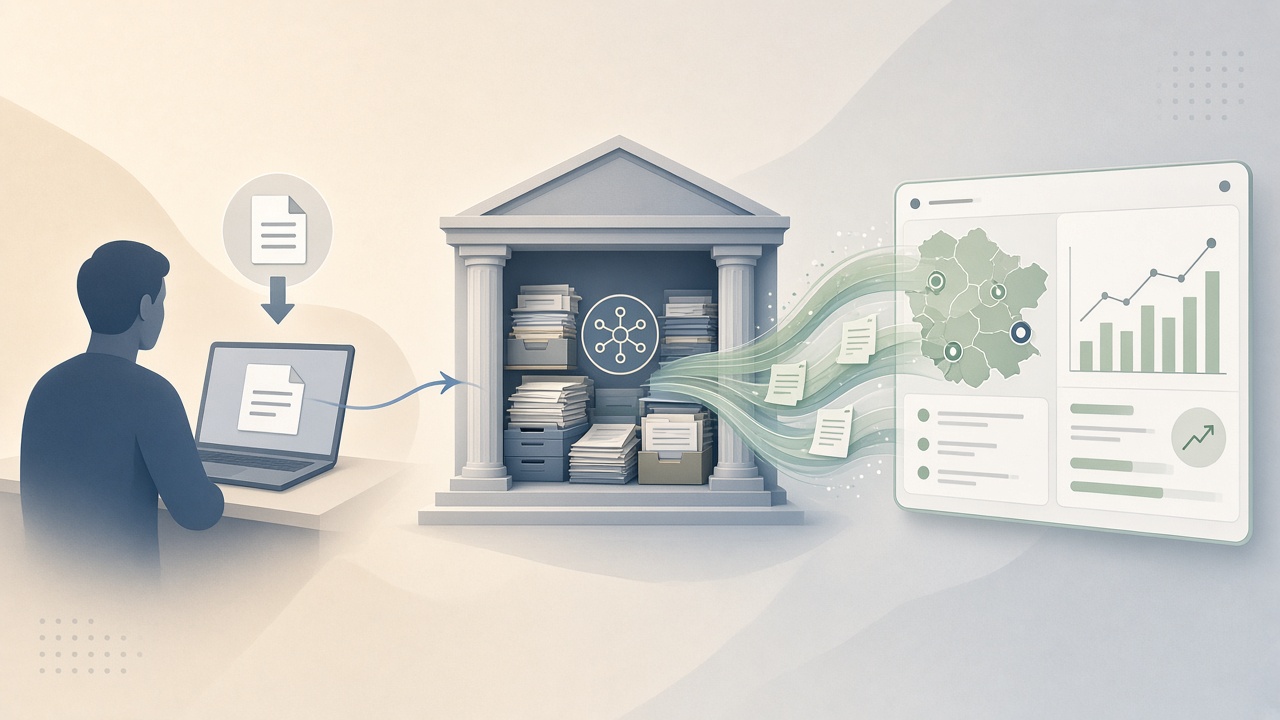
AI public-records requests are adding work to offices already facing high demand, while companies are turning government records into business tools. Those are connected developments, but they are not the same thing: one concerns people asking agencies for records; the other concerns businesses collecting public-sector data and selling products built from it.
AI public-records requests are longer, not just more numerous
Federal agencies received a record 1.7 million public-records requests last year. Separately, a University of Florida researcher found that at least 29% of requests in the US Department of Education’s July log had been written at least partly by AI. Those AI-written requests were twice as long, and 83% asked for long lists of records.
That distinction matters. The figures do not show that AI caused the record federal total, and the Education Department log is a specific slice of requests, not a measure of every agency. But they do suggest a practical change for public-records offices: a request can now be generated or expanded with little effort, while reviewing and fulfilling it still takes staff time. The source describes offices with limited staff and budgets, so longer filings can add pressure even when the technology makes asking easier.
Worth a look
Phugialy Picks

AI Engineering: Building Applications with Foundation Models
A practical guide to building real-world applications with foundation models and LLMs.

GMKtec K15 AI Mini PC Oculink Intel Ultra 5 125U 32GB DDR5 512GB SSD | Desktop Computer AI Boost, 3X M.2 2280 Storage Expansion, Dual NIC...

Agentic AI Engineering: Systems That Reason and Act Autonomously – Designing, Building, and Prompting LLM-Based Agents for Real-World Deployment
Some Phugialy Picks use affiliate links. If you buy through one, Phugialy may earn a commission. It doesn't change what we recommend. Full disclosure →
Easier requests can also mean more appeals
Chatbots may encourage people to appeal a denial, including when an appeal has little chance of success. The concern is not simply that AI helps people write. It is that a tool that readily produces another argument may make it easier to keep pressing without helping someone judge whether the next step is worthwhile.
My read is that access and workload are being treated as if they were opposite sides of a simple trade-off. They are not. Making a request easier to draft can help people participate, but it does not automatically make the agency’s response process easier or make every appeal more justified. The source does not establish how often AI-generated appeals succeed; it points instead to the possibility of added work from appeals unlikely to succeed.
Government-data products serve a different customer
At the same time, data startups are collecting government records at scale and packaging them as sales insights. Startups in this area have raised upwards of $100 million: Starbridge has raised $52 million, and Pursuit $25.5 million. Their products are intended to help businesses identify government sales opportunities using public-sector data.
That is not the same activity as filing a public-records request. The important distinction is who benefits from making information easier to use, and who carries the work of producing or organizing it. Individuals may gain a simpler route to ask for records; companies may turn collected records into tools for business decisions; government offices still handle requests under constrained resources. In my view, the underappreciated issue is this uneven distribution of effort: easier access can create value in more than one place, but the time required to process requests remains with public agencies.
The clearest signal to watch is whether the share and length of AI-assisted requests—and appeals—keep rising alongside the workload reported by public-records offices. That would show whether this is a passing shift in drafting or a lasting change in the demands placed on the system.
Holiday picks
Black Friday: big-ticket buys
The big-ticket day: computers, screens, audio and home upgrades worth waiting for.

Audio
Mid-size buySoundcore by Anker Q20i Hybrid Active Noise Cancelling Headphones, White | Over-Ear, Bluetooth, 40H ANC Playtime, Hi-Res Audio, Big Bass,...
View on Amazon (opens in a new tab): Soundcore by Anker Q20i Hybrid Active Noise Cancelling Headphones, White | Over-Ear, Bluetooth, 40H ANC Playtime, Hi-Res Audio, Big Bass,...Prices change daily. Check today's price on Amazon.

Home & Kitchen
De'Longhi Magnifica Duo Automatic Espresso Machine, Milk Frother, Silver
View on Amazon (opens in a new tab): De'Longhi Magnifica Duo Automatic Espresso Machine, Milk Frother, SilverPrices change daily. Check today's price on Amazon.

Home & Kitchen
eufy C28 Robot Vacuum Cleaner and Mop for pet hair, 15,000 Pa
View on Amazon (opens in a new tab): eufy C28 Robot Vacuum Cleaner and Mop for pet hair, 15,000 PaPrices change daily. Check today's price on Amazon.
We earn from qualifying purchases made through these links, at no extra cost to you, as an Amazon Associate and through other affiliate programs. Disclosure. See all Black Friday picks
Got a question about how this applies to you? →
Keep reading
Follow the thread

From Content Grind to Creative Flow: How AI is Your New Secret Weapon
Let’s be real: the content treadmill is exhausting. We’ve all felt that soul-crushing friction—the endless cycle of trying to draft the "perfect" caption while your creative spark fizzles out. But here is the incredible
Read this noteSame lane, different angle
From 'No Entry' to 'Guest List': How Cloudflare is Giving Creators the Remote Control
For a long time, web owners have been stuck in a frustrating digital stalemate. You either let the bots in and watch your unique content get scraped into a black box, or you build a fortress so high that you accidentally
Scaling Urban Carbon Prediction: How CarbonCLIP Bridges the Satellite-to-Street Gap
CarbonCLIP is a task-oriented multimodal distillation framework designed to solve a massive headache in remote sensing: data-source heterogeneity. Here’s the reality: it’s one thing to see a city from 3 meters up; it’s a