From Content Grind to Creative Flow: How AI is Your New Secret Weapon
Let’s be real: the content treadmill is exhausting. We’ve all felt that soul-crushing friction—the endless cycle of trying to draft the "perfect" caption while your creative spark fizzles out. But here is the incredible
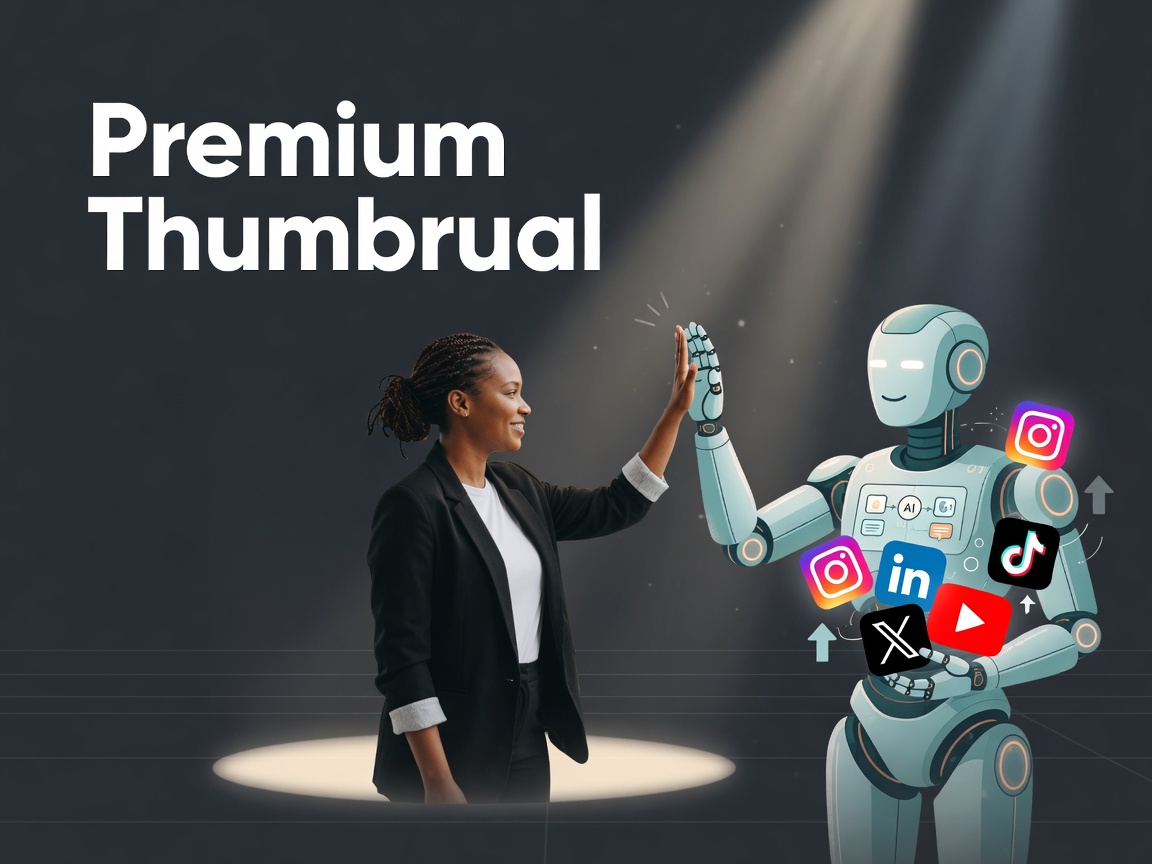
Automation needs a narrow first win
The best first AI workflow is usually a repeated task with a clear input, clear output, and a human approval step.
Let’s be real: the content treadmill is exhausting. We’ve all felt that soul-crushing friction—the endless cycle of trying to draft the "perfect" caption while your creative spark fizzles out. But here is the incredible news: AI isn't coming for your creative throne. It’s actually becoming your ultimate backstage crew, handling the heavy lifting so you can get back to the heart of what you love—the human connection.
Your New Creative Superpower
One of the most electrifying shifts in the creator economy right now is how automation is becoming a total force multiplier. We’re talking about the ability to draft captions, generate stunning visuals, and seamlessly repurpose your best work across different formats with just a few clicks. This isn't about letting a machine do your thinking; it's about nuking the tedious manual labor of content distribution. When you can predict audience responses and iterate on visuals in real-time, you aren’t just churning out "more" content—you’re making smarter content. It gives a single creator the production power of a full studio, allowing you to maintain a high-frequency presence without hitting that dreaded burnout wall.
Worth a look
Phugialy Picks

AI Engineering: Building Applications with Foundation Models
A practical guide to building real-world applications with foundation models and LLMs.

GMKtec K15 AI Mini PC Oculink Intel Ultra 5 125U 32GB DDR5 512GB SSD | Desktop Computer AI Boost, 3X M.2 2280 Storage Expansion, Dual NIC...

GEEKOM IT15 AI Mini PC, Intel Ultra 9 285H(99 Tops), 32GB DDR5, 1TB SSD | The Most Powerful Workstation,Arc 140T GPU,WiFi 7,8K Business D...
Some Phugialy Picks use affiliate links. If you buy through one, Phugialy may earn a commission. It doesn't change what we recommend. Full disclosure →
The High-Tech Bouncer: Cleaning Up the Neighborhood
While the creative side is where the magic happens, there’s some serious technical wizardry happening under the hood to keep your community healthy. Instagram is leveraging AI to manage engagement signals like watch time, likes per reach, and sends per reach, ensuring your content actually lands in front of the right eyes. Even cooler? It’s acting as a high-tech bouncer. By identifying fake followers, bot comments, and those pesky coordinated engagement pods, AI is pruning the noise. This means when you do engage, you’re talking to real humans. Even in customer service, AI agents are handling natural conversations and complex queries using live data, featuring a "human handoff" for the sensitive stuff. It ensures that while the scale is handled by tech, the empathy remains 100% yours.
The Real Story: Democratizing the 'Inner Circle'
The real story here isn't just about faster DM responses or automated captions; it’s about the democratization of high-level community management. With Instagram engagement rates projected to sit at a tiny 0.7% by 2026, the challenge isn't just being seen—it's being remembered by the right people. By helping human agents respond to customer DMs some 20 percent faster, AI is smashing a massive bottleneck for small businesses and creators alike. What this actually points to is a future where "community" doesn't have to mean "limited." We are moving toward a world where the barrier to providing elite-level customer care is finally being lowered. The "busy work" of triaging thousands of messages is being handled by intelligent agents, allowing the most creative and empathetic people to reach the widest possible audiences without losing their personal touch.
Got a question about how this applies to you? →
Keep reading
Follow the thread

From 'No Entry' to 'Guest List': How Cloudflare is Giving Creators the Remote Control
For a long time, web owners have been stuck in a frustrating digital stalemate. You either let the bots in and watch your unique content get scraped into a black box, or you build a fortress so high that you accidentally
Read this noteSame lane, different angle
Scaling Urban Carbon Prediction: How CarbonCLIP Bridges the Satellite-to-Street Gap
CarbonCLIP uses multimodal distillation to predict urban carbon emissions using only satellite imagery. By bridging the gap between top-down views and ground-level activity during pretraining, it offers a scalable way to model emissions across diverse cities.
How Social Norms Improve Human-AI Coordination
New research shows that AI agents informed by social norms can outperform human-human interactions by 43%. This suggests the next leap in coordination isn't better data, but better alignment with human social principles.