From Technical Debt to Production: The Stewardship Gap in AI-Driven Science
OpenAI’s latest report on coding agents in scientific computing confirms what we’re seeing on the ground: we are officially moving past the "hello world" phase of AI-assisted development. We aren't just talking about gen

Automation needs a narrow first win
The best first AI workflow is usually a repeated task with a clear input, clear output, and a human approval step.
OpenAI’s latest report on coding agents in scientific computing confirms what we’re seeing on the ground: we are officially moving past the "hello world" phase of AI-assisted development. We aren't just talking about generating a few snippets of Python anymore; agents like Codex and Claude Code are being deployed to tackle the most painful, high-stakes parts of research software—specifically technical debt, performance optimization, and full-scale backend ports across genomics, immunology, and statistics.
Crushing the Legacy Code Bottleneck
The report highlights a massive shift in what's actually possible for engineering teams. Agents are now successfully performing the "unglamorous, labour-intensive upkeep" that usually kills research momentum. We're seeing them handle packaging, build-system cleanup, and full-scale rewrites of large tools—including a 20,000-line aligner that would have been a logistical nightmare for a human team to tackle by hand.
When you look at the performance metrics, the numbers are staggering. In some cases, agents helped cut runtimes by as much as 60 times and disk I/O by 25 times. On single processor threads, performance jumped from 2.3–2.7 times faster to 4.4–9.5 times faster across eight threads. For a developer, these aren't just "cool" benchmarks; they represent the difference between a tool that is actually usable in a production pipeline and one that sits on a shelf because it’s too slow to run on real-world datasets.
Worth a look
Phugialy Picks

Logitech G413 SE Full-Size Mechanical Gaming Keyboard - Black | Backlit, anti-ghosting, compatible with Windows and macOS, aluminum material

RK ROYAL KLUDGE R98 Pro Wired Mechanical Keyboard, 96% Creamy Gaming Keyboard RGB Backlit with Number Pad and Volume Knob, Gasket Mount, ...

AULA F99 Wireless Mechanical Keyboard,Tri-Mode BT5.0/2.4GHz/USB-C Hot Swappable Custom Keyboard,Pre-lubed Linear Switches,RGB Backlit Com...
Some Phugialy Picks use affiliate links. If you buy through one, Phugialy may earn a commission. It doesn't change what we recommend. Full disclosure →
The Stewardship Problem at Scale
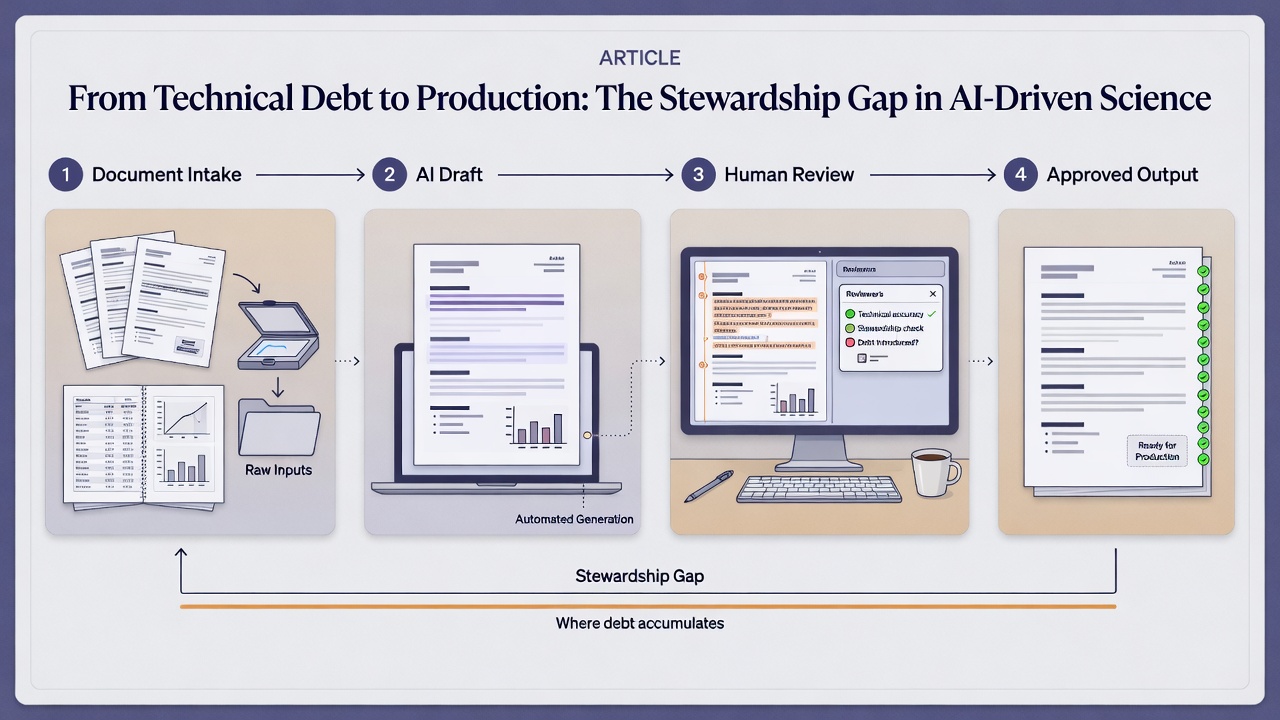
Here is where the real tension lies: as engineering costs drop, the risk of community fragmentation skyrockets. Because agents make it significantly cheaper for smaller teams to perform complex rebuilds, we face a looming crisis of ownership. If a small team uses an agent to rebuild a massive, foundational tool but lacks a plan for long-term maintenance, the scientific community loses out on a stable resource.
The report is clear: while the technology handles the "easy" part—the syntax and the initial refactor—human intervention remains non-negotiable. You still need "expert guidance, understanding, taste, and care" to ensure that agent-generated output is actually scientifically sound. This isn't just about checking if the code runs; it's about verifying that the underlying logic holds up under rigorous scientific scrutiny.
Shifting from "How to Build" to "How to Own"
The real story here isn't just that agents can write code faster; it's that they are shifting the bottleneck from "how do we build this?" to "how do we own this?" For anyone integrating these tools, the interesting question isn't whether the demo works, but what happens when you move from a clean, isolated refactor to a messy, high-stakes production environment.
The gap between a successful 20,000-line rewrite and a maintained scientific library is wide. If we outsource the "unglamorous" upkeep to an agent, the human role must evolve into that of a high-level reviewer and steward. To make this work at scale, we need to stop thinking about agents as "coders" and start treating them as high-velocity interns who require a rigorous QA process and a clear long-term ownership strategy. The technology is ready, but our models for software maintenance haven't caught up to the speed of AI-driven development.
Got a question about how this applies to you? →
Keep reading
Follow the thread
From Exploration to Infrastructure: How Agents Build Their Own Production Code
Stop treating your AI agents like permanent cost centers! Right now, every time an agent handles a recurring IT incident, it re-invokes full LLM inference to figure out the steps again. It’s like hiring a world-class con
Read this noteSame lane, different angle
Giving AI Agents the Keys to the Kingdom (Without the Risk of Burning it Down)
Let’s talk about the 'Super-Powered Intern' problem. We all want an AI agent like Claude Code or Gemini CLI to handle the heavy lifting—writing code, managing configs, and spinning up entire environments—but every IT hea
The Engineering Reality of an AI-Driven Newsroom
Acutus just dropped on December 29, 2025, and it’s not your typical "wrapper" project. They’re building a high-velocity news site for AI policy and energy, but the real story is under the hood. They aren't just hitting a