Why Graph Encoders Are Winning the Multimodal MRI Generation Race
If we keep treating brain connectivity like a flat list of numbers, how much signal are we actually losing to noise?
Automation needs a narrow first win
The best first AI workflow is usually a repeated task with a clear input, clear output, and a human approval step.
Integrating structural and functional MRI (sMRI and fMRI) into a single generative framework is a mess because the two modalities represent fundamentally different types of information. sMRI captures static gray matter volume (GMV), while fMRI captures dynamic connectivity. The recent introduction of the multimodal graph VAE (gMMVAE) attempts to bridge this gap by using modality-aware graph encoding rather than the lazy shortcut of treating both as simple vectors.
Topology Over Linearized Data
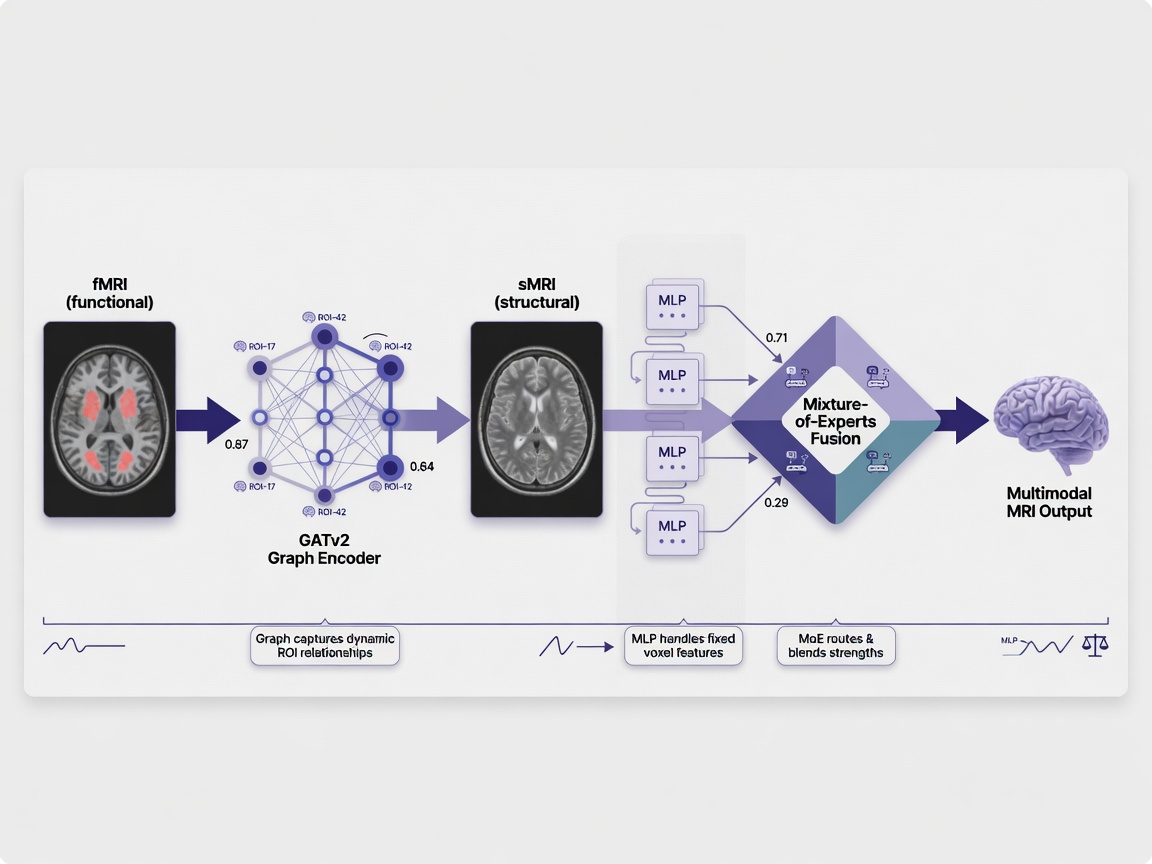
The real win here is the move away from "one-size-fits-all" encoders. The framework uses a multilayer Graph Attention Network (GATv2) to process fMRI data, specifically modeling the static functional network connectivity (sFNC) matrix as a weighted graph. This allows the model to capture higher-order dependencies and preserve the actual topology of brain networks. Conversely, it uses a Multi-Layer Perceptron (MLP) for sMRI GMV features, which are treated as fixed-length vectors without relational structure.
By using a Mixture-of-Experts (MoE) mechanism within a multimodal variational autoencoder (MMVAE), the framework fuses these distinct latent distributions into a shared space. This architecture was tested against high-profile baselines like Denoising Diffusion Probabilistic Models (DDPM), Latent Diffusion Models (LDM), and Transformers. The gMMVAE outperformed these in reconstruction quality and generation fidelity, largely because it didn't force the fMRI data into a linearized format before encoding. The system also employs feature-wise linear modulation (FiLM) at the decoder stage, allowing subject-level metadata like sex to guide the generation without expanding the latent dimensions.
Worth a look
Phugialy Picks

AI Engineering: Building Applications with Foundation Models
A practical guide to building real-world applications with foundation models and LLMs.

GMKtec K15 AI Mini PC Oculink Intel Ultra 5 125U 32GB DDR5 512GB SSD | Desktop Computer AI Boost, 3X M.2 2280 Storage Expansion, Dual NIC...

GEEKOM IT15 AI Mini PC, Intel Ultra 9 285H(99 Tops), 32GB DDR5, 1TB SSD | The Most Powerful Workstation,Arc 140T GPU,WiFi 7,8K Business D...
Some Phugialy Picks use affiliate links. If you buy through one, Phugialy may earn a commission. It doesn't change what we recommend. Full disclosure →
The Reality of Latent Space Discriminability
While the gMMVAE shows superior performance across multiple metrics—including Mean Squared Error (MSE) and Structural Similarity Index (SSIM)—the real story lies in its latent space discriminability. The study used a random forest classifier to show that the joint latent embeddings could distinguish between sexes, which validates that the model is preserving high-level biological variance.
From a production standpoint, however, the success of this framework is heavily tied to the NeuroMark pipeline for preprocessed rs-fMRI data. The model's reliance on specific spatial maps and time courses means that if input data quality varies significantly outside of a controlled dataset like the UK Biobank, the graph encoder's sensitivity to topology might become a liability rather than an asset. Furthermore, we need to talk about scale. The graph-based approach is adaptable, but the computational complexity of GATv2 grows with the number of nodes; moving from 53 brain regions to more granular, high-resolution parcellations will create significant bottlenecks for real-time clinical applications.
Got a question about how this applies to you? →
Keep reading
Follow the thread

Interactive AI Systems for Structural Design Get Friction Right
Generative AI keeps trying to hand creators finished answers - but structural designers need something completely different: a partner that iterates with them. New research shows how interactive systems can erase the tedious modelling work while keeping exactly the friction that makes design thinking work.
Read this noteSame lane, different angle
LLMs in Cybersecurity: Reading Past the 50% Malware Claim
A new survey claims LLM-generated malware will account for 50% of detected threats in 2025, up from just 2% in 2021 — and that projection is doing more work than any evidence behind it. The paper, a synthesis of over 70
The Frictionless Problem: Why AI Design Misses the Point of Typography
The original draft was slightly under the word count and lacked the full 'Skeptic' weight in its prose. I expanded the analysis of the 'Plato's Cave' metaphor and sharpened the critique of 'selection vs. creation' to ensure it met the length and persona requirements while maintaining all source facts.