Analytics Agent Insights Still Need Better Business Context
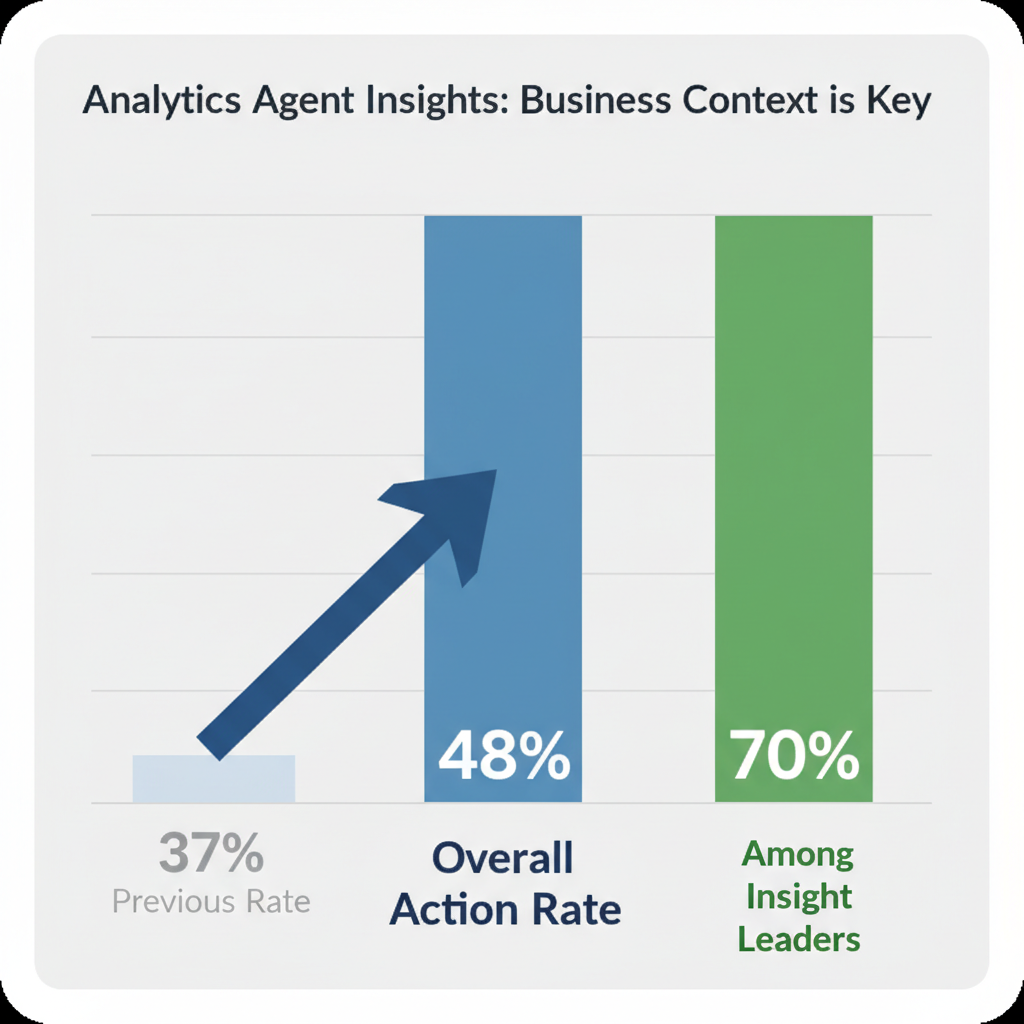
Analytics agents now lead to business-improving actions 48% of the time, up from 37% a year earlier. But too many insights still go unevaluated, and the reported blockers are familiar integration work: business context and fragmented data.

Automation needs a narrow first win
The best first AI workflow is usually a repeated task with a clear input, clear output, and a human approval step.
Analytics agent insights led to business-improving actions 48% of the time in the latest survey, up from 37% a year earlier. That is meaningful progress, but it also means more than half still did not lead to an action that improved the business.
Analytics agent insights need business context, not just volume
The gap is not simply about whether an agent can produce an analysis. Surveyed executives pointed to insufficient business context (55%) and fragmented or inaccessible data (45%) as reasons for low-quality insights. An answer can be analytically plausible and still miss the operating constraints, definitions, or priorities that would make it useful to a decision-maker.
My read is that these are integration problems as much as model problems. If the agent cannot draw on consistent data or understand what a metric means in the business, asking it to generate more analysis is unlikely to fix the weak handoff from insight to action. The report does not establish that any one technical fix will solve this; it identifies context and data access as obstacles organizations are trying to address.
Worth a look
Phugialy Picks

AI Engineering: Building Applications with Foundation Models
A practical guide to building real-world applications with foundation models and LLMs.

GMKtec K15 AI Mini PC Oculink Intel Ultra 5 125U 32GB DDR5 512GB SSD | Desktop Computer AI Boost, 3X M.2 2280 Storage Expansion, Dual NIC...

2084 and the AI Revolution, Updated and Expanded Edition: How Artificial Intelligence Informs Our Future
Some Phugialy Picks use affiliate links. If you buy through one, Phugialy may earn a commission. It doesn't change what we recommend. Full disclosure →
Too many insights can become an evaluation bottleneck
At 52% of surveyed organizations, agents generated more insights than people could properly evaluate. Only 24% said they could evaluate all of them. That makes the 48% action rate harder to read as a standalone measure: a useful insight that arrives in an unreviewable stream may never get the scrutiny needed to become a decision.
The comparison with “insight leaders” is encouraging: more than 70% of agent insights at those organizations led to business-improving actions. But the figures do not explain what qualifies an organization as an insight leader or establish why its rate is higher. I would treat that result as a sign that better outcomes are possible, not as a benchmark every team can reproduce by turning on an agent.
For a production integration, I would want to track not only how many insights the system generates, but also how many get evaluated and which lead to action. That is a practical interpretation of the reported gap, not a measurement recipe supplied by the report.
Governance and semantic layers are the work behind better results
Organizations are prioritizing stronger AI and data governance (60%) and adding a semantic layer to data architecture (45%). Those investments line up with the reported problems: governance can help set expectations for how AI is used, while a semantic layer is intended to make data meaning more consistent for systems and people. The survey reports these priorities; it does not prove their impact on the action rate.
The useful takeaway is to treat insight quality as an end-to-end system property, not a model score. Before expanding an analytics agent, check whether it has usable business context, accessible data, and a manageable review load. If those conditions are missing, improving the path from insight to evaluation is a more grounded next step than asking the agent to produce more. The signal worth watching is whether action rates rise alongside better data foundations—and whether teams can still evaluate the insights they receive.
Got a question about how this applies to you? →
For the governance side of this problem, see “The Governance Gap: Moving from Generative Chat to Agentic Autonomy.”
Keep reading
Follow the thread

Generative AI for Information Is Growing, Not Agents
Generative AI is already a common route to information, but that does not mean people are ready to hand over tasks to agents or let AI write the news. The gap between those uses is the part product teams should pay attention to.
Read this noteSame lane, different angle
AI Training Data Needs Better Agent Evaluations
Handshake’s AI training business reportedly reached $1 billion in gross annualized revenue about a year after launch. Its benchmark demonstrations make the less comfortable point: a polished final answer can hide mistakes in how an agent handled the task.
Autonomous Security Operations: What Greenlight Shows
Greenlight says its AI system resolves more than 90 percent of security and risk cases. The architecture behind that figure includes escalation, memory, and a feedback pipeline—but the rate alone does not show whether the hardest mistakes are being caught.