Autonomous Security Operations: What Greenlight Shows
Greenlight says its AI system resolves more than 90 percent of security and risk cases. The architecture behind that figure includes escalation, memory, and a feedback pipeline—but the rate alone does not show whether the hardest mistakes are being caught.
Automation needs a narrow first win
The best first AI workflow is usually a repeated task with a clear input, clear output, and a human approval step.
Greenlight’s autonomous security operations system reportedly resolves more than 90 percent of its security and risk cases, but that headline leaves out the harder question: what kinds of cases count as resolved, and how often does the system’s judgment hold up? The result is worth examining as an operational deployment, not as proof that security triage is broadly solved.
Autonomous security operations depend on escalation, not one agent
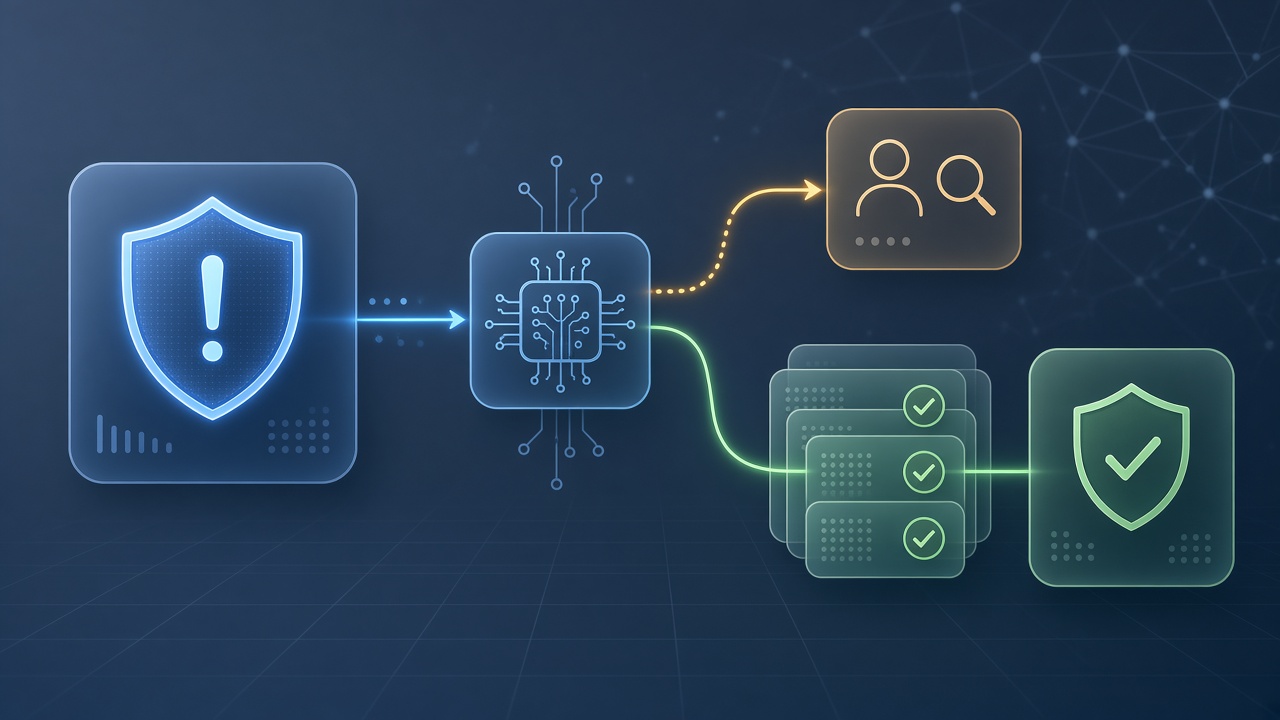
Greenlight built Luna as a tiered multi-agent system on Amazon Bedrock AgentCore. Tier 1 uses more than 30 specialized agents for routine cases; when a case exceeds its confidence threshold, it moves to Tier 2 for deeper investigation. AgentCore runtime hosts the agent code, while AgentCore memory supports the system’s use of prior cases.
That design matters more than the agent count. The system is not presented as one model making every call unaided: routine work is separated from cases that need additional reasoning. The source reports single-digit-second median triage for routine cases and says roughly 10 percent of cases require multi-step reasoning. This is a narrower and more credible claim than “autonomous security” on its own: fast handling for a large share of a defined workflow, with an escalation path for the rest.
Worth a look
Phugialy Picks

AI Engineering: Building Applications with Foundation Models
A practical guide to building real-world applications with foundation models and LLMs.

GMKtec K15 AI Mini PC Oculink Intel Ultra 5 125U 32GB DDR5 512GB SSD | Desktop Computer AI Boost, 3X M.2 2280 Storage Expansion, Dual NIC...

2084 and the AI Revolution, Updated and Expanded Edition: How Artificial Intelligence Informs Our Future
Some Phugialy Picks use affiliate links. If you buy through one, Phugialy may earn a commission. It doesn't change what we recommend. Full disclosure →
What the resolution-rate increase actually shows
The reported autonomous resolution rate rose from 83 percent with Tier 1 alone to more than 90 percent after adding Tier 2 and a case-learnings pipeline. Luna handles 3,000–4,000 security and risk alerts per month, or up to 4,000 cases according to the account. Greenlight also expanded Luna from SOC operations into financial-risk triage within two months.
Memory helps explain the improvement. Episodic memory uses a rolling 30-day window to check whether Luna has seen a pattern and what verdict it reached. The system also records a pattern as confirmed after resolving a case the same way three times. Case outcomes feed back through the learnings pipeline. In one example, the source cites a dark-web card source with a 73 percent false-positive rate and says deduplication should be prioritized.
These mechanisms make the reported gain plausible as a workflow result, but the percentage alone does not establish the quality of every decision. The material here does not specify the case mix, the consequences of incorrect resolutions, or how performance was independently checked. Those details matter because a high resolution rate can mean less human work—or less human visibility into mistakes.
The defensible claim is bounded to this workflow
The important boundary is between automating triage and demonstrating reliable security judgment across conditions. The account gives evidence of a deployment, its architecture, volume, and reported resolution rate; it does not establish that the same outcome transfers to other organizations, alert types, or operating conditions. Nor does the headline tell us how often escalation catches errors that Tier 1 would otherwise make.
My read is that Luna’s most useful lesson is architectural: confidence-based escalation and case feedback can extend automation without requiring every case to be handled the same way. That is an operational pattern worth watching, not a guarantee that autonomous security operations are safe by default. The narrower claim that survives is that Greenlight reports more than 90 percent autonomous resolution in its own security and risk workflow after adding escalation and learnings; whether that rate reflects dependable outcomes depends on the quality and visibility of the cases behind it.
Got a question about how this applies to you? →
For another operational use of multi-agent AI, see “From 6 Hours to 15 Minutes: How Multi-Agent AI is Crushing Hospital Pharmacy Bottlenecks.”
Keep reading
Follow the thread
AI Training Data Needs Better Agent Evaluations
Handshake’s AI training business reportedly reached $1 billion in gross annualized revenue about a year after launch. Its benchmark demonstrations make the less comfortable point: a polished final answer can hide mistakes in how an agent handled the task.
Read this noteSame lane, different angle
AI Agent Security: What Anthropic’s Test Shows
Cathedral’s AI agents reached some Anthropic sales, HR and IT data in less than 12 hours. That is evidence of access—not evidence that agents outperform human-led security assessments. Separate Claude cases raise a different question: how tightly are information access and actions controlled?
AI Agent Cyberattacks: What Cairn Evidence Shows
Norforge says hackers used Cairn to coordinate attacks on more than 100 websites, with agents doing much of the work. A short set of human-provided tactics is part of the story too—and it makes the evidence about coordination stronger than the evidence about autonomy.