AI Data Center Water Use Has a Cost Beyond Compute
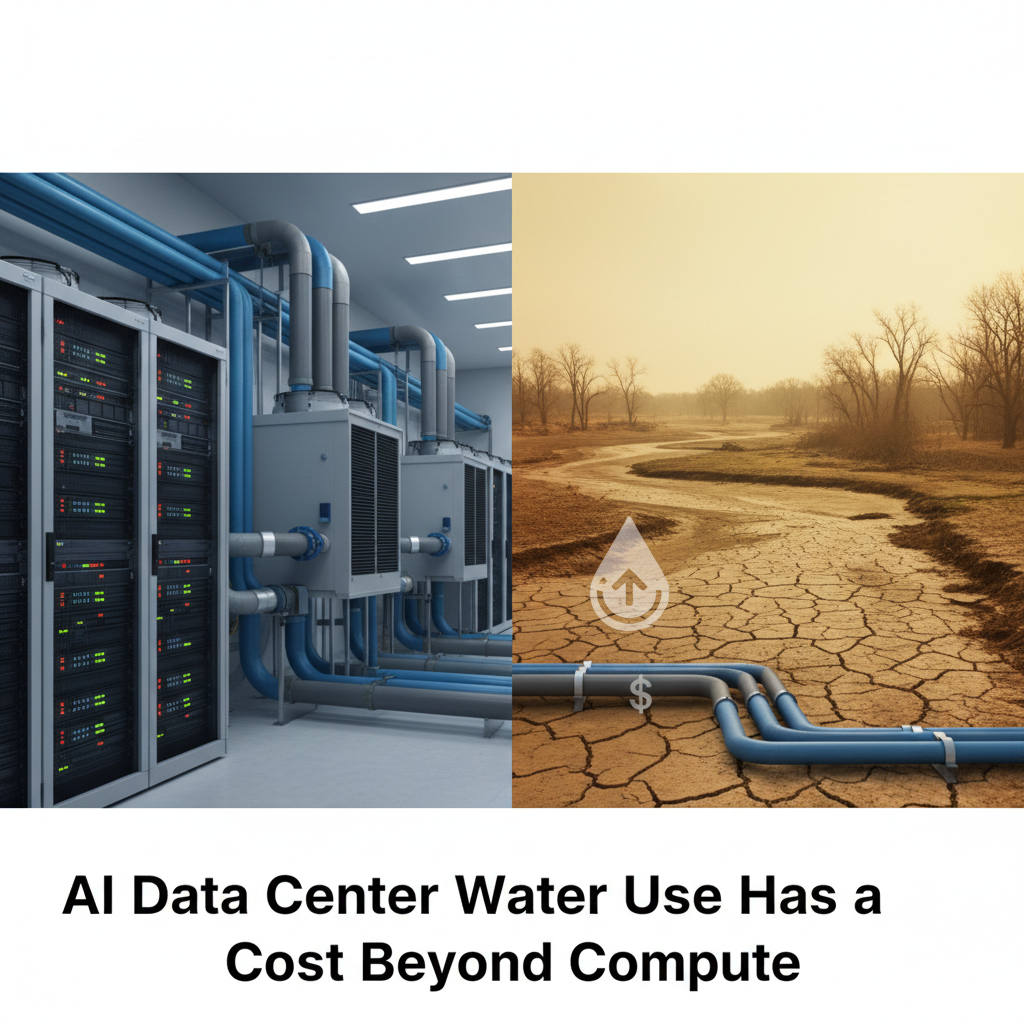
Data centers in Quilicura use large amounts of water to cool servers amid Chile’s ongoing drought. A local project made that infrastructure visible by having residents act as “human A.I.” for a day—but the bigger question is what water-use data would let communities evaluate the impact.
Automation needs a narrow first win
The best first AI workflow is usually a repeated task with a clear input, clear output, and a human approval step.
AI data center water use in Quilicura is not an abstract sustainability metric: the source article links server cooling to pressure on local water resources amid Chile’s ongoing drought. It also describes a local project that made the issue tangible by having residents act as “human A.I.” for a day, answering prompts and creating content manually with local artists.
AI data center water use meets local water pressure
The source establishes the central conflict plainly: data centers use large amounts of water to cool servers, while Quilicura is part of a country facing ongoing drought. It connects that demand to the climate crisis and pressure on local water resources. The material provided does not give a volume, identify the water source, or quantify the impact, so it cannot support a comparison between data-center use and other local demand.
That missing detail matters if you are trying to evaluate a real infrastructure decision. “Large amounts” signals a concern, but it is not enough to assess how much water a facility uses, when it uses it, or what alternatives might change that burden. My read is that the article makes the local stakes visible, while leaving the operational questions open. For anyone building or choosing AI services, the practical lesson is not that every workload has the same water footprint; it is that compute efficiency alone does not describe the resource cost of running it.

Worth a look
Phugialy Picks

AI Engineering: Building Applications with Foundation Models
A practical guide to building real-world applications with foundation models and LLMs.

GMKtec K15 AI Mini PC Oculink Intel Ultra 5 125U 32GB DDR5 512GB SSD | Desktop Computer AI Boost, 3X M.2 2280 Storage Expansion, Dual NIC...

2084 and the AI Revolution, Updated and Expanded Edition: How Artificial Intelligence Informs Our Future
Some Phugialy Picks use affiliate links. If you buy through one, Phugialy may earn a commission. It doesn't change what we recommend. Full disclosure →
Residents turned AI prompts into a physical demonstration
For a day, residents answered prompts and created content manually with local artists, acting as “human A.I.” The format puts people in the process rather than asking them to treat AI infrastructure as an invisible backend. It gives the water-use discussion a local, participatory frame without pretending that a one-day activity measures the data centers’ actual consumption.
That distinction is useful. A demo can make a consequence easier to discuss, but it is not a substitute for site-level data. I interpret the project as a way to create attention and conversation around a resource burden that is otherwise difficult to see in an AI product interface. The strongest version of this kind of public engagement would sit alongside clear information about water use, rather than being asked to stand in for it.
The useful next step is better infrastructure accounting
If I were evaluating an AI service or facility, I would want water use to be legible alongside compute performance and cost. This source does not provide enough evidence to recommend a particular cooling system or to say how much Quilicura’s data centers contribute to local scarcity. It does make a case for asking the question before treating AI capacity as a purely digital resource.
The signal worth watching is whether future reporting supplies concrete, local water-use figures and explains how they relate to drought conditions. Until then, the human-AI exercise is a strong prompt for scrutiny, not a measurement. The next useful step is connecting that visibility to numbers people can evaluate.
Got a question about how this applies to you? →
For another angle on how people participate in AI systems, read “Moving Past the AI Mythology: Engineering Social Collaboration.”
Keep reading
Follow the thread

Why Advanced Materials Are AI Infrastructure's Next Bottleneck
The constraint on AI's next phase isn't compute or capital - it's whether the physical materials underneath data centers can keep up. That's the argument Syensqo CTO Mike Finelli makes in a recent MIT Technology Review p
Read this noteSame lane, different angle
AI Data Center Expansion Faces a Policy Risk Test
AI data center expansion is becoming a policy-risk story, but election results are not the same as construction delays. Democratic wins in Texas and other states with substantial planned capacity have raised questions ab
Amazon Nova Models Move to Minimal Support as Focus Shifts
Amazon has put most of its Nova text, video, and image models into minimal support while redirecting resources to a frontier-model effort led by Pieter Abbeel. That is an organizational decision, not a technical verdict