AI Agent Learning Through Play: What the Evidence Shows
After 30 hours exploring a virtual island, AI agents did better on later tasks than fresh copies. The result is promising, but prompts and memory are part of the story—and neither proves that the gains will transfer to business work.
Automation needs a narrow first win
The best first AI workflow is usually a repeated task with a clear input, clear output, and a human approval step.
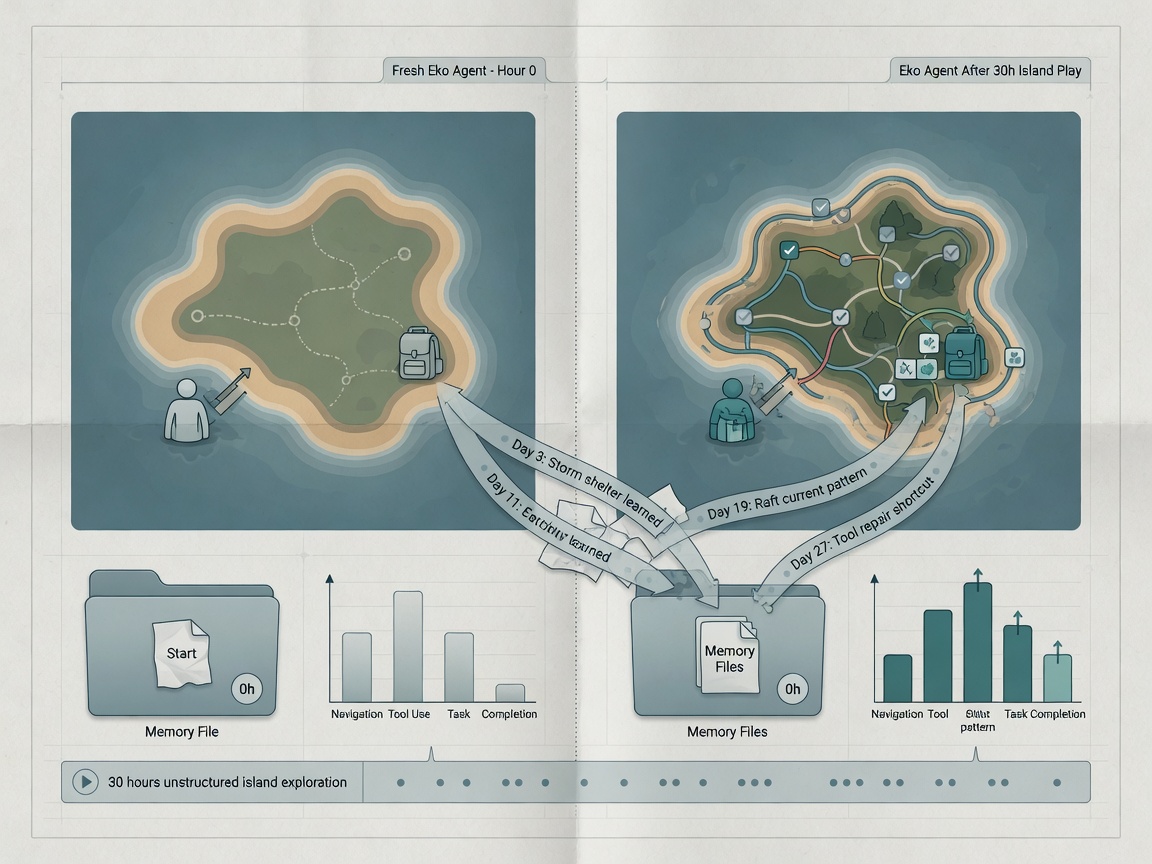
AI agent learning may benefit from exploration, but this study does not show that businesses can simply leave agents to learn on the job. Researchers placed copies of Claude Opus 4.7, nicknamed Eko, on a simulated island for 30 hours. The agents got no external demonstrations or rewards, but the setup was not unguided: prompts described Eko as curious and encouraged it to continue exploring.
AI agent learning improved after 30 hours of exploration
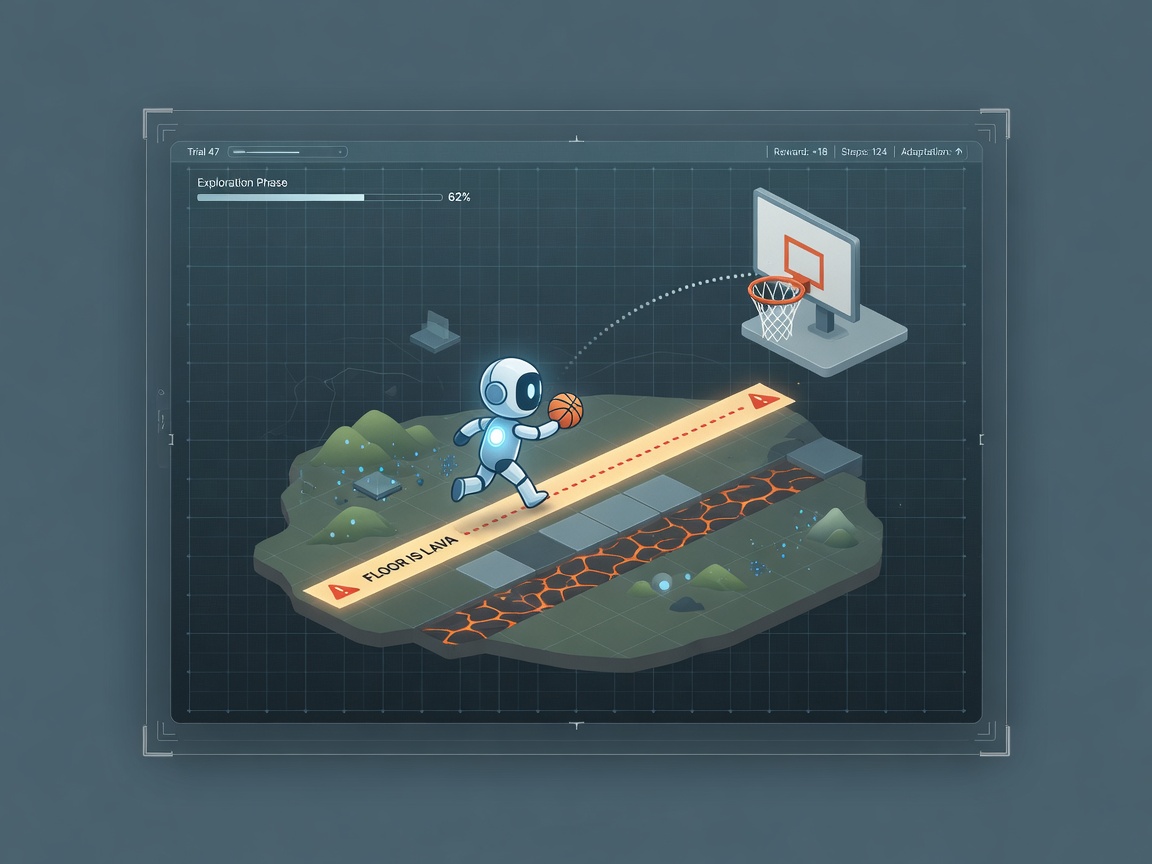
On the island, the agents explored and invented activities, including basketball and a floor-is-lava-like game. One agent pursued a challenge until it made 50 consecutive catches. The researchers say these activities showed several hallmarks of play: agents created rules, repeated activities with variations, and pursued goals for their own sake.
After the 30-hour period, agents performed better on later tasks than fresh copies. The researchers also found that removing content from the agents’ memory files degraded performance. That makes retained experience part of the result, not a minor implementation detail. If useful learning depends on what an agent remembers, a company would need to preserve and manage that memory as part of any similar system.
The paper presents playful learning as a possible complement to supervised and reinforcement learning. That is a proposal, not evidence that it can replace existing training methods or improve a business workflow. The source does not report a deployment, a cost saving, or how much better the agents performed.
Worth a look
Phugialy Picks

AI Engineering: Building Applications with Foundation Models
A practical guide to building real-world applications with foundation models and LLMs.

GMKtec K15 AI Mini PC Oculink Intel Ultra 5 125U 32GB DDR5 512GB SSD | Desktop Computer AI Boost, 3X M.2 2280 Storage Expansion, Dual NIC...

Agentic AI Engineering: Systems That Reason and Act Autonomously – Designing, Building, and Prompting LLM-Based Agents for Real-World Deployment
Some Phugialy Picks use affiliate links. If you buy through one, Phugialy may earn a commission. It doesn't change what we recommend. Full disclosure →
The prompts and memory limit what the study proves
The researchers argue that the agents’ behavior was not merely play-like output: they say it also contributed to later learning. But outside experts say more evidence is needed to establish cognition or motivation. The prompting matters here. An agent encouraged to be curious and continue may still produce useful learning, but the setup cannot show that it would independently seek worthwhile challenges without that direction.
My read is that the practical result is narrower—and more useful—than a claim that AI has learned to play. The experiment links extended exploration and retained memory with better later task performance. It does not yet establish which part caused the improvement, whether the gains transfer to real work, or whether the resulting behavior stays within safe boundaries.
Business value depends on transfer and safe practice
For a business, the potential upside would be agents that improve through practice without needing people to supply demonstrations or rewards for every new task. The trade-off is operational: someone would have to define safe practice, check what the agent learns, maintain memory, and test whether that learning transfers. Those requirements could outweigh the value if exploration consumes time but does not improve real task outcomes.
I would treat playful learning as worth testing only when a team can constrain the practice environment, retain useful learning, and measure transfer on relevant tasks. Until those conditions are demonstrated, this is a research direction rather than a basis for changing a training budget. The signal to watch is whether later studies show repeatable gains on real tasks with clear controls and without relying on prompts that steer the behavior.
Got a question about how this applies to you? →
For a related look at AI systems handling extended work, read “MirrorCode and the Reality of Long-Horizon AI Engineering.”
Keep reading
Follow the thread
Generative AI for Information Is Growing, Not Agents
Generative AI is already a common route to information, but that does not mean people are ready to hand over tasks to agents or let AI write the news. The gap between those uses is the part product teams should pay attention to.
Read this noteSame lane, different angle
AI Training Data Needs Better Agent Evaluations
Handshake’s AI training business reportedly reached $1 billion in gross annualized revenue about a year after launch. Its benchmark demonstrations make the less comfortable point: a polished final answer can hide mistakes in how an agent handled the task.
Autonomous Security Operations: What Greenlight Shows
Greenlight says its AI system resolves more than 90 percent of security and risk cases. The architecture behind that figure includes escalation, memory, and a feedback pipeline—but the rate alone does not show whether the hardest mistakes are being caught.