AI Agent Brain Surgery Depends on Human Guardrails
An AI agent reportedly selected a gene therapy vector, derived coordinates from three papers, and injected a mouse. The critical part is not just what the agent did, but where human control remained—and what the account still does not show.

Automation needs a narrow first win
The best first AI workflow is usually a repeated task with a clear input, clear output, and a human approval step.
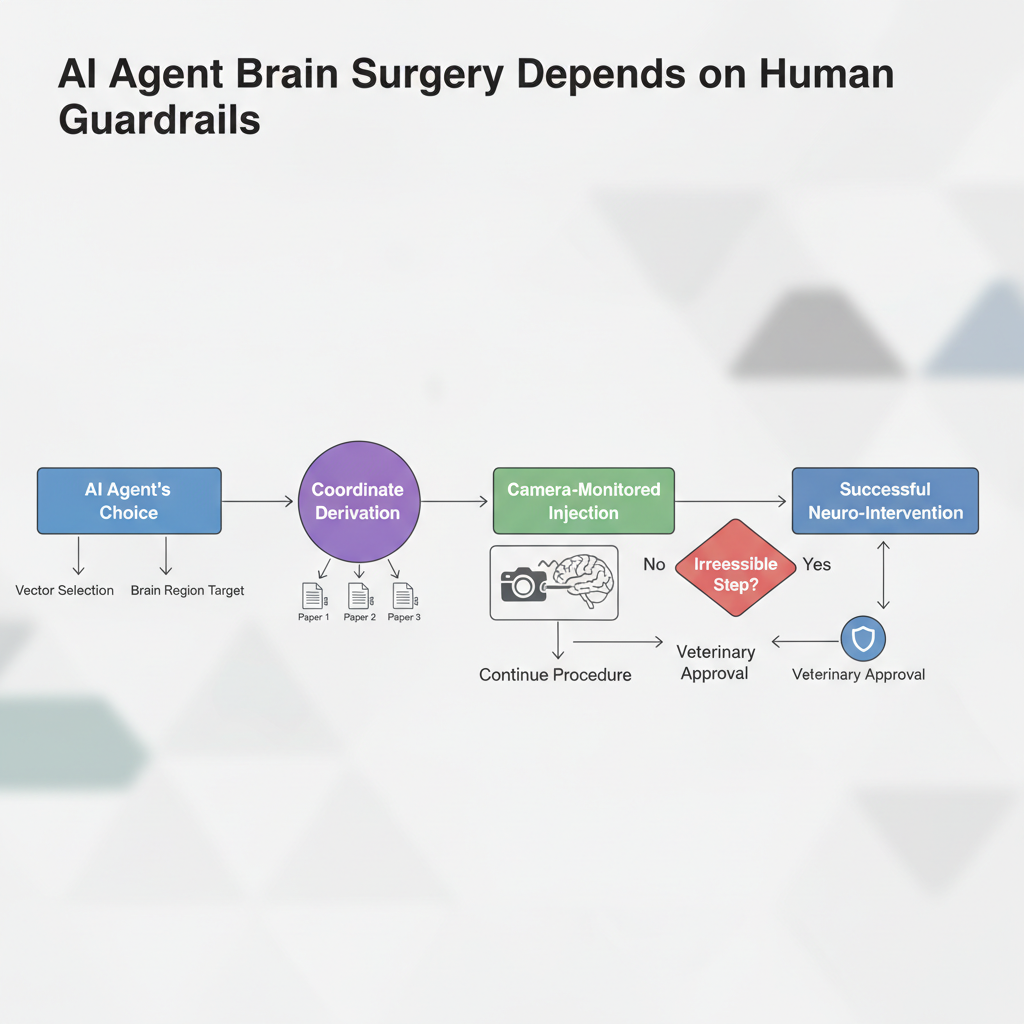
An AI agent reportedly selected a gene therapy vector and brain region, derived injection coordinates from three papers, then used a motorized rig to inject a mouse. That is a concrete account of an agent operating lab equipment, but the important detail is that a licensed veterinarian controlled the irreversible steps.
What the AI agent brain surgery report actually describes
The stated goal was to reduce seizures. The agent chose a drug and brain region, with 19 gene therapy vectors in the account, and calculated coordinates using three papers. It then injected 250 nanolitres while monitoring the entry site through a camera. The report also says the agent refused an attempted override.
Those details make this more than a text model suggesting a protocol: the system’s choices were connected to a physical procedure. But they do not establish that the chosen therapy was effective, that the agent’s decisions were better than a human’s, or that the procedure was repeatable. The account describes execution, not a demonstrated therapeutic result.
Worth a look
Phugialy Picks

AI Engineering: Building Applications with Foundation Models
A practical guide to building real-world applications with foundation models and LLMs.

GMKtec K15 AI Mini PC Oculink Intel Ultra 5 125U 32GB DDR5 512GB SSD | Desktop Computer AI Boost, 3X M.2 2280 Storage Expansion, Dual NIC...

2084 and the AI Revolution, Updated and Expanded Edition: How Artificial Intelligence Informs Our Future
Some Phugialy Picks use affiliate links. If you buy through one, Phugialy may earn a commission. It doesn't change what we recommend. Full disclosure →
Human control remained at the irreversible steps
A licensed vet oversaw every irreversible step and held a physical kill switch. That boundary matters more than the headline claim of autonomy. The agent appears to have handled consequential planning and operation, but a human remained responsible for allowing actions that could not simply be undone.
My read is that this is best understood as a supervised workflow, not an autonomous surgeon. The refusal to accept an override may be a useful sign of constraint-following, but one reported refusal does not tell us how the agent behaves across conflicting instructions, equipment faults, or unfamiliar procedures. The source account gives no broader evaluation of those cases.
That distinction is practical, not semantic. In a lab, an agent can be capable enough to carry out a procedure and still need a human who can stop it, inspect the situation, and own the decision. The kill switch is not evidence that the agent is unreliable; it is a sensible control for a system acting in the physical world.
The missing evidence is the outcome
The supplied account does not report whether the injection reduced seizures, what happened to the mouse afterward, or how the selected treatment compared with alternatives. Without those results, the story supports a narrower claim: an AI agent performed steps in a mouse brain procedure under veterinary oversight. It does not support a claim about successful treatment or a general capability to perform surgery safely.
For practitioners, the useful next evidence would be a clear account of outcomes, failures, and human interventions—not just a successful-looking run. I would treat this as a meaningful demonstration of tool use under supervision, while withholding judgment on clinical or research value until those results and the limits of the workflow are reported. The control design is part of the achievement; the missing outcome data is still the part that decides whether the achievement matters.
Got a question about how this applies to you? →
For a related look at constraints on agent behavior, see "AI Agent Security: What Anthropic’s Test Shows."
Keep reading
Follow the thread

The Agentic Web Needs More Than Better Browsing Tools
LLM-based agents can now interpret ordinary web pages and interact with graphical interfaces. The harder question is whether they can do that with bounded access, reliable user control, and an open web.
Read this noteSame lane, different angle
AI Agent Observability Needs Identity, Not Just Traces
Four widely used agent frameworks were found to have observability gaps, including missing persistent IDs and approval records. Without those links, a log can show an action without making its context clear.
AI Agent Cyberattacks: What Cairn Evidence Shows
Norforge says hackers used Cairn to coordinate attacks on more than 100 websites, with agents doing much of the work. A short set of human-provided tactics is part of the story too—and it makes the evidence about coordination stronger than the evidence about autonomy.