Agentic AI for Lab Operations Depends on Better Data
SWARM reports roughly 130 times faster first responses and 96.2 percent automated ticket coverage. The more useful engineering lesson may be less about adding agents and more about building the equipment-specific document pipeline that helps them retrieve the right knowledge.

Automation needs a narrow first win
The best first AI workflow is usually a repeated task with a clear input, clear output, and a human approval step.
Agentic AI for lab operations is useful only if it can retrieve the right equipment knowledge when a support ticket arrives. Natera and AWS built SWARM around that job: automated ticket diagnostics, a real-time assistant for engineers, and a document pipeline designed to make troubleshooting information usable by both.
Agentic AI for lab operations starts with shared knowledge
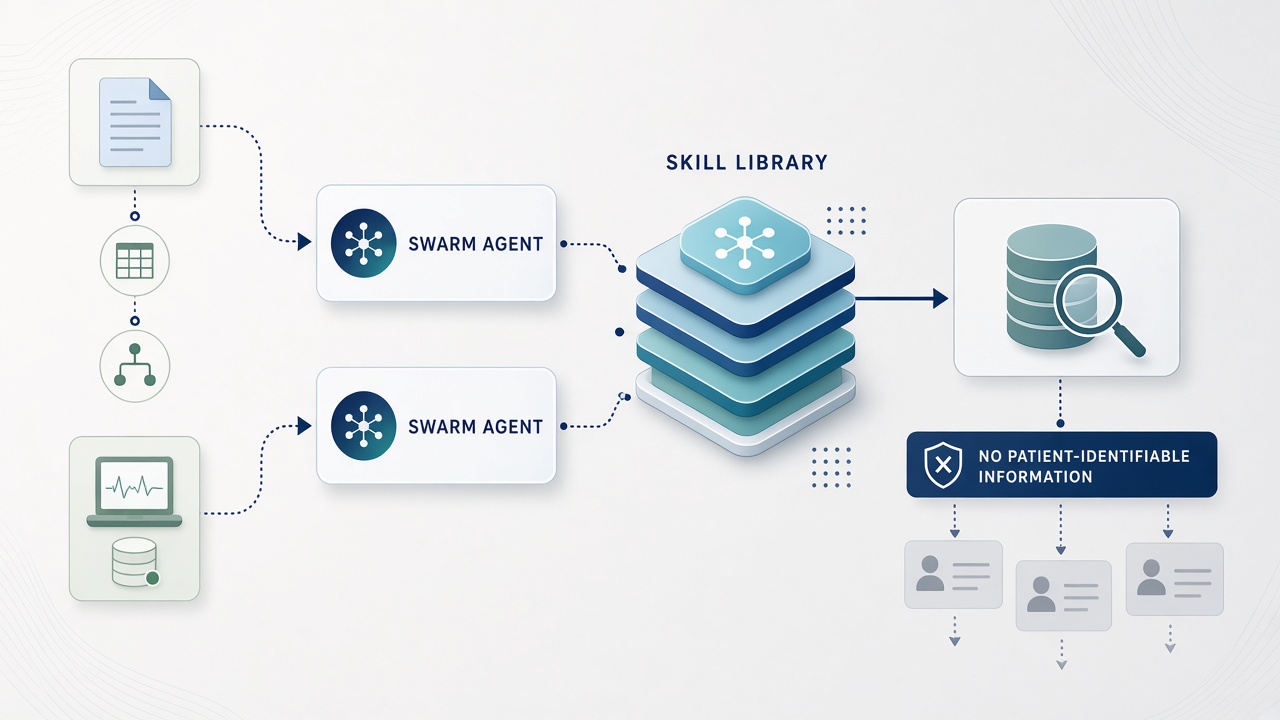
SWARM uses two agents, named swarm-agent and swarm-hive, that share one skill library. Amazon Bedrock AgentCore provides the managed runtime; Amazon Bedrock Knowledge Bases and Amazon Titan Text Embeddings support document retrieval. The system also includes a custom document pipeline and equipment-specific metadata, which the source says were used to improve diagnostic accuracy.
That last detail is the part I’d pay closest attention to when integrating something similar. A retrieval system can only be as useful as the documents and labels it can search. The source quotes the team saying, “Diagnostic accuracy is a data quality problem first.” That is a practical warning against treating the agent framework as the whole solution: the equipment-specific context and document preparation are part of the product, not setup chores to ignore after the demo.
Worth a look
Phugialy Picks

AI Engineering: Building Applications with Foundation Models
A practical guide to building real-world applications with foundation models and LLMs.

GMKtec K15 AI Mini PC Oculink Intel Ultra 5 125U 32GB DDR5 512GB SSD | Desktop Computer AI Boost, 3X M.2 2280 Storage Expansion, Dual NIC...

2084 and the AI Revolution, Updated and Expanded Edition: How Artificial Intelligence Informs Our Future
Some Phugialy Picks use affiliate links. If you buy through one, Phugialy may earn a commission. It doesn't change what we recommend. Full disclosure →
Faster first responses are not the same as resolved tickets
The reported results are about 130 times faster first response time and 96.2 percent automated coverage across support tickets, with more than 65 tickets per day. Those figures suggest SWARM can make troubleshooting knowledge available at scale. But “coverage” is not the same thing as successful resolution, and the source summary does not provide enough detail to equate the two.
That distinction matters in a lab setting. An assistant that quickly surfaces a plausible troubleshooting step can still leave the engineer with the hard work of checking whether it matches the specific equipment and ticket. SWARM is described as assisting rather than replacing engineers; the quoted description says it gives them access to institutional knowledge when a ticket arrives. My read is that the useful measure is not just how many tickets the system touches, but whether the suggestions help engineers diagnose them accurately without adding review overhead.
Privacy boundaries and evaluation deserve the next test
SWARM is designed to keep patient-identifiable information out of both the vector index and the language model. That is an important architectural boundary for lab operations, where troubleshooting context and patient data should not be casually mixed. The source also reports a managed runtime with built-in identity management and flexibility to swap models without rewriting agent logic.
I’d treat those as promising design choices, not proof that every deployment edge case is settled. The practical test is whether the document pipeline continues to produce accurate retrieval across varied equipment and messy tickets, while the privacy boundary holds as the knowledge base grows. The source reports improved diagnostic accuracy after adding the pipeline and metadata, but the available details do not establish how performance changes on unfamiliar cases or over time.
For a team considering a similar system, the first investment should be in the knowledge pipeline and a clear evaluation of diagnostic quality, not in multiplying agents. SWARM’s numbers make the approach worth examining; the evidence that would make it compelling to copy is sustained accuracy on real tickets, alongside fast responses and dependable privacy controls.
Holiday picks
Thanksgiving: early shopping
Start early: products for hosting, travel and home, plus the gear you have been watching.

Monitors
Big purchaseAlienware 34 Curved Gaming Monitor – AW3425DWM - 34-inch WQHD 180Hz 1ms Display, 1500R, AMD FreeSync Premium, VESA AdaptiveSync.
View on Amazon (opens in a new tab): Alienware 34 Curved Gaming Monitor – AW3425DWM - 34-inch WQHD 180Hz 1ms Display, 1500R, AMD FreeSync Premium, VESA AdaptiveSync.Prices change daily. Check today's price on Amazon.

Home & Kitchen
De'Longhi Magnifica Duo Automatic Espresso Machine, Milk Frother, Silver
View on Amazon (opens in a new tab): De'Longhi Magnifica Duo Automatic Espresso Machine, Milk Frother, SilverPrices change daily. Check today's price on Amazon.

Home & Kitchen
eufy C28 Robot Vacuum Cleaner and Mop for pet hair, 15,000 Pa
View on Amazon (opens in a new tab): eufy C28 Robot Vacuum Cleaner and Mop for pet hair, 15,000 PaPrices change daily. Check today's price on Amazon.
We earn from qualifying purchases made through these links, at no extra cost to you, as an Amazon Associate and through other affiliate programs. Disclosure. See all Thanksgiving picks
Got a question about how this applies to you? →
For another look at agentic systems in operational settings, read “Autonomous Security Operations: What Greenlight Shows.”
Keep reading
Follow the thread

AI Loan Servicing Assistant: Where the Work Really Is
LoanPro’s assistant works across eight API endpoints and synthesizes around 1,400 fields per account. The reported call-time reduction is up to 15 percent, but the more useful question for builders is how each stage handles messy account data.
Read this noteSame lane, different angle
Autonomous Security Operations: What Greenlight Shows
Greenlight says its AI system resolves more than 90 percent of security and risk cases. The architecture behind that figure includes escalation, memory, and a feedback pipeline—but the rate alone does not show whether the hardest mistakes are being caught.
Agentic AI for Financial Services: Duco’s Stack
Duco’s agentic AI for financial services stack pairs Amazon Bedrock’s foundation-model access with Amazon Bedrock AgentCore’s managed agent runtime. The useful change is not just adding agents: Duco can select models fro