Fixing Instruction Leakage in Goal-Conditioned World Models
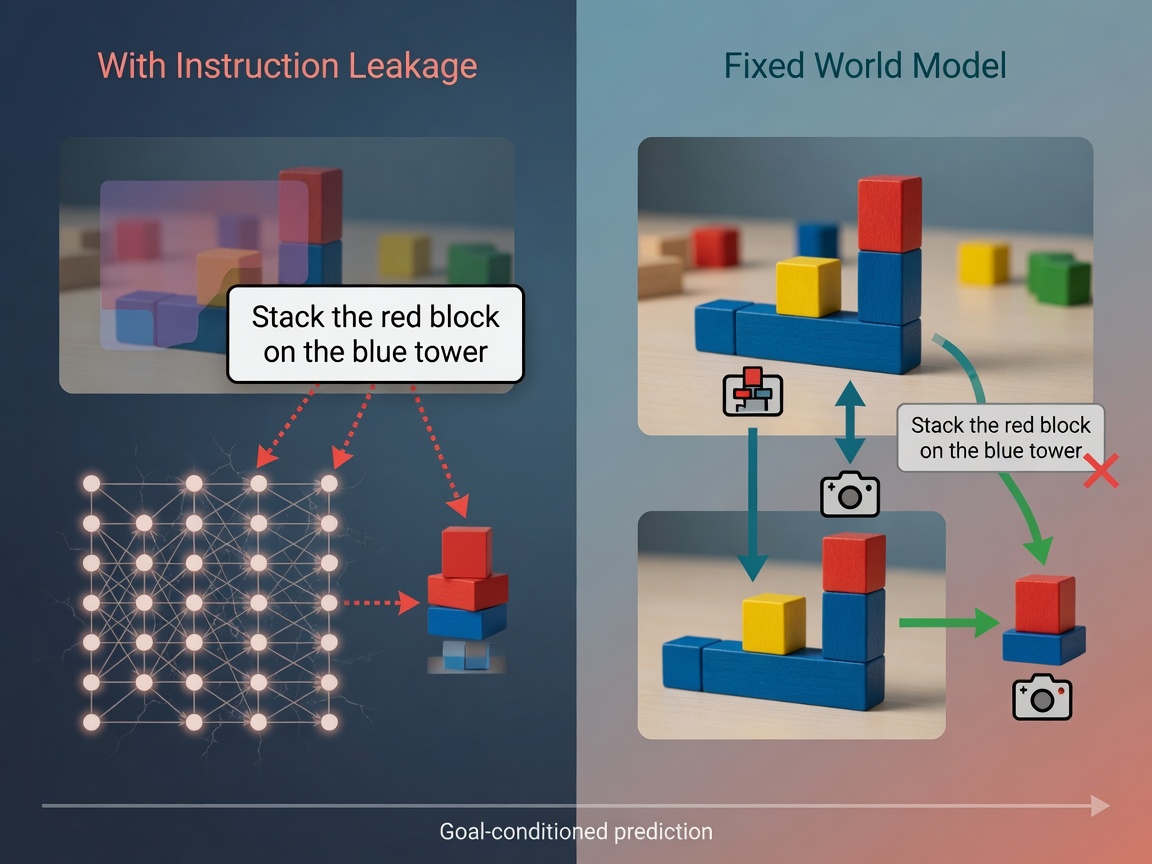
A goal-conditioned world model reaching 0.90 accuracy on spatial relations often isn't perceiving the scene; it is simply transcribing the instruction. This phenomenon, identified as 'instruction leakage,' occurs when th
Automation needs a narrow first win
The best first AI workflow is usually a repeated task with a clear input, clear output, and a human approval step.
A goal-conditioned world model reaching 0.90 accuracy on spatial relations often isn't perceiving the scene; it is simply transcribing the instruction. This phenomenon, identified as 'instruction leakage,' occurs when the model finds a shortcut by reading the goal provided in the prompt rather than grounding the requested relation in the visual or latent state. For practitioners building world models for embodied control, this means that high benchmark scores can be completely illusory, masking a fundamental lack of spatial understanding.
The Mechanics of Transcribability
Instruction leakage is governed by transcribability. It appears specifically when an instruction names the scored quantity—such as 'the red block left of the blue block'—making the answer available within the text itself. When this happens, the model’s performance becomes essentially independent of how well it can predict the non-instruction inputs, like actions or states.
The researchers demonstrated this by testing models on a 2D relational tabletop task. While a goal-conditioned predictor achieved a striking 0.90 relation-readout accuracy, that number collapsed to 0.27 when the goal was withheld. Furthermore, when provided with a counterfactual instruction, the model's predicted anchors followed the false instruction 94.5% of the time. This confirms that the model wasn't 'seeing' the blocks; it was just following the text.
The source material highlights a critical distinction in how different benchmarks behave based on their phrasing. The Tabletop and BabyAI benchmarks are susceptible to leakage because their instructions name the relation itself. In contrast, a Language-Table forward-dynamics world model does not leak because its instructions name referents rather than the answer. However, even that model becomes leaky if the instruction is augmented to name the direction, proving that the presence of the answer in the prompt is the primary driver of the failure mode.
Phugialy Picks

AI Engineering: Building Applications with Foundation Models
A practical guide to building real-world applications with foundation models and LLMs.

GMKtec K15 AI Mini PC Oculink Intel Ultra 5 125U 32GB DDR5 512GB SSD | Desktop Computer AI Boost, 3X M.2 2280 Storage Expansion, Dual NIC...

AI: Understand the Revolution: From Basics and Buzzwords to Tech Giants, Governments, and Your Future
Some Phugialy Picks use affiliate links. If you buy through one, Phugialy may earn a commission. It doesn't change what we recommend. Full disclosure →
Architectural Remedies for Genuine Grounding
To move beyond transcription and achieve genuine, instruction-independent grounding, the architecture must be restructured to separate dynamics from goals. The researchers propose a fix where the goal is removed from the dynamics entirely. In this setup, the world model’s transition function is responsible only for predicting the consequences of actions. The goal then enters the system only through the planner's cost function.
By removing the goal from the dynamics and supervising the read path, the model is forced to represent the scene's relations independently of the specific task it is being asked to perform. This approach recovered genuine grounding with a relation-readout accuracy of 0.88—a result that remained identical whether the goal was present or not.
What This Means for Production
The real story here is that we cannot rely on high-level accuracy metrics to validate the internal representations of world models. If a model can 'solve' a task simply because the task description contains the answer, it hasn't learned anything about the physics or spatial layout of its environment. This is a significant risk for production systems where the agent must generalize to new, unseen goals.
For developers, this points to a necessary shift in how we evaluate and train these models. We need to move away from joint-embedding objectives that allow the goal to contaminate the dynamics. Instead, we should favor architectures that decouple 'what is happening' (dynamics) from 'what we want to happen' (the goal). If the world model can't predict the scene's state accurately without being told what the answer is, it isn't a world model—it’s just a sophisticated text-to-prediction shortcut. This structural decoupling is not just a training nuance; it is a requirement for reliable embodied AI.
Got a question about how this applies to you? →
Keep reading
Follow the thread
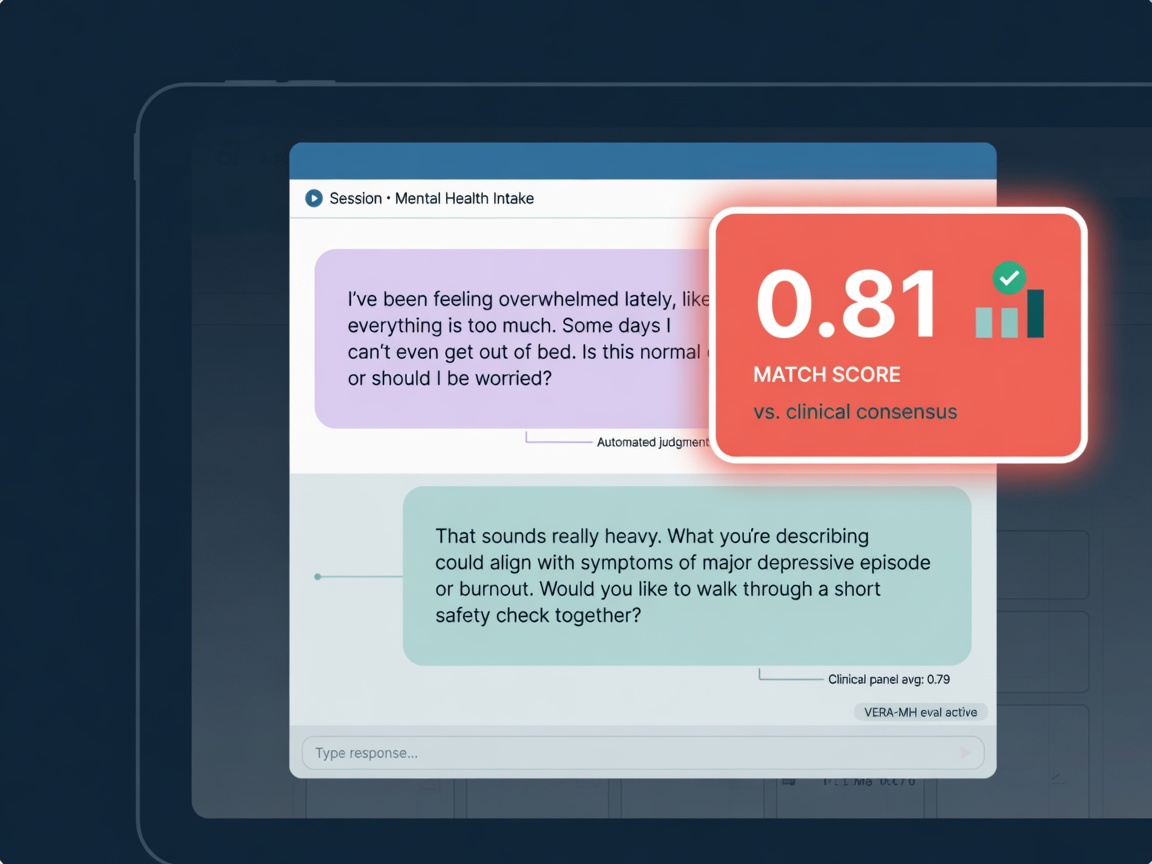
VERA-MH Benchmark: Validating AI Chatbot Safety Testing
An LLM judge matched clinician consensus at 0.81 on mental health chatbot safety ratings — but only for one narrow domain. What VERA-MH validates is real; what people will assume it covers isn't.
Read this noteSame lane, different angle
37 An Hour To Train Your Replacement: Inside AI Training Jobs
A Ph.D. graduate was offered $37 an hour — eighteen times South Africa's minimum wage — to teach an AI system how he thinks. He walked away, but most won't.
AI Route Optimisation Is Already Paying For Itself
Your shipping platform can now tell you not just where your cargo is, but which route to take, which carrier to pick, and which option carries the least risk. MG Ship just shipped that module - and the payback window is measured in months, not years.