OpenShell Runtime: Bounded Agent Access Needs Good Policies
OpenShell 0.1.x is a runtime for autonomous AI agents that checks file access, system calls, and network connections against policy. The practical promise is bounded access: agents can do approved work without receiving
Automation needs a narrow first win
The best first AI workflow is usually a repeated task with a clear input, clear output, and a human approval step.
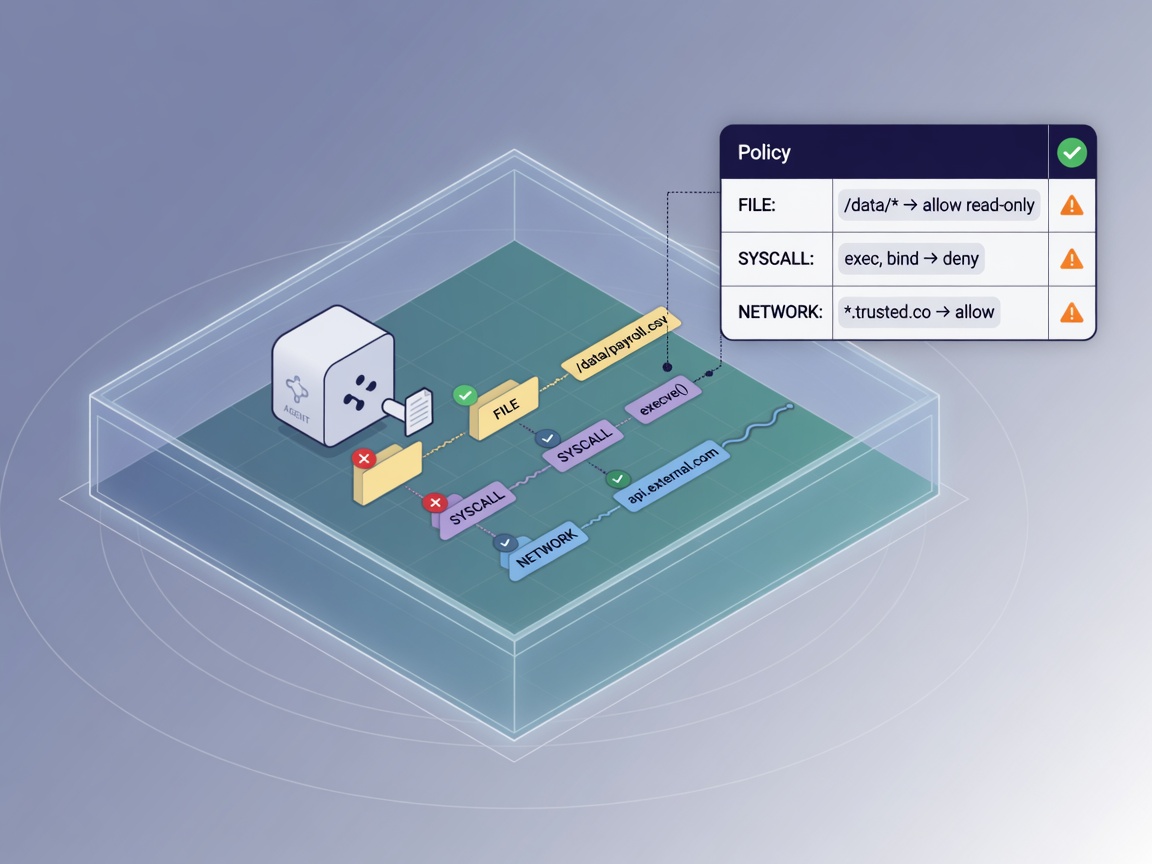
OpenShell 0.1.x is a runtime for autonomous AI agents that checks file access, system calls, and network connections against policy. The practical promise is bounded access: agents can do approved work without receiving unrestricted access to a machine or its credentials. Whether that boundary is useful depends on how well you can define the policy around a real task.
OpenShell runtime makes policy the access boundary
OpenShell confines agents in isolated sandboxes and enforces policy at the kernel level. That gives a policy a concrete job: specify which resources an agent can reach, then check its file, system-call, and network activity against those rules. The 0.1.x release also brings a stable release cadence, new isolation primitives, an expanded extension surface, and new runtime APIs.
Those additions matter if you’re integrating agents into workflows that touch files or external services. But the sandbox itself doesn’t decide what access is appropriate. Someone still has to define the allowed actions and endpoints, and keep those rules aligned with what the workflow actually needs. In my view, that policy work—not the existence of an isolation boundary—is the part to evaluate first.
Worth a look
Phugialy Picks

AI Engineering: Building Applications with Foundation Models
A practical guide to building real-world applications with foundation models and LLMs.

Redragon K745 PRO Wireless 108-Key Gasket RGB Gaming Keyboard, 4 Hotkeys

GMKtec K15 AI Mini PC Oculink Intel Ultra 5 125U 32GB DDR5 512GB SSD | Desktop Computer AI Boost, 3X M.2 2280 Storage Expansion, Dual NIC...
Some Phugialy Picks use affiliate links. If you buy through one, Phugialy may earn a commission. It doesn't change what we recommend. Full disclosure →
Credential handling and policy changes get a review boundary
OpenShell says agents never see real credentials: it adds them only to requests bound for approved endpoints. That separates the agent’s ability to form a request from direct access to the underlying secret. For a workflow that needs to call a known service, that’s a useful design boundary, provided the approved endpoint list is accurate and maintained.
Formal verification adds another check when policies change. It flags the new access a proposed change would grant before the change is approved, leaving risky expansions for human review. This is a meaningful safeguard, but it doesn’t remove the reviewer’s responsibility to decide whether the access is justified. A rule can be checked formally and still be broader than the task needs.
Test one workflow before trusting the boundary
I’d start with one agent workflow and write down the minimum files, system calls, network destinations, and credentials it needs. Then I’d configure those permissions and see whether the workflow can complete its task without widening the policy at every unexpected input. That test can expose the practical cost of maintaining approved endpoints and handling policy exceptions before the same rules are applied more broadly.
The source points to a 0.1.0 upgrade guide and a quickstart for Linux, macOS on Apple Silicon, and experimental Windows with WSL 2. The available details don’t specify performance, fleet-scale behavior, or how the human review experience works, so I wouldn’t treat a successful quickstart as evidence that those questions are settled.
The useful next step is not a fleet rollout; it’s that single-workflow test. If the policy stays narrow while the agent handles realistic requests, OpenShell may offer a workable way to bound agent access. If routine cases keep demanding broader permissions or endpoint exceptions, the policy becomes the operational bottleneck. That is what I’d measure before expanding the deployment.
Got a question about how this applies to you? →
Keep reading
Follow the thread

Generative AI for Information Is Growing, Not Agents
Generative AI is already a common route to information, but that does not mean people are ready to hand over tasks to agents or let AI write the news. The gap between those uses is the part product teams should pay attention to.
Read this noteSame lane, different angle
AI Training Data Needs Better Agent Evaluations
Handshake’s AI training business reportedly reached $1 billion in gross annualized revenue about a year after launch. Its benchmark demonstrations make the less comfortable point: a polished final answer can hide mistakes in how an agent handled the task.
Autonomous Security Operations: What Greenlight Shows
Greenlight says its AI system resolves more than 90 percent of security and risk cases. The architecture behind that figure includes escalation, memory, and a feedback pipeline—but the rate alone does not show whether the hardest mistakes are being caught.