3 min read
Back to all posts

The Orchestration Layer: Agentic AI's Biggest Efficiency Lever

What if the biggest lever for making AI agents cheaper and faster isn't the model you pick at all? A new study says it's the layer wrapped around the model - the orchestration layer, or "harness" - and the numbers behind
agentic AIorchestration layerAI cost efficiencyfoundation modelsAI agents
The Orchestration Layer: Agentic AI's Biggest Efficiency Lever
Those aren't rounding errors they're the difference between an agent workflow that's marginal and one that's obviously worth running.
Reader Lens

Automation needs a narrow first win

The best first AI workflow is usually a repeated task with a clear input, clear output, and a human approval step.

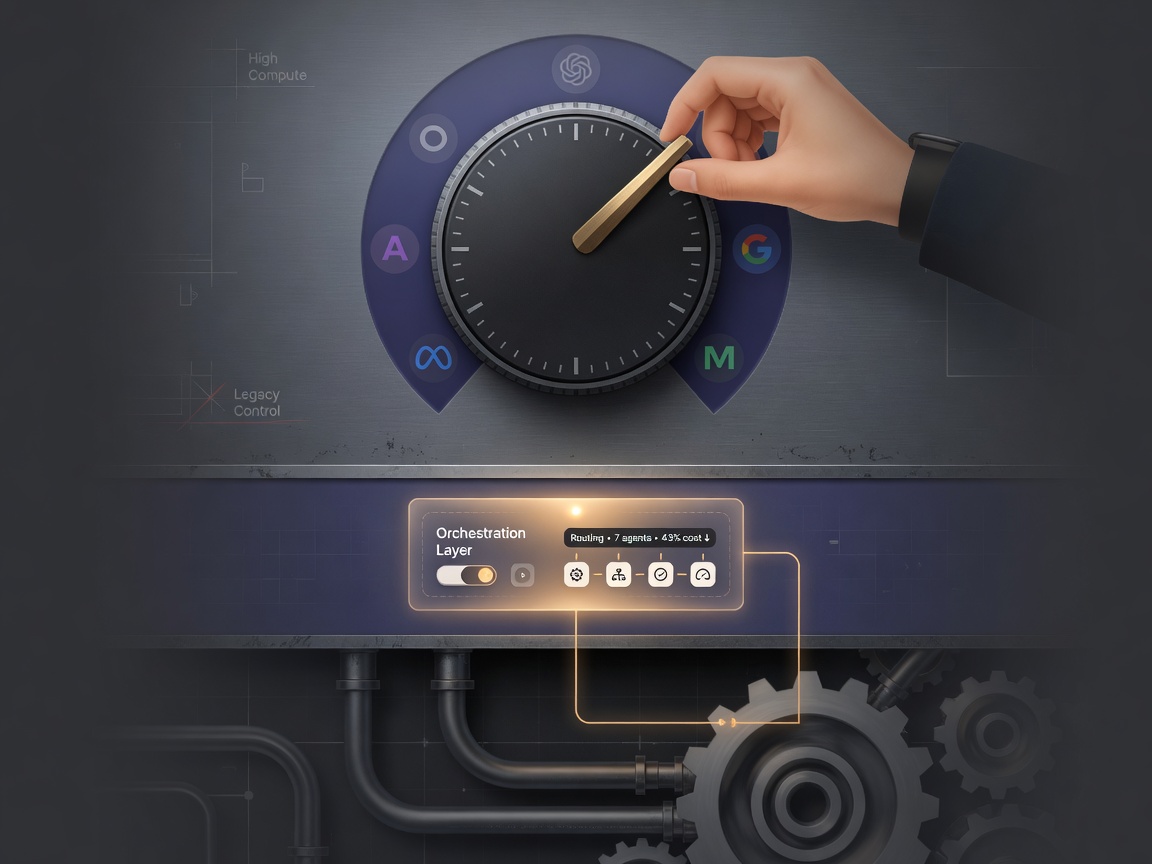
What if the biggest lever for making AI agents cheaper and faster isn't the model you pick at all? A new study says it's the layer wrapped around the model - the orchestration layer, or "harness" - and the numbers behind that claim are genuinely hard to ignore.

The Numbers Behind the Harness Effect

The research isolates what the authors call the harness effect using controlled evaluations across six foundation models, and the results are consistent: blended cost per task drops 41% (from $0.21 to $0.12), median wall-clock time falls 44% (48s to 27s), and tokens per task shrink 38% (14.2k to 8.8k). Quality doesn't get sacrificed to get there - it actually edges up from 0.78 to 0.81.

The efficiency story gets better the further you zoom out. Quality per dollar rises 82%, and task-completions per million tokens climb from 54.9 to 92.0. Those aren't rounding errors - they're the difference between an agent workflow that's marginal and one that's obviously worth running.

Phugialy Picks

AI Engineering: Building Applications with Foundation Models
Amazon

AI Engineering: Building Applications with Foundation Models

A practical guide to building real-world applications with foundation models and LLMs.

GMKtec K15 AI Mini PC Oculink Intel Ultra 5 125U 32GB DDR5 512GB SSD | Desktop Computer AI Boost, 3X M.2 2280 Storage Expansion, Dual NIC...
Amazon

GMKtec K15 AI Mini PC Oculink Intel Ultra 5 125U 32GB DDR5 512GB SSD | Desktop Computer AI Boost, 3X M.2 2280 Storage Expansion, Dual NIC...

AI: Understand the Revolution: From Basics and Buzzwords to Tech Giants, Governments, and Your Future
Amazon

AI: Understand the Revolution: From Basics and Buzzwords to Tech Giants, Governments, and Your Future

Some Phugialy Picks use affiliate links. If you buy through one, Phugialy may earn a commission. It doesn't change what we recommend. Full disclosure →

Why This Works on Every Model

Here's the part that makes this more than a one-off benchmark win: the gains are model-invariant. Every one of the six models tested got cheaper, with cost reductions ranging from 33-61%. The harness isn't tuning to one model's quirks - it's a general-purpose efficiency multiplier.

The study's framing is blunt about the status quo: "Agentic AI development today runs on token maxing: buying capability with tokens." The orchestration layer is positioned as the decisive lever against that habit. And there's a quietly striking comparison buried in the results: on this workload, the orchestration layer moved cost per task more than the full spread of the model menu did.

One more relationship worth noting: quality gains correlate almost perfectly with baseline model strength (r=0.99, n=6). The harness doesn't rescue weak models into greatness - it amplifies strong ones. Put a good harness on your best model and both get better together.

The Underappreciated Part: It Multiplies

The real story here, in my view, isn't any single percentage - it's what model-invariance implies. If orchestration-layer efficiency works across every model you run, then it multiplies across your entire model portfolio at once. You don't have to re-engineer per model, and you don't have to bet your architecture on whichever model tops the leaderboard this quarter. That's a genuinely different posture for anyone building agentic AI: the harness becomes durable infrastructure while models stay swappable commodities.

It also quietly reframes the cost conversation. Most teams treat model choice as the main cost dial. If the harness moved cost per task more than the entire model menu did on this workload, then the most boring-sounding part of the stack - the plumbing around the model - may deserve the attention people are currently spending on model shopping.

Give this a year, and I'd expect harness engineering to stop being an afterthought and start being a hiring priority. The teams that treat orchestration as a first-class discipline could run the same agents for roughly half the cost and time of the teams still token-maxing their way to capability. That's not a model upgrade. That's a structural advantage - and honestly, that's the fun kind of advantage to have.

Source and trust note

Built from source research and filtered through practical implementation judgment.

Reference: arxiv.org

Field Notes

Field Note· September 15, 2026

Memory Lanes: Why Your AI Agent Should Think Small Before It Thinks Big

To every developer out there — quick question. Why does an AI model sometimes answer you instantly, and other times pause like it's actually thinking about it? The answer is memory, and once you actually get how it works, you build agents that do less work and get smarter results — not the other way around. It's a genuinely wild time to be in this field. Coding used to be about fundamentals: sharpen your syntax, shave off milliseconds, beat the next person to the result. That still matters. But the AI boom cracked something open — now an agent can go head-to-head with a human, a bot, or another agent, and it doesn't really matter which. The competition itself is pushing us past syntax and scripts into questions like: how much can one agent actually hold in a single conversation? The big labs are racing at a scale most of us will never touch. So instead of trying to out-scale them, I think the rest of us should think small — per call, per token, per process. Nail that, and scaling later is the easy part. What memory actually means Simple: it's any information your AI system keeps around and reuses beyond the one exchange that produced it. Everything below is just a different flavor of that one idea. Every agent has its own way of handling that — some cached, some sitting on your device, some shipped off to a server. Why does any of that exist? A few real reasons stack up, not just one. There's the context window — limited space per call, so memory is partly how a system reaches past what fits in one conversation. There's cost — re-sending or re-computing the same thing over and over adds up, so caching saves real money. There's accuracy — pulling from real, current data instead of guessing keeps an agent grounded instead of making things up. And yes, personalization too. That last one's just the one you notice first as a user — it's not the whole reason this stuff exists. Six types of memory, quickly Short-term (working) memory — whatever's alive in the current chat. The second it ends and nothing got written down, it's gone. Long-term memory — meant to survive past this one chat. The model doesn't magically remember you tomorrow; something has to physically write it down and hand it back later. Persistent memory — long-term's tougher sibling. Less about "does it last," more about "does it survive getting knocked over" — restarts, crashes, redeploys. Stored somewhere solid, not somewhere that evaporates. Episodic memory — memory of one specific moment. "This person asked me X yesterday." Tied to an event, not a fact. Semantic memory — general knowledge, no event attached. "Python is a programming language" doesn't care who asked or when. Chunking — real talk, this one's not actually a type like the other five. It's the delivery method. You can't hand a model an entire book in one shot, so you slice it up first, store the pieces, and only pull back the couple that matter. No chunking, no realistic long-term memory — it's the plumbing everything above runs through. Now, back to that instant-vs-pauses question from the top. For the instant answer, the fact was baked into the model during training — closer to semantic memory than anything stored and fetched. For the pause, it didn't have that baked in, so it went and got it — actual retrieval. One wrinkle: sometimes a model pauses just to reason more carefully, even when it already knows the answer. Looks identical from the outside. Different thing entirely — that's reasoning time, not memory. (Quick aside for developers: if you're calling AI models through an API, look into OpenRouter. It gives you one API to call basically any AI model out there instead of wiring up each provider separately.) So here's the real question: when your agent goes and retrieves something, does it actually know what to do with it? Honest answer — it depends. Entirely on how you process it, and how you design around it. Think of any AI workflow as three steps: Trigger → Process → Output. The heart of it is Process — specifically when you call your data. Before the prompt? After it? Before the output? During validation? Every choice is a trade-off: more retrieval, more precision, more tokens burned. And that cost doesn't multiply per user — it multiplies per prompt. One user, a hundred prompts in a session. Keep that in mind. Why does any of this matter? Because being smart isn't about doing more work — it's about not doing too much work. Imagine calling up every book in a library to answer "what's 1+1" or "how do you spell A." The model probably already knows without any of that. If you're building something real for real users, you already know they won't accept "well, technically I checked every book first" as a good answer. (Somewhere there's probably an edge case that needs the deep search — not the point here.) I just want to plant the idea and let you sit with it. So how do I actually use this? On my own blog's pipeline: memory gets stored every time new data is discovered. It gets pulled back out before every write. After every validation, anything that came out wrong or out of place gets stored too — as a persistent memory — so the same mistake doesn't happen twice. Then a log gets written after every push. I'm not going to show you the whole system here. I'd rather you sit with the idea and build your own version of it — that's how this stuff actually gets better for everyone. Hope this helps you build whatever you're working on.

Got a question about how this applies to you? →

Keep reading

Follow the thread