The Homogenization of arXiv: Why AI Editing is Flattening Research
The data is out: one-third of new papers on arXiv are showing signs of machine-like writing. This isn't some far-off prediction; it’s a measurement derived from an analysis of 12,750 papers. The divergence across discipl

Automation needs a narrow first win
The best first AI workflow is usually a repeated task with a clear input, clear output, and a human approval step.
The data is out: one-third of new papers on arXiv are showing signs of machine-like writing. This isn't some far-off prediction; it’s a measurement derived from an analysis of 12,750 papers. The divergence across disciplines is striking. Computer science leads the pack with a flagged share of roughly 65%, while mathematics remains almost untouched at 0.7%.
The Notation Shield vs. The Prose Trap
Why the massive gap? It comes down to how we communicate. Mathematics relies on sparse prose and heavy notation—structures that are inherently resistant to the "flow" of an LLM. In contrast, computer science is prose-heavy. When you rely on descriptive text to explain complex systems, you provide more surface area for an AI to "smooth out."
The study clarifies a crucial point: these papers aren't necessarily 100% AI-authored. They represent "heavy AI-assisted editing." A researcher provides the core methodology, but an LLM handles the structural heavy lifting—smoothing the prose, ensuring grammatical consistency, and bridging the gap between complex ideas and "readable" text. The detector used in this study was specifically calibrated for academic writing to maintain a low 0.4% false-positive rate, but its sensitivity naturally fluctuates based on how much prose a field requires to be understood.
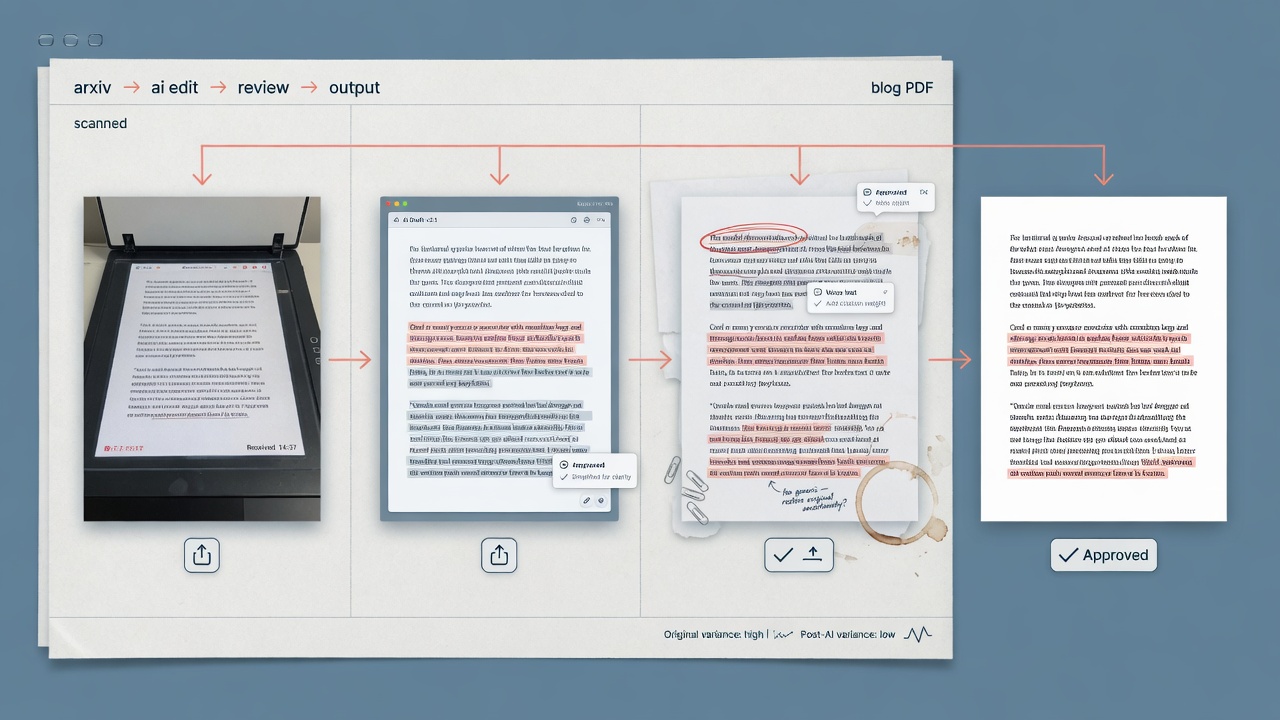
Worth a look
Phugialy Picks

AI Engineering: Building Applications with Foundation Models
A practical guide to building real-world applications with foundation models and LLMs.

GMKtec K15 AI Mini PC Oculink Intel Ultra 5 125U 32GB DDR5 512GB SSD | Desktop Computer AI Boost, 3X M.2 2280 Storage Expansion, Dual NIC...

GEEKOM IT15 AI Mini PC, Intel Ultra 9 285H(99 Tops), 32GB DDR5, 1TB SSD | The Most Powerful Workstation,Arc 140T GPU,WiFi 7,8K Business D...
Some Phugialy Picks use affiliate links. If you buy through one, Phugialy may earn a commission. It doesn't change what we recommend. Full disclosure →
The Risk of the "Polished Average"
The real story here isn't a crisis of authorship; it's a shift toward a homogenization of academic texture. When 65% of computer science papers exhibit machine-like writing, the "voice" of the field begins to converge toward the mean of the training data. We are entering an era of "polished averages."
For the practitioner, this is a double-edged sword. AI-assisted editing is a functional tool for non-native speakers or for turning a messy first draft into a coherent narrative. It lowers the friction of publication. However, we have to be critical of what's being lost in that friction. If the goal of academic writing is to communicate a new idea as clearly as possible, AI is a win. But if the goal is to provide a distinct, idiosyncratic perspective on a problem, we need to be wary.
When every paper is polished to the same machine-like sheen, the unique stylistic nuances that often signal original thinking get smoothed away. We risk a future where the papers are perfectly readable, but the underlying logic is just a recycled average of what's already been said. We need to ask: are we using these tools to amplify our insights, or are we using them to hide the fact that we don't have any?
Got a question about how this applies to you? →
Keep reading
Follow the thread

The Math Phase Transition: Moving Beyond Pattern Recognition
OpenAI recently demonstrated that AI models are moving beyond simple pattern recognition and into the territory of novel mathematical discovery. An internal model successfully provided a counterexample to the 'unit dista
Read this noteSame lane, different angle
Google’s AI Power Shuffle: Consolidation vs. Research Independence
The draft was slightly under the word count floor. I expanded the analysis on the Public Benefit Corporation and the production-scale implications to ensure it hit the 400-700 word range while sharpening the 'Practitioner' persona's opinionated tone.
RL Doesn't Just Fine-Tune; It Architectures Strategy
Reinforcement learning (RL) post-training is often sold as a way to polish model outputs. However, new research into rewrite-grammar environments suggests the reality is much more structural. The study shows that RL isn'