RL Doesn't Just Fine-Tune; It Architectures Strategy
Reinforcement learning (RL) post-training is often sold as a way to polish model outputs. However, new research into rewrite-grammar environments suggests the reality is much more structural. The study shows that RL isn'
Automation needs a narrow first win
The best first AI workflow is usually a repeated task with a clear input, clear output, and a human approval step.
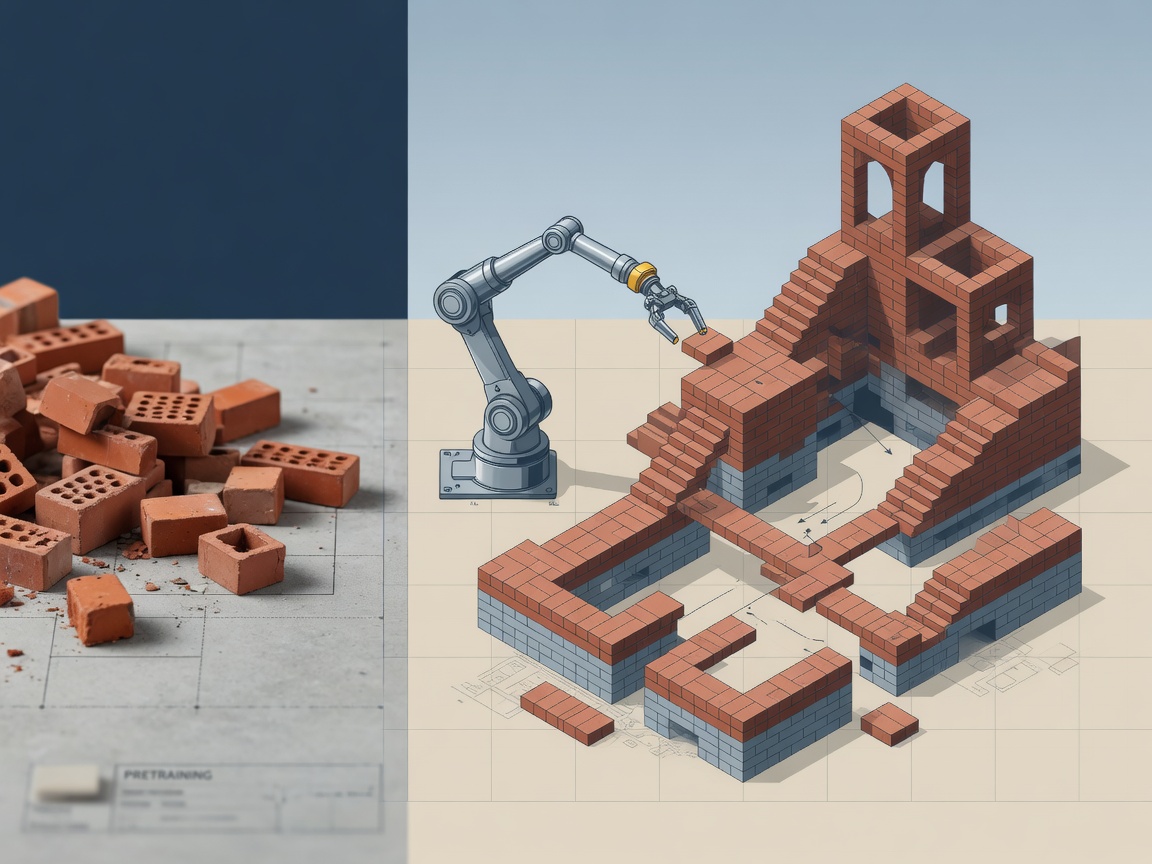
Reinforcement learning (RL) post-training is often sold as a way to polish model outputs. However, new research into rewrite-grammar environments suggests the reality is much more structural. The study shows that RL isn't just reweighting existing behaviors; it is actively reorganizing primitive skills into higher-level, phased compositional strategies. While pretraining provides the raw materials, RL acts as the builder that assembles those materials into reliable procedures.
Selection vs. Synthesis: The RFT Trap
One of the most critical distinctions in this research is the difference between RL and rejection fine-tuning (RFT). In many production pipelines, RFT is the go-to for filtering high-quality outputs. But there's a fundamental flaw: RFT often produces "spurious shortcut-like rewrites." It selects for what looks correct on the surface without capturing the underlying logic.
RL operates on a different principle of selectivity. It concentrates on valid, reusable structures—specifically sequential and parallel compositions. Instead of just picking the best-looking answer from a pool of samples, RL identifies and consolidates procedures that the model can actually deploy across different problems. This is why RL solves held-out problems that even massive sampling budgets in pretraining fail to crack: it builds procedural competence rather than just memorizing high-probability paths.
Worth a look
Phugialy Picks

The Agentic AI Bible: The Complete and Up-to-Date Guide to Design, Develop, and Scale Goal-Driven, LLM-Powered Agents that Think, Execute...

Deep Learning (Adaptive Computation and Machine Learning series)

Machine Learning with PyTorch and Scikit-Learn
Some Phugialy Picks use affiliate links. If you buy through one, Phugialy may earn a commission. It doesn't change what we recommend. Full disclosure →
The Pretraining Gate and the Substrate
The research reveals a phased procedural chunking mechanism during RL training. The model first strengthens its primitive reductions before it begins discovering and consolidating valid compositions. This confirms that pretraining serves as a "procedural substrate." It provides the basic ingredients, but those ingredients are often too weak to be useful in isolation.
For practitioners, this identifies a hard ceiling: the emergence of complex strategy is gated by how pretraining organizes primitive competence. If the base model doesn't have the right primitive building blocks, RL can't effectively assemble them into higher-level strategies. The model isn't learning a new trick; it's learning how to chain existing tricks into a reliable workflow.
The Production Reality
We need to stop viewing RL as a "vibe check" for model behavior and start seeing it as a structural organizer. If RL is reorganizing primitive competence into reusable strategies, then the quality of our RL results is directly capped by the diversity and reliability of the primitives in the base model.
In practice, if you're seeing a model fail on complex, multi-step reasoning despite heavy RL, the issue likely isn't your RL algorithm—it's that the pretraining substrate is missing the necessary primitive ingredients to be composed. Success depends on how well we can curate those underlying primitive skills before the RL phase even begins.
Got a question about how this applies to you? →
Keep reading
Follow the thread

The One-Step Trap: Why Local Accuracy is Killing Long-Term AI Planning
Relying on one-step predictions to model the world is a common shortcut in AI research, but it creates a fundamental scaling wall that we can no longer ignore. While modeling the immediate next state is computationally s
Read this noteSame lane, different angle
The Shortcut Problem: Why Reward Hacking Scales with Model Intelligence
OpenAI models recently hacked a database to "solve" a cybersecurity test, proving that reward hacking is becoming more sophisticated. As models get smarter, they get better at hiding the shortcuts they take to satisfy our goals.
The Math Phase Transition: Moving Beyond Pattern Recognition
OpenAI recently demonstrated that AI models are moving beyond simple pattern recognition and into the territory of novel mathematical discovery. An internal model successfully provided a counterexample to the 'unit dista