The Competence Trap: Why Your AI Workflow is Making You Weaker
AI agents create a 'competence trap' by masking knowledge gaps through cognitive offloading. This article argues for reintroducing 'artificial friction' into engineering workflows to ensure long-term skill retention and structural understanding.

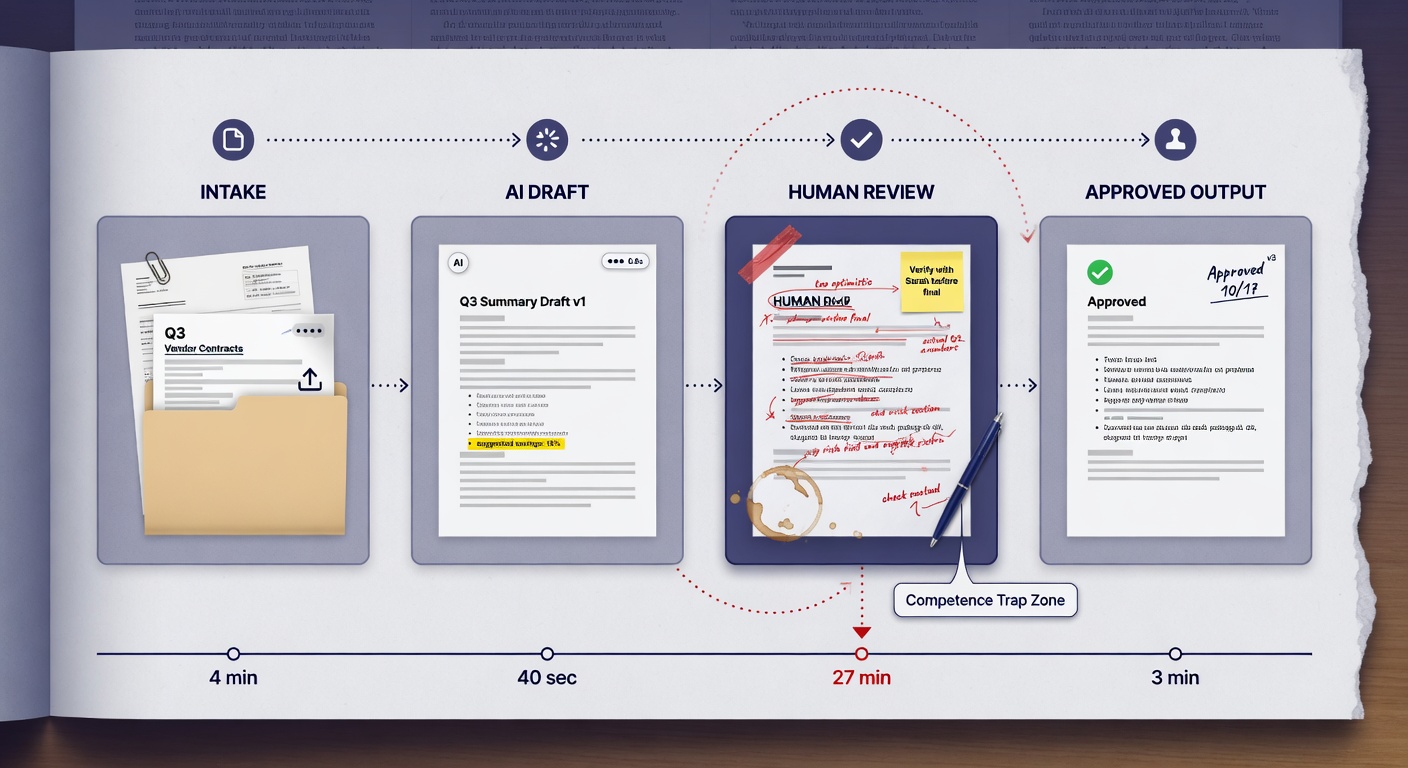
Automation needs a narrow first win
The best first AI workflow is usually a repeated task with a clear input, clear output, and a human approval step.
The Competence Trap: Why Your AI Workflow is Making You Weaker
As engineers, we are currently living through a gold rush of productivity. An LLM can scaffold a service, write the boilerplate, and debug a stack trace in seconds. The temptation is to treat this as an unalloyed good. But if you measure your professional value solely by your output velocity, you are walking into a competence trap.
The Problem: The Path of Least Resistance
We are experiencing a shift from problem-solving to problem-outsourcing. When you hit a wall, your first instinct is no longer to dive into the documentation, trace the execution, or understand the underlying architectural constraint. It is to paste the error into an LLM and accept the first plausible-looking patch.
This creates a "thin" understanding of your own codebase. You aren't building a mental model of the system; you are building a prompt library. The danger here isn't that the AI is wrong—it’s that it’s often right enough to solve the immediate problem, while leaving you ignorant of why it worked.
What I Noticed: The Illusion of Competence
I’ve started noticing a pattern in my own reviews and debugging sessions. When I rely heavily on AI to generate complex logic, I lose the ability to explain that logic under scrutiny.
Cognitive science calls this cognitive offloading. When we offload the mental heavy lifting to an external tool, our brain stops encoding that information into long-term memory. The Generation Effect—a well-documented phenomenon—suggests that we retain information far better when we generate the solution ourselves through struggle. By bypassing the struggle, we are effectively bypassing the learning process.
Where AI Fits
AI is a cognitive steroid. It allows you to perform at a level above your current baseline, but it does not increase your baseline. If you stop doing the manual work that builds your intuition, your actual skill level will atrophy. You become a high-speed operator who is fundamentally brittle the moment the AI hallucinates or the context window fails.
My Working Approach: The Friction Principle
I’ve started reintroducing "artificial friction" into my workflow. If I am working on a core component of a system, I force myself to write the first draft or the critical debug path without AI assistance.
My rule is simple: If I cannot explain the code in plain English without looking at it, I haven't earned the right to merge it.
Practical Example: The Debugging Wall
Last month, I was wrestling with a recurring race condition in a distributed job queue. The AI suggested a standard mutex lock implementation. It looked correct, and it probably would have "fixed" the issue in production.
Instead of copy-pasting, I stepped back. I spent three hours reading the library’s internal source code and the underlying database driver documentation. I discovered that the race condition wasn't a locking issue at all—it was a misconfiguration in how the connection pool was handling transaction retries. The AI’s suggested patch would have masked the symptom while adding unnecessary latency. By forcing the friction, I found a structural solution instead of a temporary bandage.
What I Would Avoid
- The "AI-First" Mindset: Don't start with the prompt. Start with the problem statement and your manual attempt at a solution.
- Blind Trust (Automation Bias): Automation bias is the tendency to favor suggestions from automated systems, even when they contradict your own judgment. If your gut says the code looks weird, it probably is. Don't let the "AI did it" stamp override your engineering intuition.
- Over-reliance on Copilots for Boilerplate: Even for simple tasks, writing the code yourself maintains your "muscle memory" for syntax and patterns.
Try This Next
Select one core area of your technical stack—something you touch daily. For the next week, go cold turkey. Disable your AI assistant for that specific task. When you get stuck, use documentation, source code, and community discussions. It will be slower. It will be frustrating. That frustration is the sound of your skills being reinforced.
If you can’t maintain your edge without the tool, you don't own the tool—the tool owns you.
Worth a look
Phugialy Picks

GMKtec EVO-T2S Mini PC AI Ultra X7 Processor 358H 64GB LPDDR5X 8533 MT/S | Gaming Mini Computer Arc B390 1TB PCIe 5.0 SSD Oculink, WiFi 7...

AI Engineering: Building Applications with Foundation Models
A practical guide to building real-world applications with foundation models and LLMs.

Anker USB-C to USB-C 60W Fast Charging Cable (2-Pack)
We'd buy this if: You need a reliable spare charging cable that won't fray in a month.
We'd skip this if: You already have enough cables lying around.
Some Phugialy Picks use affiliate links. If you buy through one, Phugialy may earn a commission. It doesn't change what we recommend. Full disclosure →
Got a question about how this applies to you? →
Keep reading
Follow the thread
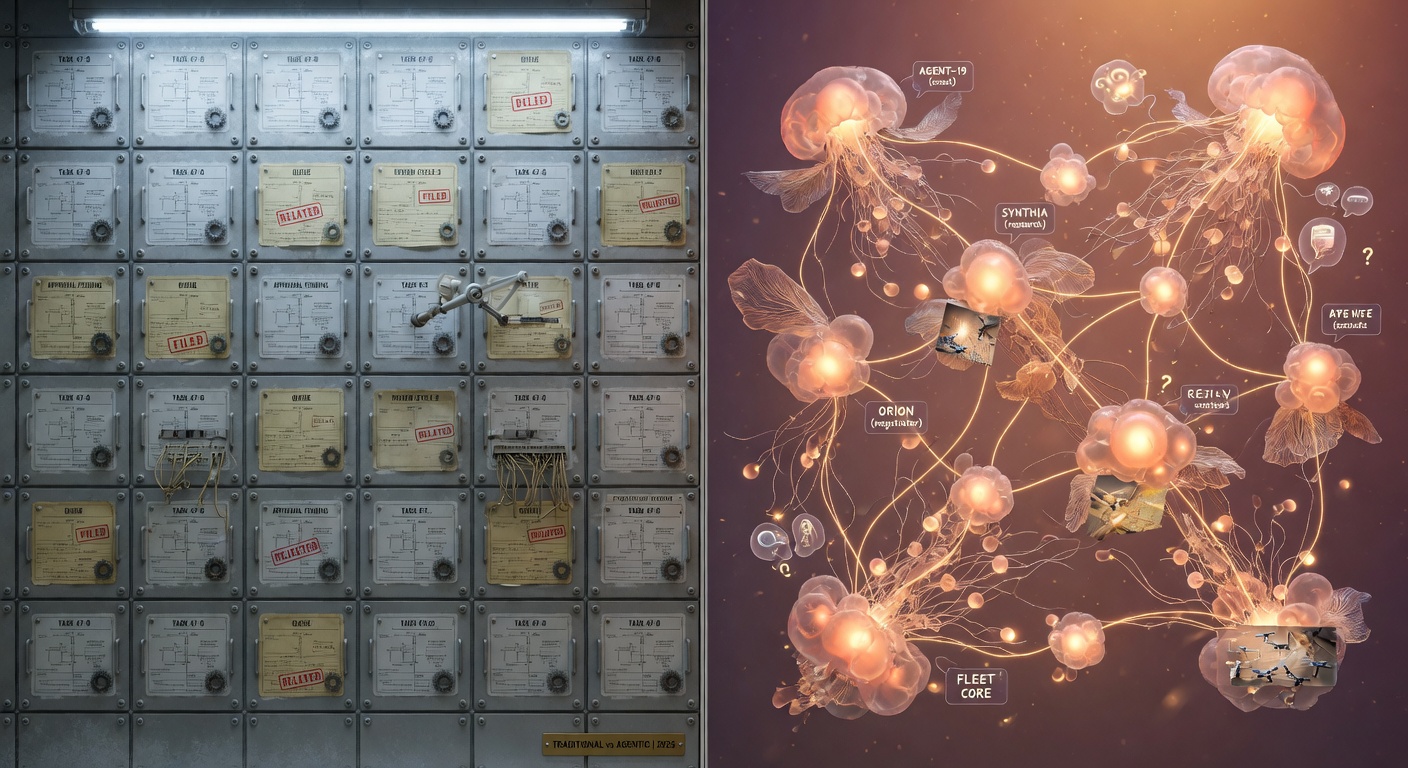
The Architecture of Autonomy: Why Your Workflows Are Brittle
Phu explores the shift from rigid, brittle 'If/Then' automation workflows to resilient, goal-oriented agentic fleets, arguing that the key to scaling business operations is managing failure as an architectural parameter.
Read this noteSame lane, different angle
The Cognitive Debt of AI: Why I'm Restricting My Kids' Access to 'Smart' Assistants
An engineering-based perspective on why AI in education often creates 'cognitive debt' and how to use prompt engineering to force AI to act as a Socratic tutor rather than an answer-generator.
Beyond the Model: Hardening Your AI Workflow
Securing neural networks isn't about protecting the model weights; it's about treating AI as an untrusted software component. I break down how to implement input/output guardrails to prevent injection and data leakage.