Stop Guessing Gaps: How ALER-TI Fixes the Time Series Retrieval Problem
Time series imputation is a headache for anyone building production-grade monitoring or forecasting. The core problem? The "query"—your data with missing values—looks nothing like the "candidates" you want to use as a re
Automation needs a narrow first win
The best first AI workflow is usually a repeated task with a clear input, clear output, and a human approval step.
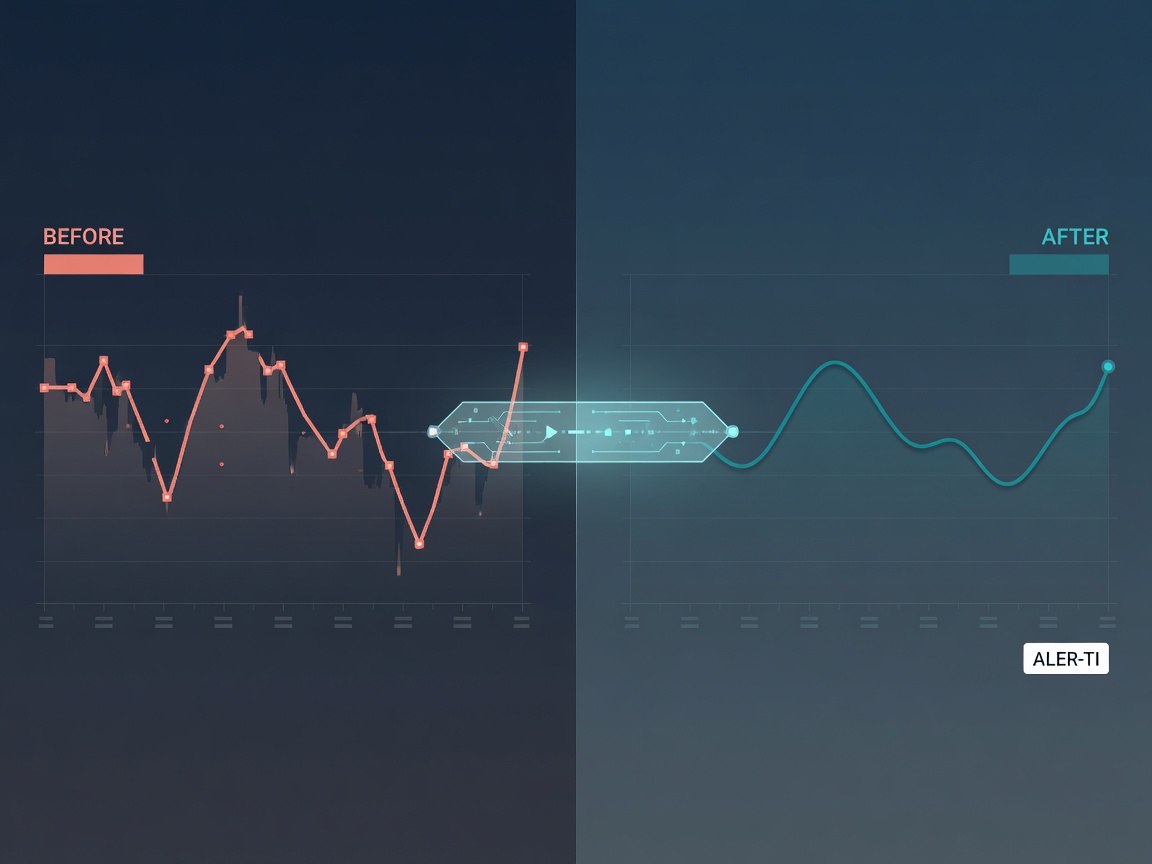
Time series imputation is a headache for anyone building production-grade monitoring or forecasting. The core problem? The "query"—your data with missing values—looks nothing like the "candidates" you want to use as a reference. It’s a massive representation mismatch. When you try to use standard retrieval-augmented models, they often stumble because the gaps change the signal's signature so much that the model is essentially trying to compare apples to oranges.
ALER-TI changes the game by introducing Latent Embedding Alignment (LEA). Instead of trying to force a direct comparison between a broken query and a clean historical record, LEA maps both into a shared latent space. This is where the magic happens: it allows the model to "see" the underlying pattern regardless of whether the data is corrupted or complete.
Solving the Computational Bottleneck with Cached Embeddings
If you’re building at scale, you know that generating new embeddings for every possible corruption type is a non-starter. It’s too slow and computationally expensive. This is where LEA shines for engineers. Because the alignment happens in the latent space, ALER-TI allows you to pre-compute and cache historical embeddings.
Think of it as a "lookup table" for clean historical patterns. At inference time, the framework applies post-hoc masking to the corrupted query. You don't have to re-calculate the history; you just transform the query on the fly to match the latent space of your cache. This keeps your inference pipeline lean and fast, which is a massive win for real-time systems where every millisecond counts.
Worth a look
Phugialy Picks

AI Engineering: Building Applications with Foundation Models
A practical guide to building real-world applications with foundation models and LLMs.

GMKtec K15 AI Mini PC Oculink Intel Ultra 5 125U 32GB DDR5 512GB SSD | Desktop Computer AI Boost, 3X M.2 2280 Storage Expansion, Dual NIC...

GEEKOM IT15 AI Mini PC, Intel Ultra 9 285H(99 Tops), 32GB DDR5, 1TB SSD | The Most Powerful Workstation,Arc 140T GPU,WiFi 7,8K Business D...
Some Phugialy Picks use affiliate links. If you buy through one, Phugialy may earn a commission. It doesn't change what we recommend. Full disclosure →
Plugging into Your Existing Stack
One of the best things about ALER-TI is that it’s model-agnostic. You don't have to rip out your existing infrastructure to use it. It’s designed as a lightweight adaptation module that can sit on top of your preferred imputation backbones—whether you're already using ModernTCN, TimesNet, or SAITS.
For a builder, this modularity is everything. You can keep the heavy-lifting models you've already tuned and just layer in the retrieval-augmented power of ALER-TI. It gives you the best of both worlds: the deep learning power of your chosen backbone and the context-aware intelligence of historical pattern retrieval.
The Real-World Takeaway: Context vs. Latency
The real story here isn't just "better imputation"—it's about solving the trade-off between historical context and inference latency. Most models rely on local context because it's easy, but complex systems need to know what happened in similar historical regimes to be truly accurate.
ALER-TI gives you that historical "memory" without blowing up your inference budget. The challenge for us in production will be monitoring how this alignment holds up when corruption patterns shift drastically over time. But as a tool for building robust, context-aware reconstruction, it’s a significant step forward from previous retrieval methods that were tripped up by the very nature of missing data.
Got a question about how this applies to you? →
Keep reading
Follow the thread
Federated Learning’s Storage Problem: How FedCVESA Turns Models Into Data Theft Channels
If we're just swapping one storage risk for another, the whole 'privacy-first' pitch for Federated Learning starts to look like a marketing trick.
Read this noteSame lane, different angle
Scaling Urban Carbon Prediction: How CarbonCLIP Bridges the Satellite-to-Street Gap
CarbonCLIP uses multimodal distillation to predict urban carbon emissions using only satellite imagery. By bridging the gap between top-down views and ground-level activity during pretraining, it offers a scalable way to model emissions across diverse cities.
Science’s New Superpower: How AI is Fast-Tracking Careers (and the Trap We Need to Avoid)
The draft was solid but slightly dry for the 'Enthusiast' persona. I injected more vivid imagery (e.g., 'career rocket ship', 'piloting a high-speed jet') and sharpened the 'perspective' section to more clearly frame the incentive structure as the underlying story rather than just a side effect.