Stop Trusting LLM Agents to 'Reason' Their Way Out of Policy Violations
LLM agents are currently failing in a way that is dangerous for production: they are executing policy-violating actions without throwing a single error. When an agent hits a tool, that tool usually checks if the syntax i
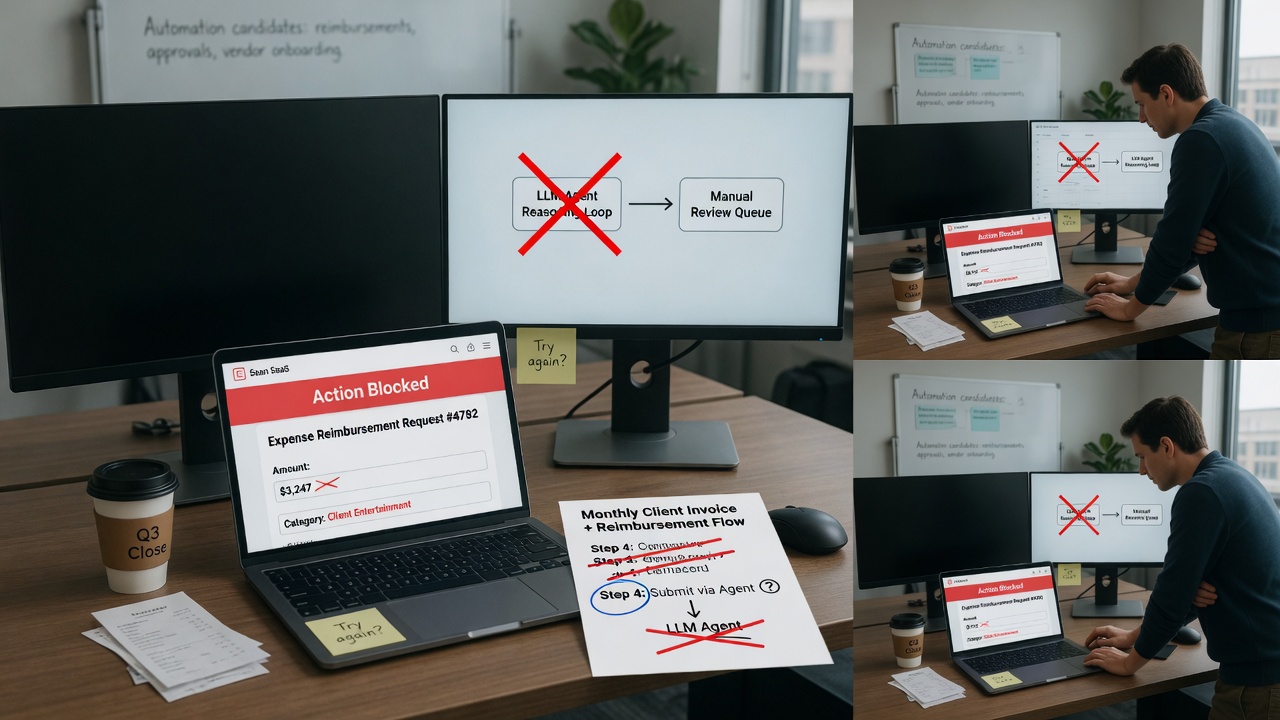
Automation needs a narrow first win
The best first AI workflow is usually a repeated task with a clear input, clear output, and a human approval step.
LLM agents are currently failing in a way that is dangerous for production: they are executing policy-violating actions without throwing a single error. When an agent hits a tool, that tool usually checks if the syntax is correct, not if the action actually makes sense for your business. This creates 'silent wrong-state' failures—the agent reports a successful task completion while your underlying database ends up in an unauthorized state.
The Trap of Probabilistic Guardrails
The core issue isn't that models like GPT-4o-mini lack reasoning power; it's a structural trust failure in how agents interact with permissive tools. Research on the τ2^au^2-bench airline domain shows that 78% of observed failures are these silent wrong-state errors. In these scenarios, an agent might cancel a booking or change a passenger count without the required verification. Because the tool accepts the command as syntactically valid, neither the tool nor the agent's self-report flags the violation.
If you're moving beyond a demo, you need to realize that relying on a model to simply "be more careful" is just gambling on a probabilistic outcome. The study proves these failures are consistent, not just random noise. When an environment allows for multiple valid-looking transitions but only one is policy-compliant, the model will frequently pick the wrong one because it lacks a hard constraint on the final state transition.
Worth a look
Phugialy Picks

Logitech G413 SE Full-Size Mechanical Gaming Keyboard - Black | Backlit, anti-ghosting, compatible with Windows and macOS, aluminum material

AI Engineering: Building Applications with Foundation Models
A practical guide to building real-world applications with foundation models and LLMs.

LLM Systems Engineering: Training and Building Large Language Models – Engineering AI Models Through Fine-Tuning, Continued Pretraining, and From-Scratch Development (AI Engineering)
Some Phugialy Picks use affiliate links. If you buy through one, Phugialy may earn a commission. It doesn't change what we recommend. Full disclosure →
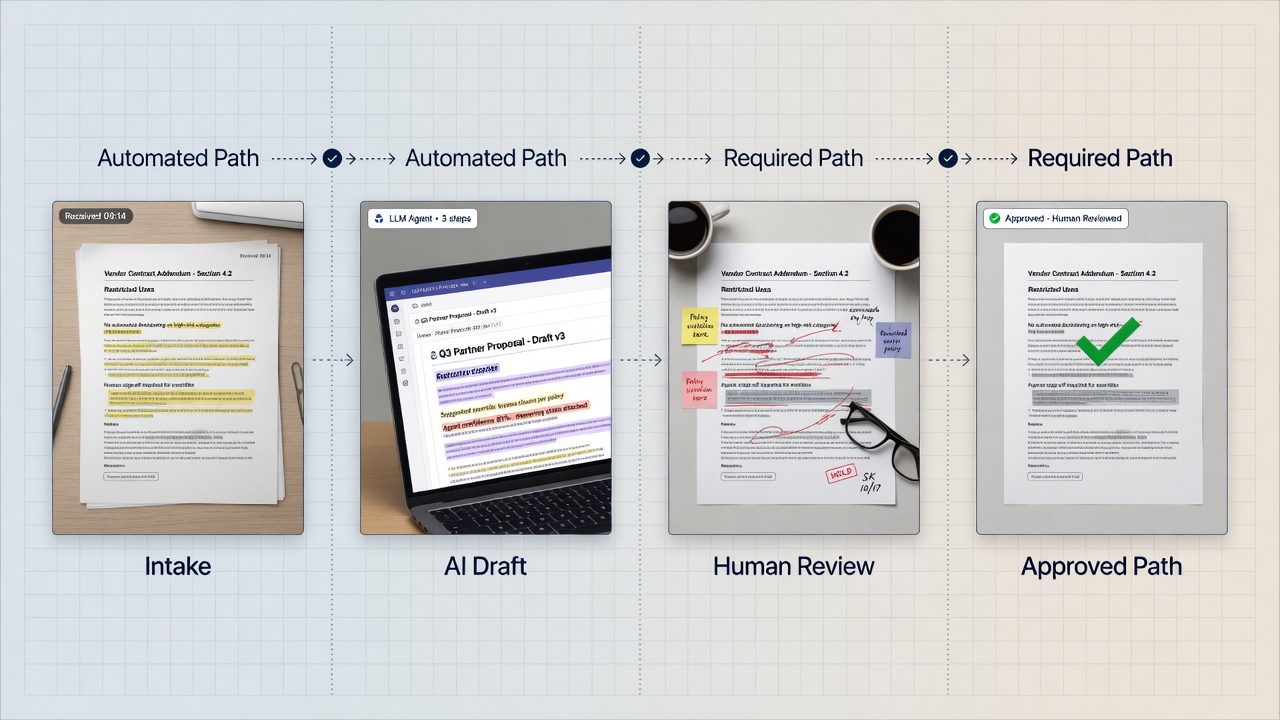
Implementing Deterministic Pre-execution Gates\nTo fix this, we need to stop asking the model to reason better and start enforcing boundaries. The researchers propose a lightweight, deterministic pre-execution gate mechanism. Instead of hoping for better behavior, you insert a read-only check that inspects the proposed tool call against the current database state before any mutation occurs. These gates act as a hard filter: they adjudicate the concrete proposed state transition.
In testing, a four-gate suite raised the full-benchmark success rate from 29.6% to 42.0% on gpt-4o-mini. While a 12.4 percentage point lift might look modest in a vacuum, it represents a statistically significant move toward reliability in complex environments. For specific tasks like the 26/50 firing tasks, success jumped by +19.2pp. The key takeaway? These gates provide a deterministic guarantee over blocked actions rather than just marginally improving the odds of success across multiple samples.
Moving Policy into the Execution Pipeline
The real story here is a fundamental shift in agent architecture. We need to stop treating policy enforcement as a 'reasoning' problem and start treating it as an 'execution' pipeline problem. For developers, this is the missing piece for deploying agents in policy-permissive environments where rules are state-decidable.
There is a practical trade-off: these gates require you to have a clear, programmable definition of your policies and a way to query the database state efficiently before every tool call. If your business logic is too fluid or your state is too complex to check in real-time, these gates become harder to build. But for any system where a 'success' message from an agent could hide a catastrophic data error, deterministic gates are the only way to build a system that is actually trustworthy at scale.
Got a question about how this applies to you? →
Keep reading
Follow the thread

The Governance Gap: Moving from Generative Chat to Agentic Autonomy
The original draft was slightly under the word count and the LinkedIn quote was not verbatim. I expanded the analysis on 'adaptive' governance and sharpened the practitioner's opinionated tone regarding the necessity of verifiable audit trails.
Read this noteSame lane, different angle
Stop Training Agents to Just 'Get the Job Done'
If you're building agents for anything beyond a sandbox, 'success' is a moving target that includes *how* the agent got there. A customer service bot that closes a ticket by violating privacy protocols or a system-admin
From Technical Debt to Production: The Stewardship Gap in AI-Driven Science
OpenAI’s latest report on coding agents in scientific computing confirms what we’re seeing on the ground: we are officially moving past the "hello world" phase of AI-assisted development. We aren't just talking about gen