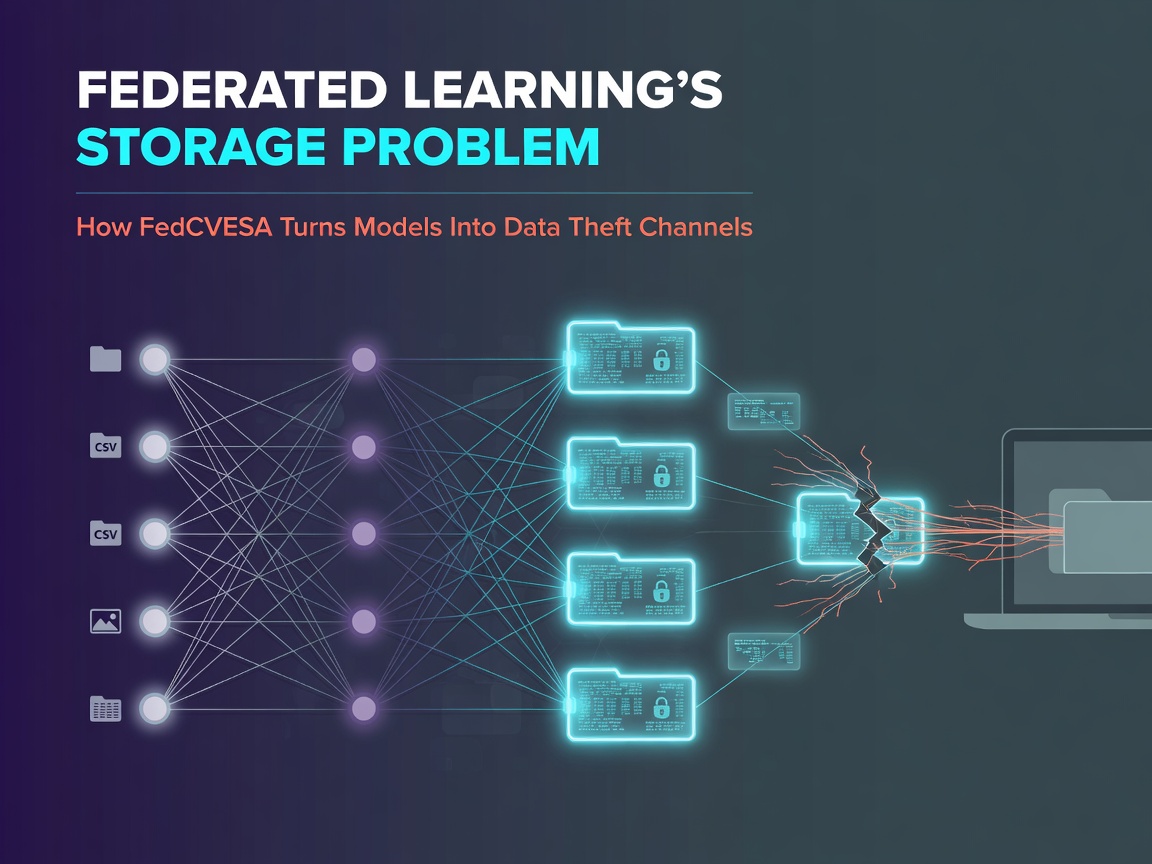
Federated Learning’s Storage Problem: How FedCVESA Turns Models Into Data Theft Channels
If we're just swapping one storage risk for another, the whole 'privacy-first' pitch for Federated Learning starts to look like a marketing trick.
Automation needs a narrow first win
The best first AI workflow is usually a repeated task with a clear input, clear output, and a human approval step.
Federated learning (FL) is the darling of privacy-sensitive industries like healthcare and finance. The pitch is simple: keep raw data on the device, share only the updates. But FedCVESA proves that this architecture doesn't eliminate risk; it just moves the goalposts. We need to stop looking for accidental leaks and start worrying about active "Taking Away Training Data" (TATD) attacks, where a malicious server deliberately forces a model to memorize and store specific private samples.
Moving From Passive Leakage to Active Theft
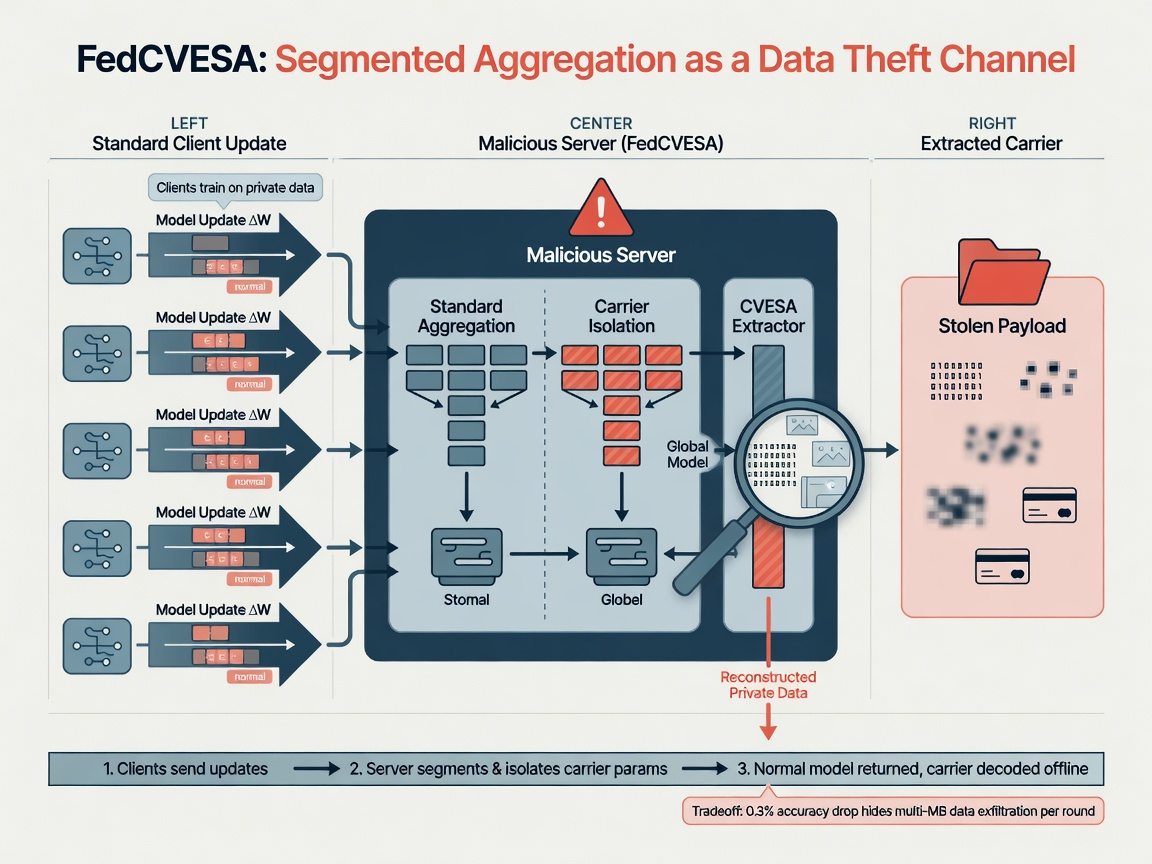
Most existing privacy research in FL focuses on gradient inversion—where an attacker is a passive observer trying to reconstruct whatever information the gradients already expose. FedCVESA shifts the focus from observation to active manipulation. It builds on the Correlation Value Encoding Attack (CVEA), which uses a Pearson-correlation regularizer to write data into specific "carrier parameters" within the model.
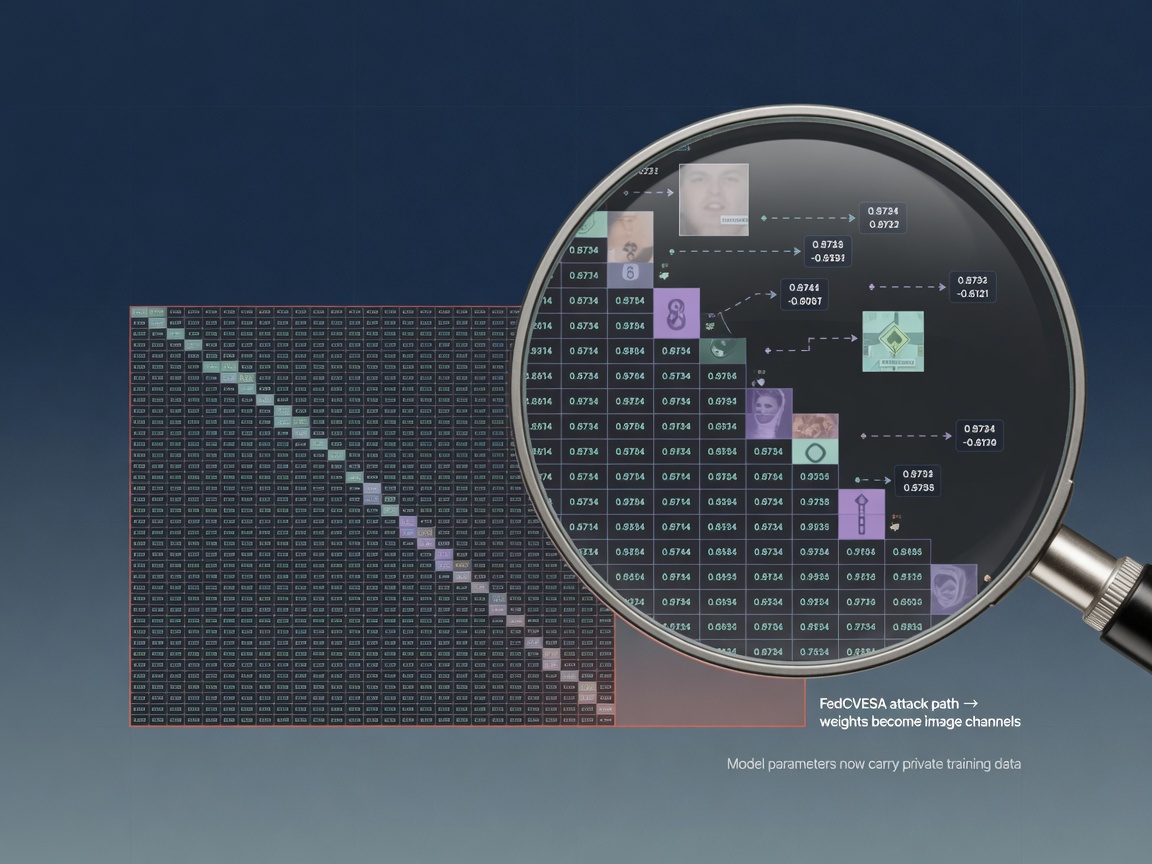
This isn't just a side effect of over-fitting. The attacker is actively using the model’s memorization capacity as a storage channel. By modifying the local optimization objective on target clients, the malicious server can ensure that private training data is gradually encoded into a subset of the global model's weights. The goal isn't just to see if a model can remember data, but to force it to store concrete training points while maintaining the model's utility for its intended task.
Worth a look
Phugialy Picks

AI Engineering: Building Applications with Foundation Models
A practical guide to building real-world applications with foundation models and LLMs.

GMKtec K15 AI Mini PC Oculink Intel Ultra 5 125U 32GB DDR5 512GB SSD | Desktop Computer AI Boost, 3X M.2 2280 Storage Expansion, Dual NIC...

GEEKOM IT15 AI Mini PC, Intel Ultra 9 285H(99 Tops), 32GB DDR5, 1TB SSD | The Most Powerful Workstation,Arc 140T GPU,WiFi 7,8K Business D...
Some Phugialy Picks use affiliate links. If you buy through one, Phugialy may earn a commission. It doesn't change what we recommend. Full disclosure →
Bypassing the Aggregation Shield
The primary hurdle for this type of attack in a federated setting is the aggregation process. In standard FL, multiple clients submit updates that are averaged together. This mixing usually overwrites the specific weight patterns used to store stolen data, effectively "washing away" the theft.
FedCVESA addresses this with a segmented aggregation scheme. Instead of a blanket average, the server performs standard averaging on most parameters but preserves the specific carrier parameters used for the attack. This allows the server to maintain the integrity of the encoded data from target clients while incorporating updates from the rest of the pool. It's a surgical approach to parameter manipulation that ensures the stolen data remains retrievable even after the global model is updated.
The Practicality Gap in Production
While the results on MNIST and CIFAR-10 are technically sound, we have to be realistic about production deployment. The paper establishes a white-box proof-of-concept where the server has significant control over target clients. In a production environment with thousands of heterogeneous clients, the "signal" of the stolen data might get lost in the noise of legitimate updates, even with segmented aggregation.
The real story here is that federated learning isn't a "set it and forget it" privacy solution. It introduces a new class of vulnerability where the model itself becomes a liability. If we don't account for the fact that model parameters can be weaponized as storage channels, we’re just moving the data from one vulnerable location to another. The focus needs to shift from just protecting the transmission of gradients to auditing what the global model is actually being "asked" to remember during the training process.
Got a question about how this applies to you? →
Keep reading
Follow the thread

The Structural Failure of AI Trust: How Document-Borne Worms Bypass Model Upgrades
Microsoft Copilot is being weaponized in a way that feels like a regression to early malware concepts, but with a modern, AI-driven twist. Researchers have identified a vulnerability where hidden instructions in shared d
Read this noteSame lane, different angle
From 'No Entry' to 'Guest List': How Cloudflare is Giving Creators the Remote Control
For a long time, web owners have been stuck in a frustrating digital stalemate. You either let the bots in and watch your unique content get scraped into a black box, or you build a fortress so high that you accidentally
Scaling Urban Carbon Prediction: How CarbonCLIP Bridges the Satellite-to-Street Gap
CarbonCLIP uses multimodal distillation to predict urban carbon emissions using only satellite imagery. By bridging the gap between top-down views and ground-level activity during pretraining, it offers a scalable way to model emissions across diverse cities.