Scaling Agentic Workflows: How EvoSOP Turns Agent Experience into Reusable SOPs
The draft was already strong, but I tightened the 'Builder' persona by making the prose more direct and punchy. I enhanced the perspective section to more clearly frame the 'fluke vs. pattern' distinction as a core engineering challenge.
Automation needs a narrow first win
The best first AI workflow is usually a repeated task with a clear input, clear output, and a human approval step.
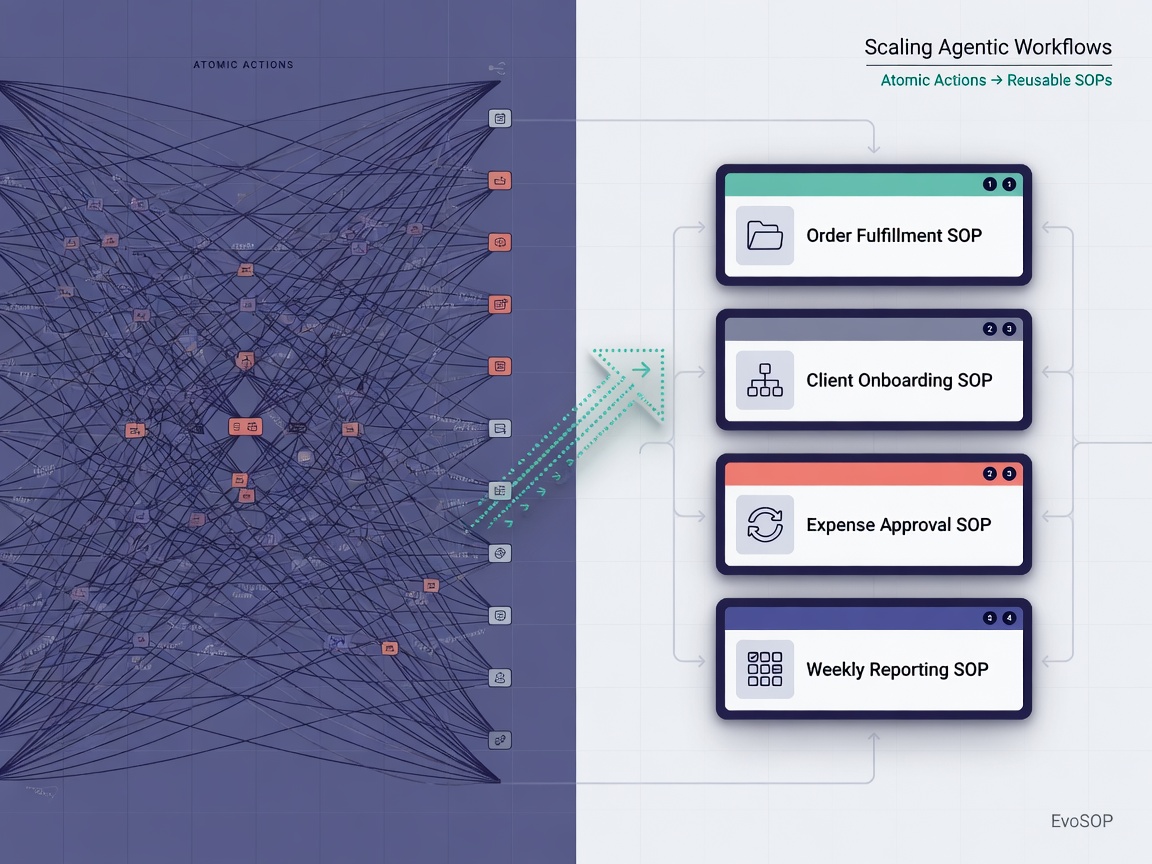
The bottleneck in LLM agents isn't just the model's IQ; it's the friction of tool interaction. When you hand an agent a pile of atomic, single-step functions, you're forcing it to do heavy lifting on every intermediate step. This creates massive reasoning overhead and invites "cascading errors"—where one tiny slip-up at step 2 ruins the output at step 20. EvoSOP fixes this by letting agents synthesize those atomic actions into reusable Standard Operating Procedures (SOPs). We're talking about higher-order tools that encapsulate multi-step logic into a single, reliable call.
Moving Beyond Static Toolsets
Most agent frameworks are stuck with static toolsets. That works for "tell me a joke," but it breaks down for long-horizon tasks. Every time an agent has to decide "what's next" at a granular level, it burns tokens and risks losing the thread. EvoSOP suggests that without these abstractions, agents fail because they can't "remember" successful multi-step sequences. By treating a sequence of actions as a single tool, you flatten the reasoning depth. Instead of navigating a maze of tiny steps, the agent jumps from high-level goals to executed outcomes. It’s the difference between teaching someone to cook by explaining every single micro-movement versus giving them a recipe.
Worth a look
Phugialy Picks

AI Engineering: Building Applications with Foundation Models
A practical guide to building real-world applications with foundation models and LLMs.

Claude Code Mastery: Build Production-Ready Agentic AI Systems Faster with MCP, Multi-Agent Workflows, Security Patterns, and Real Projects

Anker Laptop Docking Station Dual Monitor, 8-in-1 USB C Hub with 4K HDMI
Some Phugialy Picks use affiliate links. If you buy through one, Phugialy may earn a commission. It doesn't change what we recommend. Full disclosure →
The Engineering Loop: Construction, Merging, and Pruning
EvoSOP is model-agnostic—it doesn't need to retrain your LLM. Instead, it builds a continuous optimization loop for your toolset. It watches execution trajectories, identifies successful patterns, and "packages" them into new tools. Then comes the heavy lifting: a systematic lifecycle of construction, merging redundant routines, and pruning the junk. It actually mirrors the standard ML pipeline: data acquisition (trajectories), forward execution (trying the actions), and a conceptual "backward propagation" to optimize the toolset based on success. Your agent’s capabilities expand dynamically based on its own history, not just your initial dev work.
The Real Challenge: Quality Over Quantity
The real story here is the shift from manual prompt engineering to architectural automation. For builders, the win isn't just that an agent can "learn" a new SOP; it’s the systematic pruning of the toolset. A bloated toolset is a liability—it’s a noisy environment where the model is more likely to grab the wrong hammer. EvoSOP keeps the agent's "vocabulary" lean. But here’s the catch: in messy production environments, a "successful" trajectory might be a fluke. If the framework synthesizes an SOP from a one-off outlier that doesn't generalize, you end up with brittle tools. The engineering challenge isn't just building the framework; it's defining the boundaries of what actually qualifies as a "reusable" routine versus a lucky guess.
Got a question about how this applies to you? →
Keep reading
Follow the thread
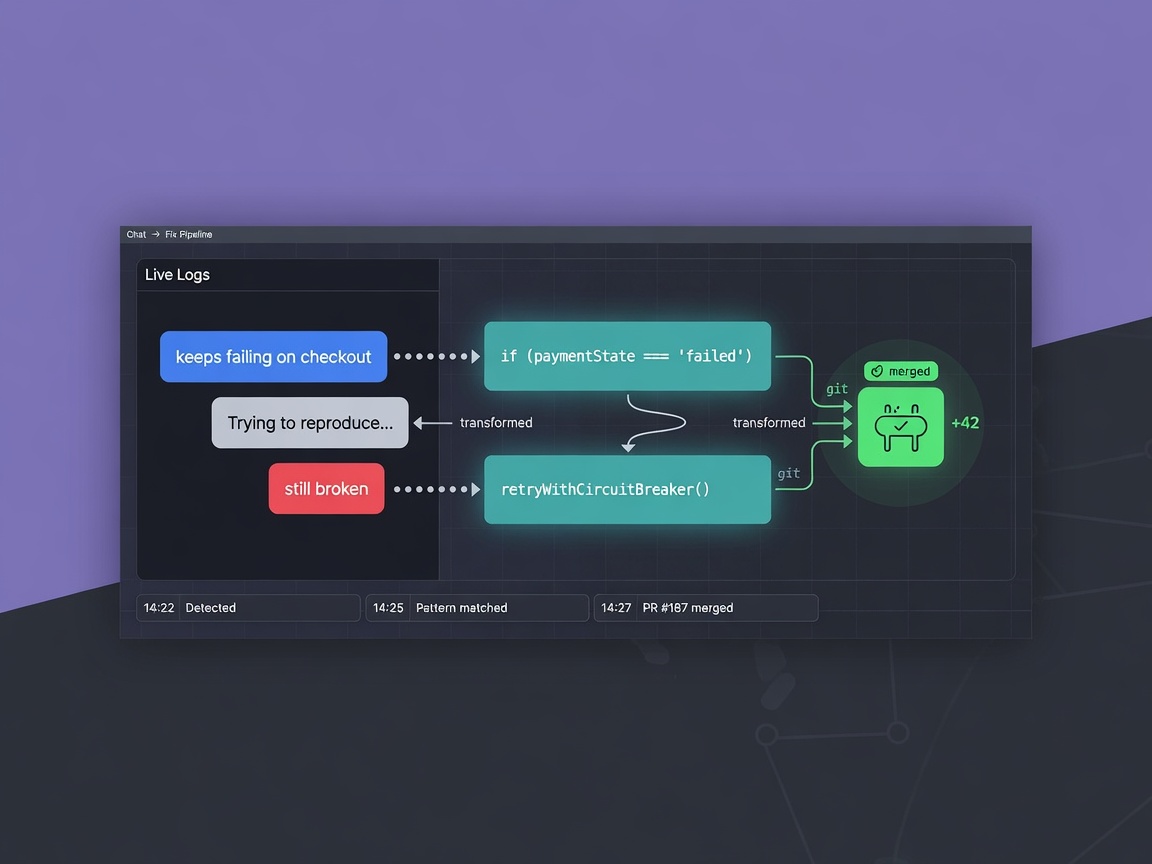
From Silent Failures to Seamless Fixes: Turning Your Chat Logs into a Product Superpower
Stop looking at your production chat and voice logs as a graveyard of past interactions—start treating them like a live, high-velocity R&D lab. Every time a user repeats a question, hits a wall, or sighs in frustration,
Read this noteSame lane, different angle
Stop Guessing: How Agnost AI Turns 'Silent' Agent Frustrations into Your Next Big Feature
What if your AI agents could tell you exactly what features your customers are dreaming of before they even know how to ask? Agnost AI is turning "silent" user frustrations into a literal roadmap for your next release.
MirrorCode and the Reality of Long-Horizon AI Engineering
MirrorCode is testing if AI can actually build entire programs from scratch without cheating. It involves models running autonomously for up to 19 days to solve complex engineering tasks, but the results raise questions about what happens when that code hits a production environment.