RAG for Public Health QA: What Retrieval Actually Fixes
Smaller open-weight models can apparently match larger ones on public health questions — as long as retrieval quality is high enough. A new RAG evaluation makes that case carefully, but its own judge-agreement data shows where the claim gets thin.

Automation needs a narrow first win
The best first AI workflow is usually a repeated task with a clear input, clear output, and a human approval step.
A study of retrieval-augmented generation on UK public health guidance claims smaller models can match larger ones — but that claim only holds when retrieval quality is already high, which is exactly the condition most real deployments can't guarantee.
The research, posted on arXiv, evaluates RAG systems built on official UK Government public health guidance, using 7,929 questions derived from that corpus. The core findings are straightforward: hybrid retrieval consistently improves recall and ranking quality across multiple embedding models and corpus variants, and providing retrieved context substantially increases multiple-choice accuracy across a diverse set of LLMs. With retrieval quality high enough, smaller open-weight models match or outperform larger models running without retrieval.
What the Evaluation Actually Covers
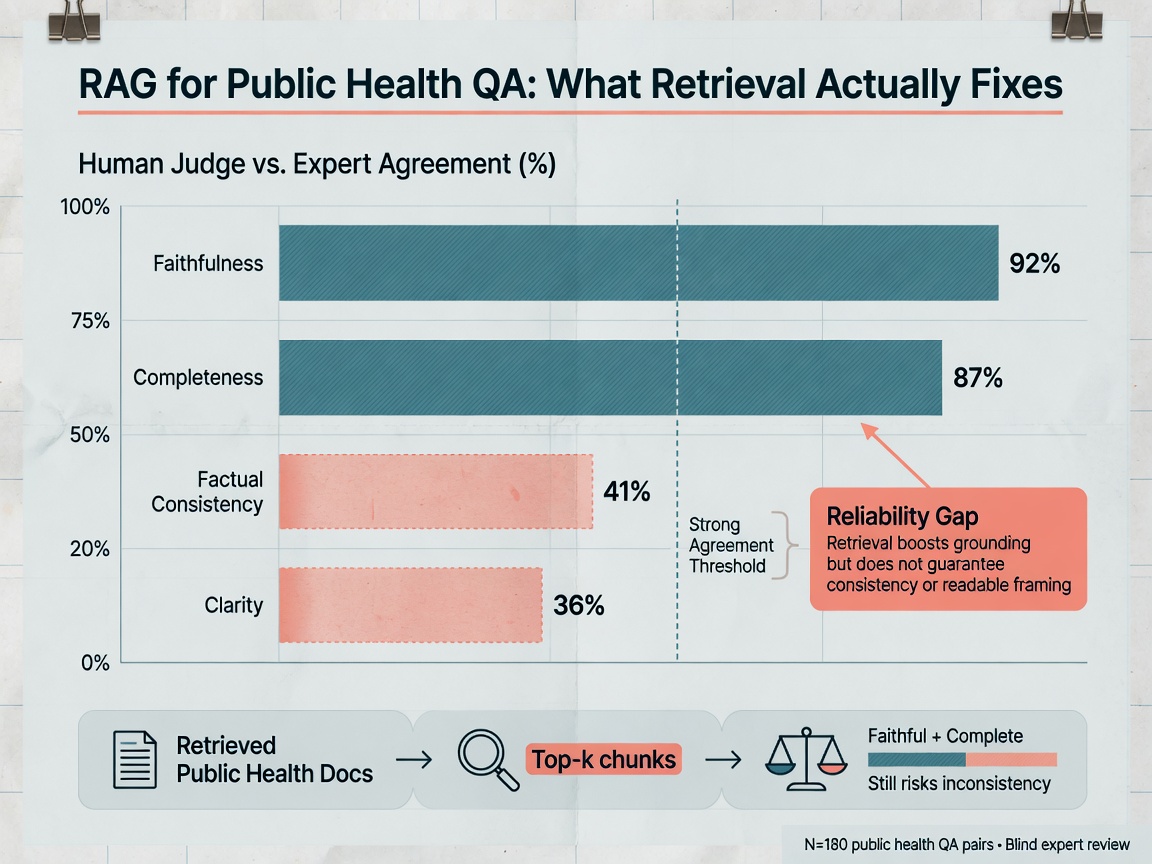
The methodology is more careful than most RAG write-ups. The researchers used rubric-based LLM-as-a-judge to assess faithfulness, completeness, clarity, and factual consistency, validated against dual human annotations. That's a real check, not a vibe score.
But the judge-human agreement results deserve more attention than they've gotten: agreement is strongest for faithfulness and completeness, while factual consistency and clarity are less reliably reproduced. In other words, the automated judge is most trustworthy on exactly the dimensions least likely to catch a subtle factual error in health guidance — and least trustworthy on the dimension where an error would matter most. For a domain like public health, that's not a footnote; it's the constraint the whole result sits inside.
Worth a look
Phugialy Picks

AI Engineering: Building Applications with Foundation Models
A practical guide to building real-world applications with foundation models and LLMs.

GMKtec K15 AI Mini PC Oculink Intel Ultra 5 125U 32GB DDR5 512GB SSD | Desktop Computer AI Boost, 3X M.2 2280 Storage Expansion, Dual NIC...

AI: Understand the Revolution: From Basics and Buzzwords to Tech Giants, Governments, and Your Future
Some Phugialy Picks use affiliate links. If you buy through one, Phugialy may earn a commission. It doesn't change what we recommend. Full disclosure →
The Claim Worth Making — And the One That Isn't
The defensible claim here is narrower than "RAG solves hallucinations for public health QA." What's actually shown is that hybrid retrieval improves recall and ranking consistently across model and corpus variants — that's an architecture-level result about retrieval itself, and it holds up well under scrutiny. The stronger inference — that small models plus good retrieval equals large models — depends entirely on retrieval quality being high. Nobody deploying this in production knows in advance whether their corpus will support that quality; the study tells you what happens when it does, not what happens when it doesn't.
What this actually points to is a shift in where the engineering burden sits: from model selection to corpus construction and retrieval tuning. If smaller open-weight models can compete under high-quality retrieval, then the differentiator isn't the LLM at all — it's how well your guidance documents are structured, indexed, and refreshed as policy changes. That reframing matters for anyone budgeting an AI project in a regulated domain: money spent on retrieval infrastructure likely buys more reliability than money spent on a bigger model.
It also connects to a broader pattern I keep seeing: fixes that don't eliminate a risk so much as relocate it. RAG reduces hallucination risk by grounding answers in retrieved documents — but it moves failure modes into retrieval quality and judge reliability instead. The study is honest enough to show that seam; most coverage of work like this isn't.
Got a question about how this applies to you? →
For another angle on how AI systems shift rather than remove risk in public-facing services, see "Triage as a Filter: New Orleans' Move to AI-Managed 911 Routing."
Keep reading
Follow the thread

When Hallucinations Help: Rethinking Vision Model Accuracy
Hallucinated captions made vision language models *more* accurate across nine tasks in a new evaluation study - and the practical question isn't whether that's weird, it's whether you can trust any multimodal output you'
Read this noteSame lane, different angle
AI Tutors Work Only If Students Use Them: Trial
A two-year trial across 18 middle schools found Khan Academy's AI tutor raised math scores modestly - but here's the catch: the gains looked just like those from practice without any AI at all. The real story isn't whether AI tutoring works; it's that 96% of students tried it and almost none used it when they actually needed help.
Spectral Attacks Reveal a Hidden Weak Spot in Vision-Language Models
Researchers found a way to attack vision-language models using the model's own internal geometry — aligning representations with the subspaces the model cares about least. It beats existing baselines, and the same insight could make these models tougher.