Owning AI Capacity vs Consumption Pricing: When It Pays
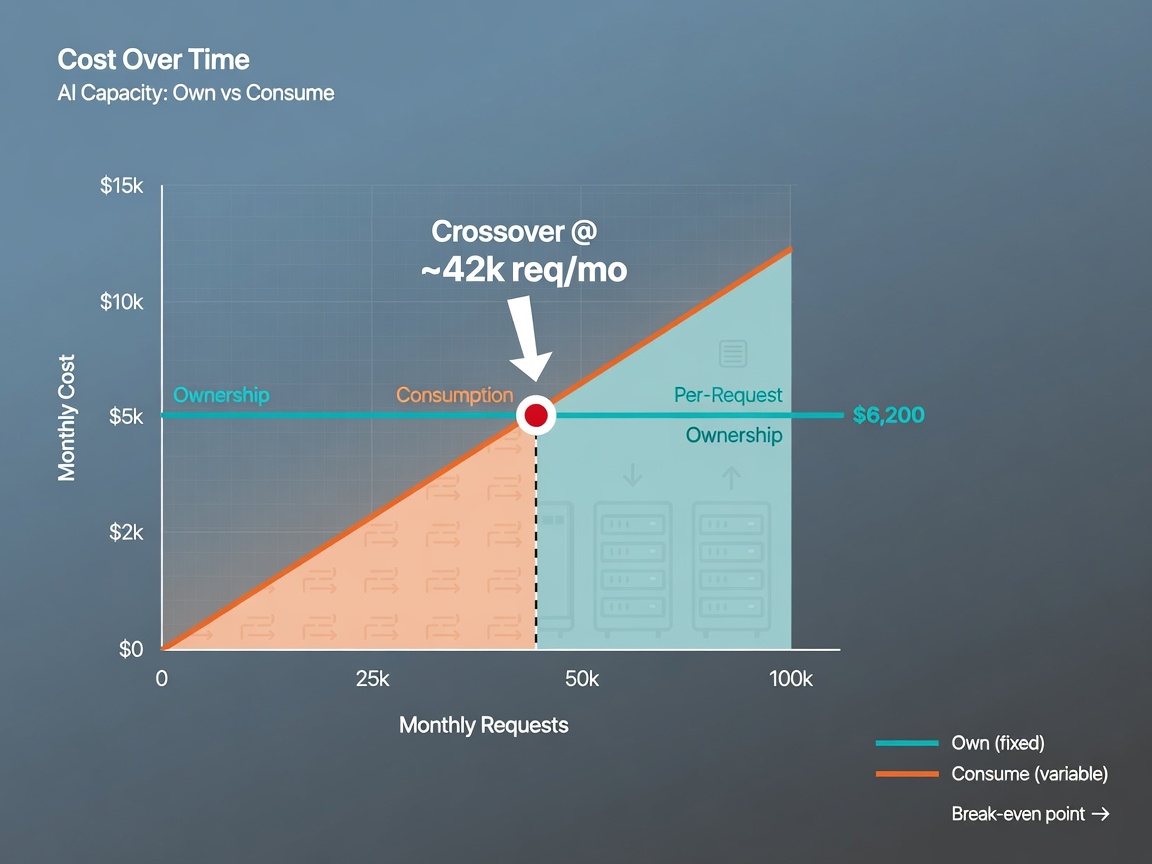
Every organization has a crossover point where owning AI capacity becomes cheaper than paying per request — and there is no universal number for where that line sits. That's the core claim of a recent analysis on AI econ
Automation needs a narrow first win
The best first AI workflow is usually a repeated task with a clear input, clear output, and a human approval step.
Every organization has a crossover point where owning AI capacity becomes cheaper than paying per request — and there is no universal number for where that line sits. That's the core claim of a recent analysis on AI economics, and it's a useful corrective to the default assumption that consumption pricing is always the safe choice.
Why Token Prices Are Only Half The Math
The article's argument is that model choice and token prices are only part of AI economics. What actually changes the calculus is steady, business-critical demand. Once AI moves from experimentation into a production portfolio, the question stops being "what does a token cost" and becomes "how many tokens am I reliably burning every day."
The data points to that shift happening fast. Deloitte's 2026 State of AI in the Enterprise found worker access to AI rose 5% in 2025, and companies with at least 40% of their AI projects in production are expected to double within six months. Over the next 12 to 18 months, a lot of organizations are going to be staring at predictable, sustained workloads — exactly the condition where per-request pricing stops making sense.
Worth a look
Phugialy Picks

AI Engineering: Building Applications with Foundation Models
A practical guide to building real-world applications with foundation models and LLMs.

GMKtec K15 AI Mini PC Oculink Intel Ultra 5 125U 32GB DDR5 512GB SSD | Desktop Computer AI Boost, 3X M.2 2280 Storage Expansion, Dual NIC...

Agentic AI Engineering: Systems That Reason and Act Autonomously – Designing, Building, and Prompting LLM-Based Agents for Real-World Deployment
Some Phugialy Picks use affiliate links. If you buy through one, Phugialy may earn a commission. It doesn't change what we recommend. Full disclosure →
Owning Capacity Only Pays If You Keep It Busy
Here's the part worth underlining: ownership is not automatically the lower-cost answer. The analysis is explicit that it only makes sense when an enterprise can keep capacity productive. That means utilization stays high, and an operating model covers adoption, governance, utilization review, and continued use-case expansion.
My read on this: it's the same trap as buying hardware you sized for peak week and running at idle every other day. The crossover math only works if you have enough real work to fill what you bought — and most teams overestimate their sustained load because they benchmark on clean examples instead of messy production traffic.
Why Generic Benchmarks Will Mislead You Here
The article makes a point I'd flag as the most practically important one: retrieval-heavy systems and agentic workflows have very different cost profiles, so generic benchmarks are insufficient. If you're trying to decide whether owning capacity beats consumption pricing for your stack, someone else's aggregate numbers tell you almost nothing. You have to model your actual workloads.
That's annoying but honest advice. A retrieval pipeline hammering embeddings against a large corpus all day has a completely different demand curve than an agent that fires off bursts of reasoning calls when users poke it. Averaging those together gives you a number that matches neither.
The Three Questions Before Committing Capital
Leaders are advised to model actual workloads and ask three questions before committing capital — the source doesn't spell them out in what I'm working from, but the shape is clear from its framing: Is demand sustained enough to justify ownership? Can we keep utilization high? Do we have an operating model that keeps workloads productive?
The line from the analysis that sticks: "That is when AI stops being an expense and becomes an asset." I'd temper it slightly — it becomes an asset only if someone owns utilization review after month three. The interesting question isn't whether the crossover math works on a spreadsheet; it's whether your workload six months in still looks like the workload you modeled.
Got a question about how this applies to you? →
Keep reading
Follow the thread

Why Advanced Materials Are AI Infrastructure's Next Bottleneck
The constraint on AI's next phase isn't compute or capital - it's whether the physical materials underneath data centers can keep up. That's the argument Syensqo CTO Mike Finelli makes in a recent MIT Technology Review p
Read this noteSame lane, different angle
AI Regulation Now Depends on the Companies It Regulates
The most uncomfortable line in a recent analysis on AI's institutional power: a government may end up trying to regulate an AI provider whose technology it simultaneously depends on. That's the vendor lock-in problem every developer knows, scaled until the dependent party writes the rules — and with a footprint of more than a billion devices, the dependency is already shipping.
Architecting AI Inference Infrastructure for Data Movement
Moving data from one place to another and making sure we can use it effectively is the primary technical hurdle in modern AI deployments. While training models captures the spotlight, the shift toward AI inference infras