JuZhou 1.0: A Lightweight Text-to-Image Model That Runs on Your Phone
A text-to-image model small enough to run entirely on your phone just outscored models several times its size - and it does it with no cloud connection at all.
Automation needs a narrow first win
The best first AI workflow is usually a repeated task with a clear input, clear output, and a human approval step.
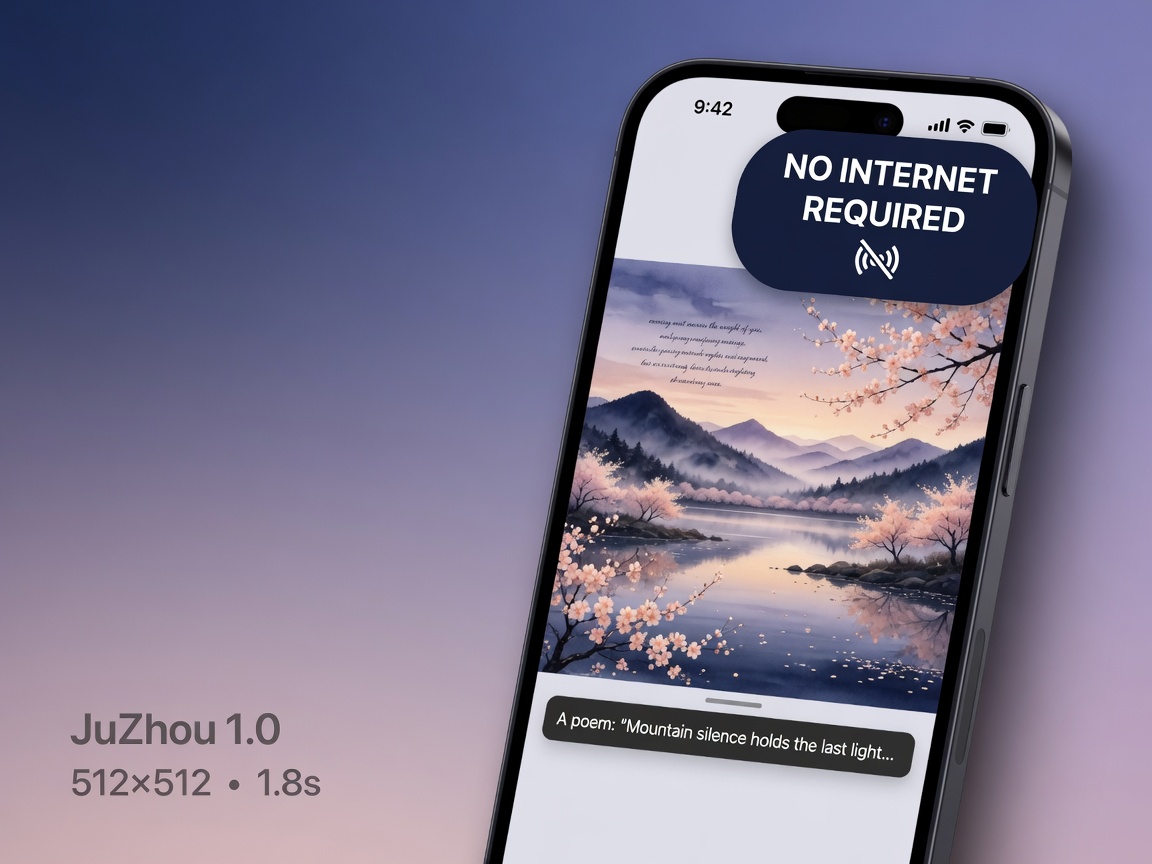
Imagine generating an image from a poem - in Chinese - entirely offline, on the phone in your pocket, in under five seconds. That's not a concept demo. That's what JuZhou 1.0 actually does.
The more interesting part isn't the speed itself - it's what full offline capability unlocks: image generation that works on a plane, in a dead zone, in privacy-sensitive settings, anywhere at all, with no API bill and no data leaving the device.
What Makes This Lightweight Text-to-Image Model So Small
JuZhou 1.0 is built for edge deployment from the ground up. Its denoising U-Net packs just 0.385B parameters, paired with an ultra-compact distilled decoder of only 1.90M parameters - roughly 0.387B total.
Two training tricks make it fast at inference: Rectified Flow training combined with DMD2 distillation cuts generation down to just 4 sampling steps. Fewer steps means less compute per image, which is exactly what you need when your GPU is also busy running your camera and your apps.
There's also a deliberate language angle here: the model was trained on Chinese semantic alignment using 9 million curated image-text pairs, so you can prompt directly in Chinese without translation gymnastics.
Worth a look
Phugialy Picks

AI Engineering: Building Applications with Foundation Models
A practical guide to building real-world applications with foundation models and LLMs.

GMKtec K15 AI Mini PC Oculink Intel Ultra 5 125U 32GB DDR5 512GB SSD | Desktop Computer AI Boost, 3X M.2 2280 Storage Expansion, Dual NIC...

Agentic AI Engineering: Systems That Reason and Act Autonomously – Designing, Building, and Prompting LLM-Based Agents for Real-World Deployment
Some Phugialy Picks use affiliate links. If you buy through one, Phugialy may earn a commission. It doesn't change what we recommend. Full disclosure →
The Numbers That Should Raise Some Eyebrows
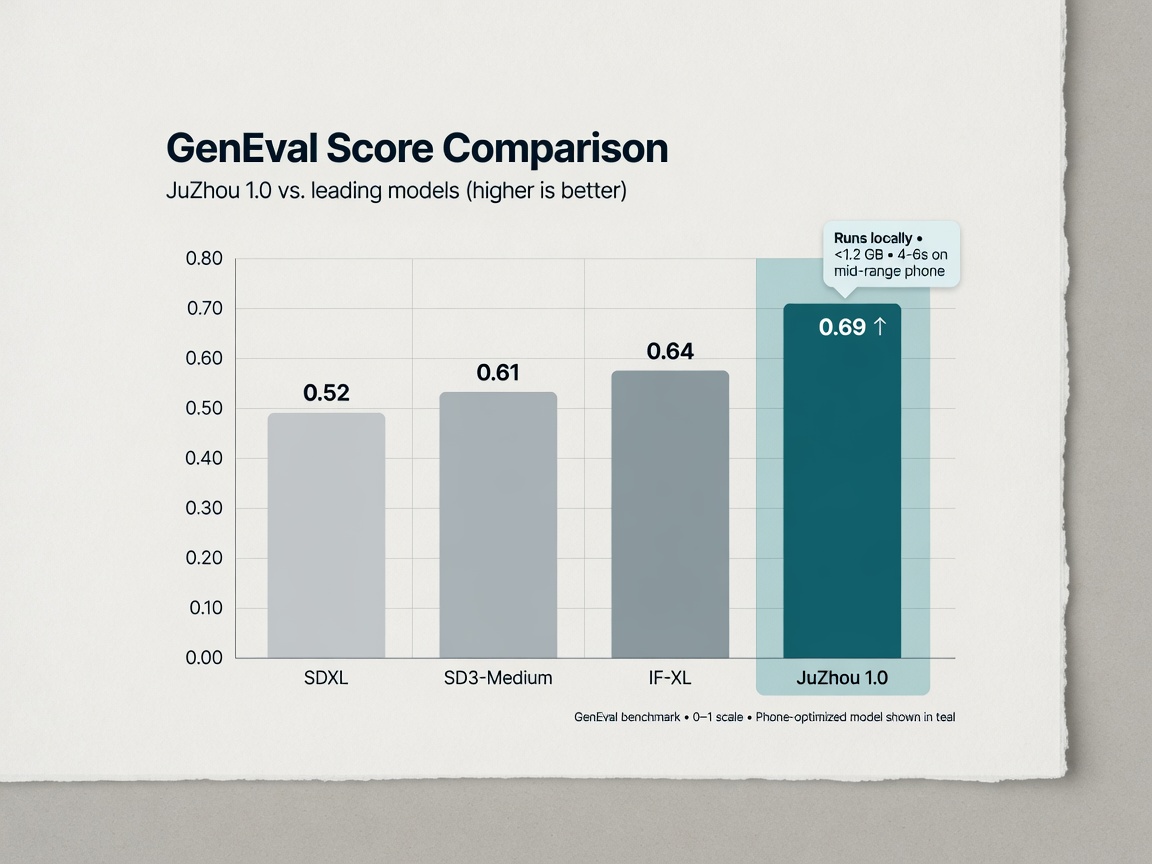
Here's where it gets fun. Despite being tiny, JuZhou scores 0.69 on GenEval - beating SDXL (2.6B parameters, scoring 0.55), SD3-Medium (2B, scoring 0.62), and IF-XL (4.3B, scoring 0.61). A fraction-of-a-billion-parameter model outperforming models many times its size on this benchmark is the kind of result that makes you rethink assumptions about how big these models need to be.
And the practical numbers hold up too: the CLIP-U-Net-VAE generation branch runs in approximately 1.6 seconds on the Snapdragon 8 Elite Gen 5 Mobile Platform, and the full poetry-to-image pipeline - including on-device prompt refinement - completes in about 4.5 seconds on Android (tested on a Xiaomi Pro Max-class flagship).
The Quietly Bigger Story: No NVIDIA Required
One detail deserves more attention than it's getting: this model was trained entirely on domestically developed Sugon K100 AI accelerators - no NVIDIA GPUs involved.
My read (and this is interpretation, not stated fact from the paper): that's arguably as significant as the benchmark score. If competitive image models can be trained without access to NVIDIA hardware, the supply-chain constraints that have quietly shaped who can build frontier-quality generative models start to look less like walls and more like fences someone found the gate to.
Give this approach a year or two of iteration and plausible follow-ons include offline creative tools baked into everyday apps - translation-free Chinese prompting for artists and hobbyists who've been underserved by English-first models - all running locally.
The takeaway isn't that big models are obsolete; it's that small models are getting good enough to live where you are instead of where the datacenter is.

Got a question about how this applies to you? →
Keep reading
Follow the thread
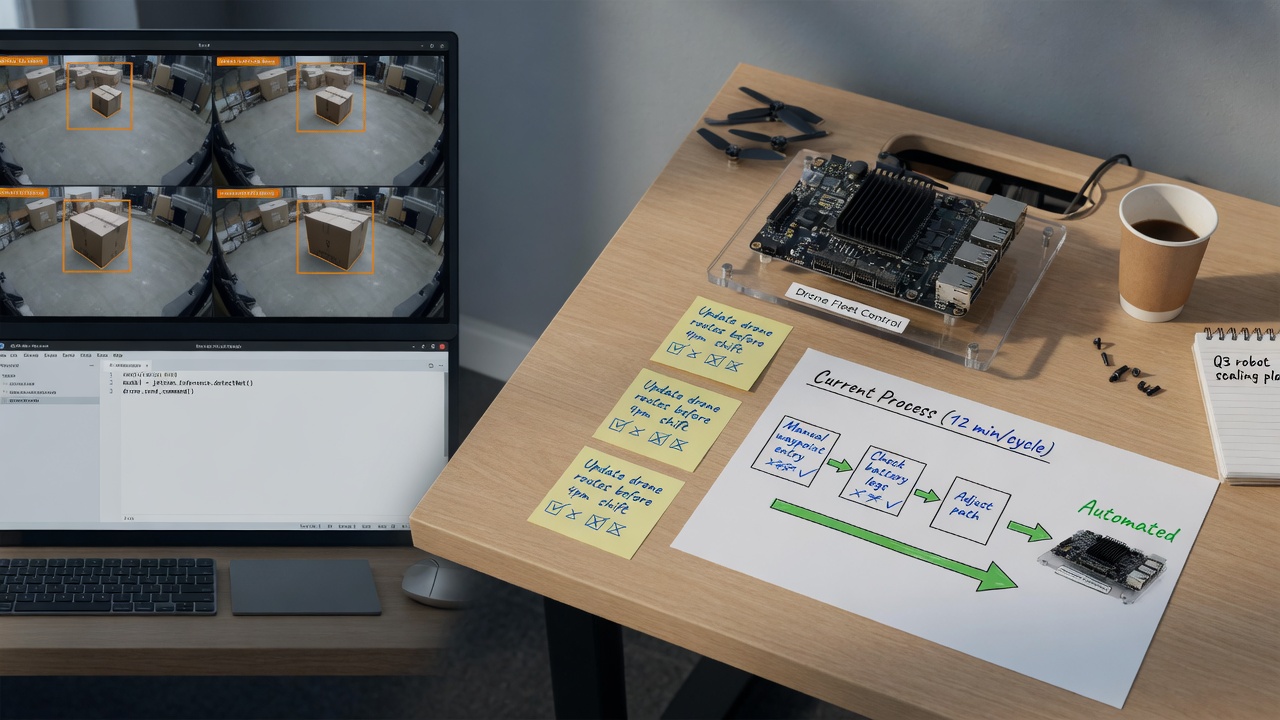
Jetson Orin Nano 2: Edge AI For Drones And Robots
NVIDIA has launched the Jetson Orin Nano 2, an entry-level edge robotics computer built to run generative AI models directly on drones, robots, and vision systems instead of in a data center. The headline spec: twice the
Read this noteSame lane, different angle
AI Tutors Work Only If Students Use Them: Trial
A two-year trial across 18 middle schools found Khan Academy's AI tutor raised math scores modestly - but here's the catch: the gains looked just like those from practice without any AI at all. The real story isn't whether AI tutoring works; it's that 96% of students tried it and almost none used it when they actually needed help.
Spectral Attacks Reveal a Hidden Weak Spot in Vision-Language Models
Researchers found a way to attack vision-language models using the model's own internal geometry — aligning representations with the subspaces the model cares about least. It beats existing baselines, and the same insight could make these models tougher.