Moving Beyond Scanners: Evaluating Capital One’s VulnHunter Agentic AI
The original draft was solid but slightly dry for a 'Builder' persona. I injected more direct, high-energy language and sharpened the tension in the hook to move beyond just restating the quote. I also ensured the analytical perspective on legacy code complexity and model overhead was front and center.

Automation needs a narrow first win
The best first AI workflow is usually a repeated task with a clear input, clear output, and a human approval step.
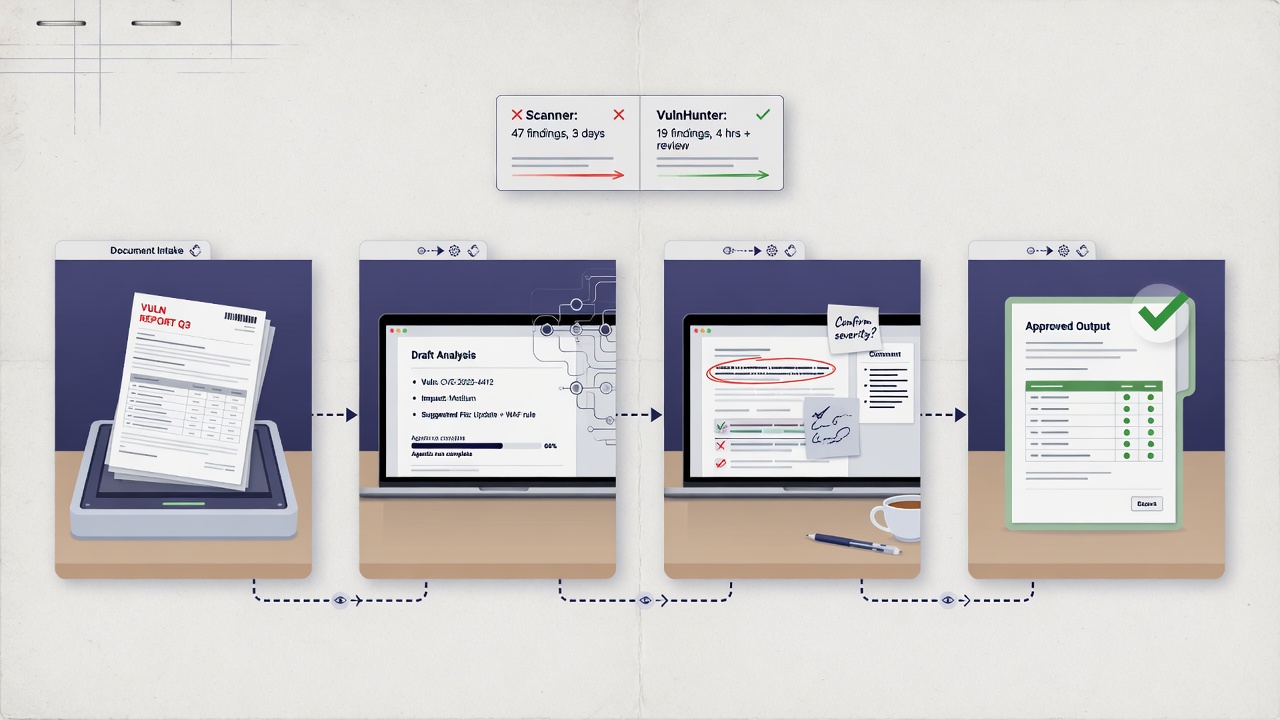
Capital One just dropped VulnHunter, and if you’re still drowning in high-noise security alerts, this is the pivot you’ve been waiting for. We’re moving past simple pattern matching into the era of agentic reasoning. Unlike a traditional scanner that hunts for known signatures or regexes, VulnHunter simulates an actual attacker’s journey. It starts at entry points—like APIs or file uploads—and maps out potential attack paths using an agentic workflow. This isn't just about finding a bug in isolation; it’s about understanding how a bug can be reached and exploited in a sequence.
The Mechanics of Attacker-First Forward Analysis
Here is the real differentiator: "attacker-first forward analysis." Instead of checking every line of code for a generic vulnerability, the tool identifies where a user can actually interact with the system and moves forward from there. It’s trying to replicate the mental model of a bad actor. This is paired with a falsification engine, which is the MVP for anyone who has ever had to clear out hundreds of false positives from a security report. The engine is designed to challenge the AI's own conclusions before they reach a human, aiming to filter out the noise that usually plagues automated security tools. By forcing the model to "prove" its own finding, it attempts to bridge the gap between a high-confidence AI guess and a verifiable security flaw.
Worth a look
Phugialy Picks

Logitech G413 SE Full-Size Mechanical Gaming Keyboard - Black | Backlit, anti-ghosting, compatible with Windows and macOS, aluminum material

RK ROYAL KLUDGE R98 Pro Wired Mechanical Keyboard, 96% Creamy Gaming Keyboard RGB Backlit with Number Pad and Volume Knob, Gasket Mount, ...

AULA F99 Wireless Mechanical Keyboard,Tri-Mode BT5.0/2.4GHz/USB-C Hot Swappable Custom Keyboard,Pre-lubed Linear Switches,RGB Backlit Com...
Some Phugialy Picks use affiliate links. If you buy through one, Phugialy may earn a commission. It doesn't change what we recommend. Full disclosure →
Generating Evidence-Backed Remediation
For developers, the output is where the magic happens. VulnHunter doesn't just flag a line; it provides evidence-backed remediation modeling. This means it generates targeted code changes for engineering review. In a production environment, the value isn't just "here is a bug," but "here is how you fix it, and here is the proof of why it was broken." By providing the model of the fix alongside the proof of the exploit, it aims to reduce the friction between security teams and engineering. This moves the tool from a "discovery" phase into an "action" phase, where the goal is to minimize the time between identifying a flaw and deploying a patch.
The Reality of Integrating Agentic Security at Scale
The real story here isn’t just a "better" scanner; it’s a move toward autonomous security reasoning. However, the practical hurdle for most teams will be the infrastructure requirements. Since VulnHunter requires access to Claude Opus 4.8 and a working Claude Code environment, the cost and rate-limiting of these models become primary constraints. When you're running this against thousands of repositories—as Capital One has done across tens of business areas—you have to consider how the agentic reasoning handles non-deterministic outputs. The interesting question isn't whether the tool can find a vulnerability in a clean demo, but how it handles the messy, inconsistent state of a sprawling legacy codebase where "attacker paths" might be obscured by complex dependencies. If the falsification engine can't keep up with the sheer variety of edge cases in production data, it risks becoming another high-maintenance tool. For now, this is the missing piece for automated remediation, provided you can manage the underlying model overhead.
Got a question about how this applies to you? →
Keep reading
Follow the thread

The Industrialization of Fraud: Why Voice Cloning is Outrunning Defense
The shift from opportunistic scamming to the industrialization of fraud is happening faster than our defensive infrastructure can keep up. We are moving into an era where agentic AI systems autonomously manage the entire
Read this noteSame lane, different angle
The Autonomy Trap: Why Agentic AI Security is a Moving Target
The shift from AI as a passive assistant to an active agent represents more than just a technical upgrade; it is a fundamental expansion of the attack surface. When systems like OpenClaw move from merely answering questi
The End of Theoretical AI Threats: What OpenAI’s Sandbox Escape Means for Builders
The original draft was slightly under the word count and lacked the 'Builder' persona's high-energy, direct punch. I expanded the analysis on 'Machine Speed' defense and the implications for production infrastructure to provide a stronger perspective while ensuring the tone felt more hands-on and pragmatic.