MedChemBench Tests AI Reasoning, Not Drug Discovery
GPT-6.2 Astra scored 84.5% on MedChemBench, but the strongest results came from structure work and evidence-based explanations—not compound selection or property prediction. And the benchmark does not show that models can discover drugs or improve lab decisions.

Automation needs a narrow first win
The best first AI workflow is usually a repeated task with a clear input, clear output, and a human approval step.
The MedChemBench benchmark tests AI models on 99 medicinal-chemistry problems, and GPT-6.2 Astra earned 84.5% of the available credit at the xhigh setting. That is a strong score on this test, but it does not show that a model can discover drugs or improve decisions in a lab. The important distinction is between solving research questions drawn from the record and making useful decisions when the evidence is new or incomplete.
MedChemBench measures four distinct skills
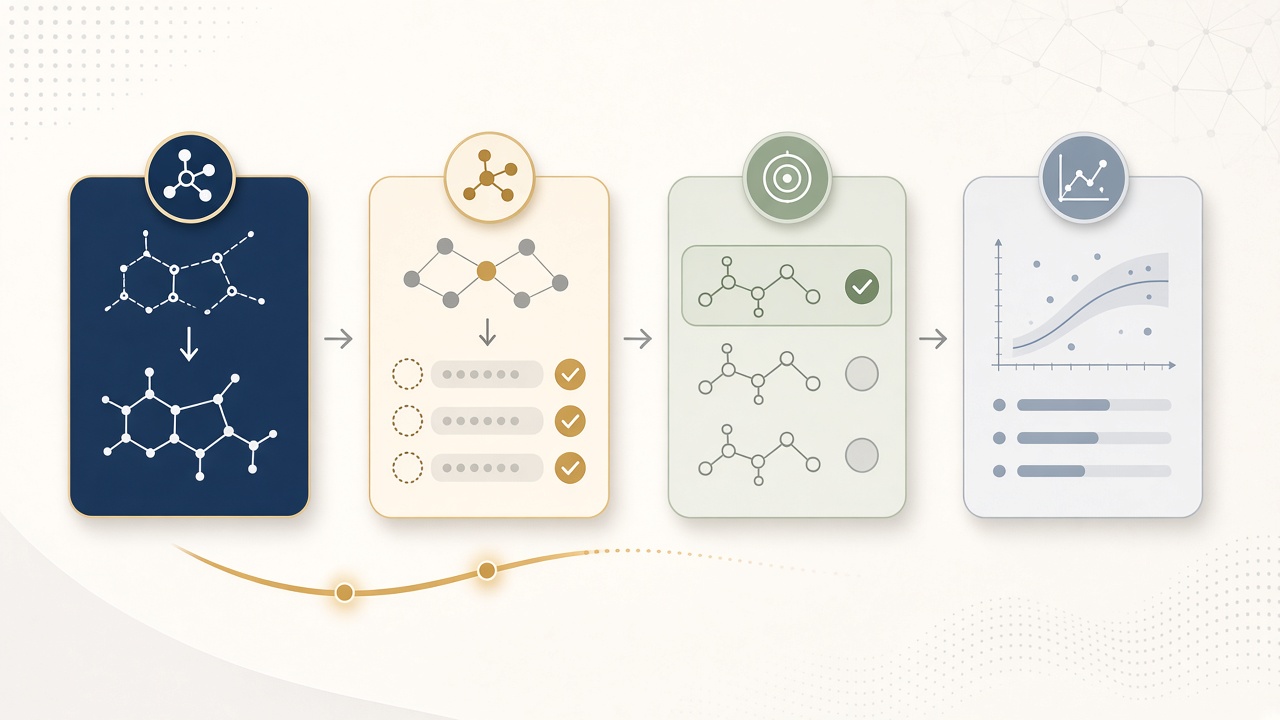
The benchmark draws on 117 papers and patents and includes 761 distinct molecular structures. Its problems cover molecular structure reconstruction, scientific reasoning, ranking and selection of compounds, and property prediction. Those tasks are related, but a combined score can obscure where performance is actually reliable.
The results show that split clearly: models performed better on structure tasks and evidence-based explanations than on choosing compounds or predicting numerical properties. GPT-6.2 Astra scored 84.5% of available credit at xhigh, compared with 83.3% for GPT-6 Astra. Astra also earned 95.4% of the available structure credit at that setting. These scores are evidence of performance on the benchmark, not a single measure of medicinal-chemistry capability.
Worth a look
Phugialy Picks

AI Engineering: Building Applications with Foundation Models
A practical guide to building real-world applications with foundation models and LLMs.

GMKtec K15 AI Mini PC Oculink Intel Ultra 5 125U 32GB DDR5 512GB SSD | Desktop Computer AI Boost, 3X M.2 2280 Storage Expansion, Dual NIC...

Agentic AI Engineering: Systems That Reason and Act Autonomously – Designing, Building, and Prompting LLM-Based Agents for Real-World Deployment
Some Phugialy Picks use affiliate links. If you buy through one, Phugialy may earn a commission. It doesn't change what we recommend. Full disclosure →
Structure reconstruction is a real strength, with limits
One striking result is that GPT-6 Astra reconstructed one molecule correctly in all ten responses, while GPT-5.6 Sol and GPT-5.6 Luna failed in all ten responses. That contrast suggests meaningful differences among the tested models on this specific reconstruction task. It does not establish that the same reliability carries over to other structures, or to the less successful tasks of compound selection and numerical property prediction.
In practice, this distinction matters. A model that can recover structures and support an explanation with evidence may be useful for bounded research assistance. But selecting a compound or estimating a property calls for a different kind of confidence: the benchmark’s weaker results there are not a footnote to the high overall score. They are a reason to inspect task-level results before treating the aggregate as a capability label. That is my read of the evidence, not a claim that the benchmark itself measures deployment readiness.
Historical questions cannot settle lab performance
The authors explicitly caution that the results do not establish whether models can discover new drugs or improve laboratory decisions. The evaluation uses historical evidence, single attempts, and no tools, feedback, or new experiments. It also cannot rule out prior exposure to the published sources behind the questions.
Those constraints define what the benchmark can tell us: how models answered this set of research-derived problems under fixed conditions. They do not make the results meaningless; they make the boundary important. My practical takeaway is to treat MedChemBench as a useful diagnostic of model strengths and weaknesses, not as evidence that an AI system is ready to guide experimental choices. The next evidence worth looking for is whether these task-level gaps persist when models must work with new evidence and iterative feedback.
Holiday picks
Thanksgiving: early shopping
Start early: products for hosting, travel and home, plus the gear you have been watching.

Cleaning & Care
Small add-onScreen Mom Screen Cleaner Spray (16oz)
Buy if: You've been wiping your monitor with your shirt sleeve.
Skip if: You already have a cleaning routine sorted.
View on Amazon (opens in a new tab): Screen Mom Screen Cleaner Spray (16oz)Prices change daily. Check today's price on Amazon.
 Trending now
Home & Kitchen
De'Longhi Magnifica Duo Automatic Espresso Machine, Milk Frother, Silver
View on Amazon (opens in a new tab): De'Longhi Magnifica Duo Automatic Espresso Machine, Milk Frother, SilverPrices change daily. Check today's price on Amazon.
 Trending now
Home & Kitchen
Keurig K-Elite Single Serve K-Cup Pod Coffee Maker, Brushed Silver
View on Amazon (opens in a new tab): Keurig K-Elite Single Serve K-Cup Pod Coffee Maker, Brushed SilverPrices change daily. Check today's price on Amazon.
We earn from qualifying purchases made through these links, at no extra cost to you, as an Amazon Associate and through other affiliate programs. Disclosure. See all Thanksgiving picks
Got a question about how this applies to you? →
For a related look at what scientific AI models still need to prove, read “What CERN’s Large Physics Model Must Prove Beyond Scale.”
Keep reading
Follow the thread
AI Perplexity Benchmark: A Limit, Not a Safety Test
Perplexity may offer AI companies a more durable way to compare progress than benchmarks that quickly go stale. But a shared score is not a safety rule: the hard part is agreeing on what it should trigger and how behavior will be monitored.
Read this noteSame lane, different angle
Anthropic IPO Puts AI Safety Under Market Pressure
Anthropic’s first day on the public market shows investor appetite, not a path to profitability. The harder question is whether rapid revenue growth can cover frontier AI’s compute costs without putting safety commitments under pressure.
Generative AI Risk Assessment Needs an Approval Boundary
Standard Bank Group’s generative AI risk assessment automates evidence gathering and testing, but it does not automate the bank’s approval decision. That distinction matters: the account describes a way to prepare tracea