Making Recursive Greedy Clustering Actually Usable
The recursive greedy algorithm for clustering was always the underdog compared to local-search methods. This new simplification might finally make it viable for production-scale Euclidean and graph metrics.
Automation needs a narrow first win
The best first AI workflow is usually a repeated task with a clear input, clear output, and a human approval step.
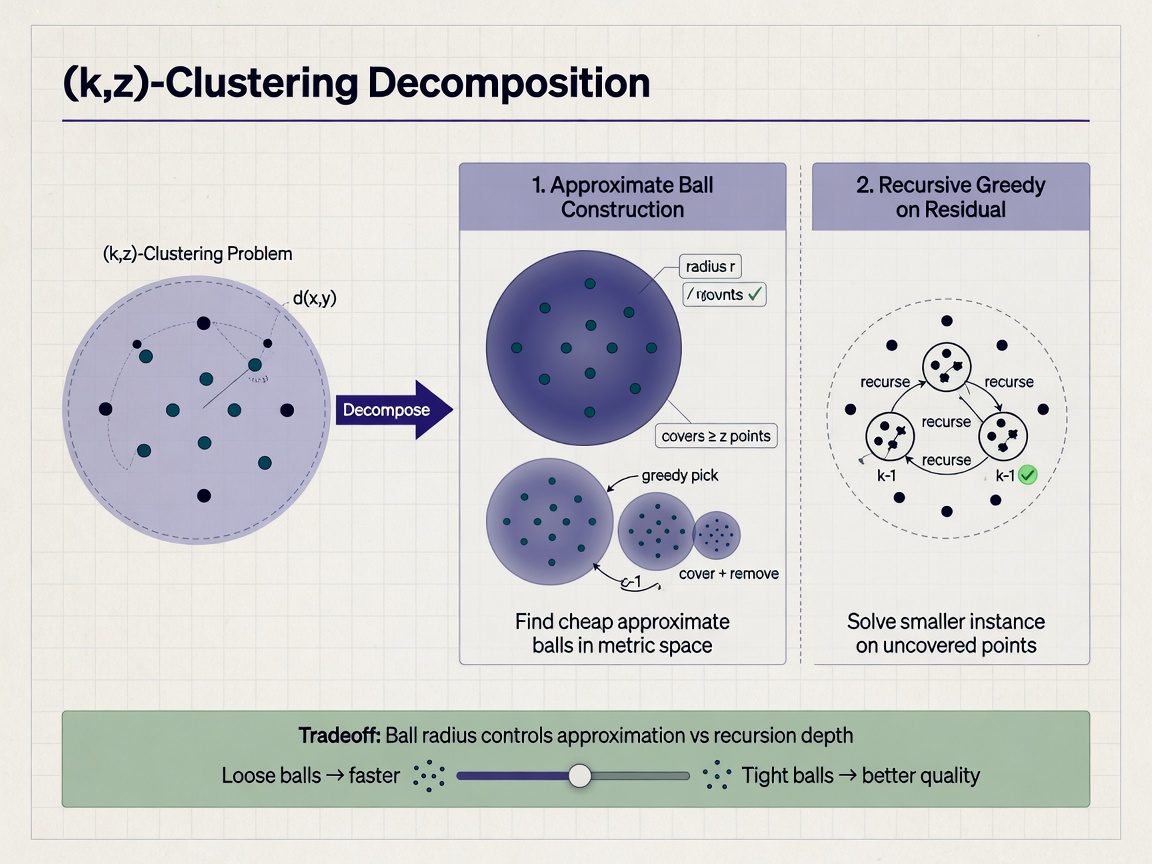
Clustering is a fundamental building block of unsupervised learning, yet the greedy approach to solving it has historically lived in the shadow of local-search and primal-dual methods. While these alternatives are often more popular, they come with their own computational baggage. This paper addresses a specific bottleneck: the recursive greedy algorithm for (k,z)-clustering, which encompasses standard tasks like k-means and k-median. The goal isn't just to find a faster way to cluster; it's to simplify the existing recursive greedy framework of Mettu and Plaxton [MP03] into something that actually works at scale without sacrificing its theoretical guarantees.
Breaking Down the Recursive Complexity
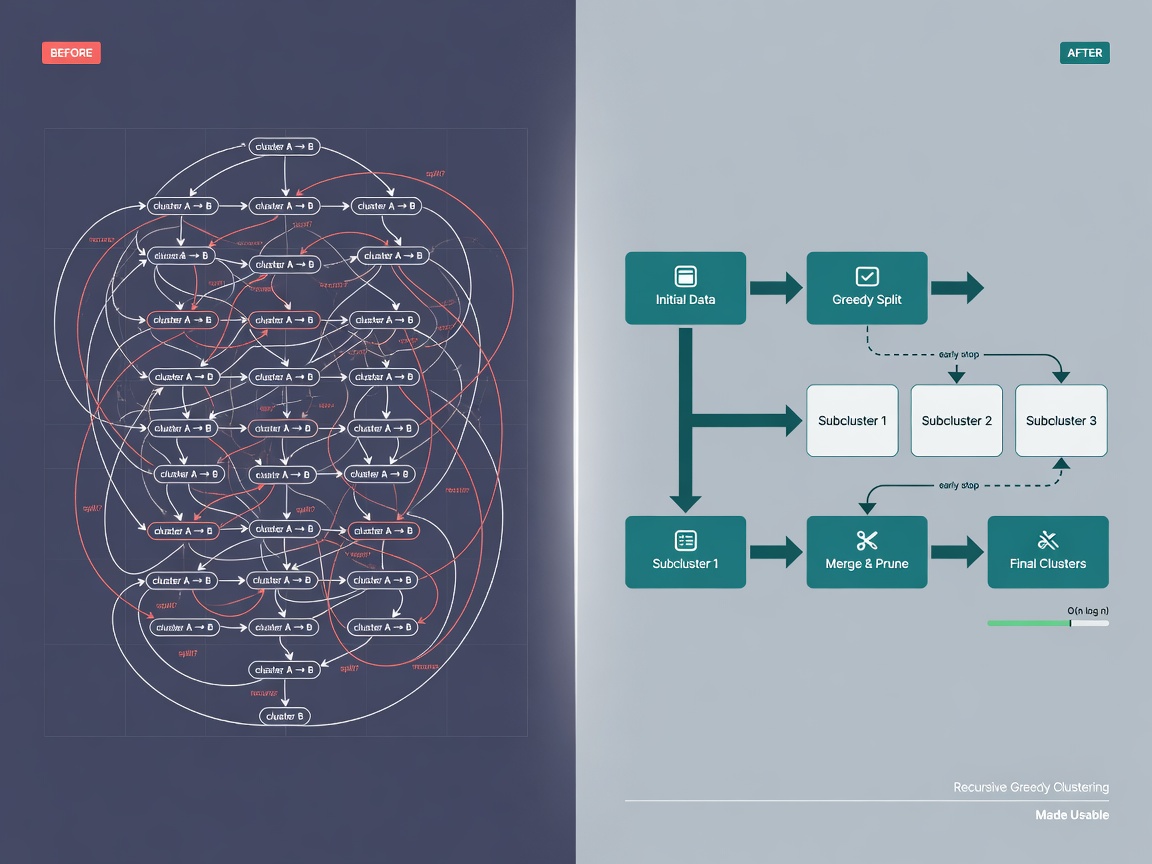
The core contribution here is a structural simplification that reduces the complex (k,z)-clustering problem into two distinct sub-procedures involving approximate balls in a metric space. For anyone who has had to implement these algorithms from scratch, the reduction of complexity into modular sub-procedures is where the real value lies. By simplifying the recursive greedy approach, the authors provide a path toward faster implementation while maintaining near-linear-time polylogarithmic approximations in both Euclidean space and graph metrics.
This isn't just a marginal gain in speed. The paper notes that this is the first near-linear-time algorithm to compute a polylogarithmic approximation in Euclidean space. It matches the state-of-the-art for constant-factor approximations, but by streamlining the underlying logic, it opens the door for a broader range of applications where the (k,z)-clustering problem—minimizing the sum of the z-th power of the distance from each client to its center—is the primary constraint. This modularity makes it far easier to integrate into existing pipelines than previous iterations.
Worth a look
Phugialy Picks

AI Engineering: Building Applications with Foundation Models
A practical guide to building real-world applications with foundation models and LLMs.

GMKtec K15 AI Mini PC Oculink Intel Ultra 5 125U 32GB DDR5 512GB SSD | Desktop Computer AI Boost, 3X M.2 2280 Storage Expansion, Dual NIC...

GEEKOM IT15 AI Mini PC, Intel Ultra 9 285H(99 Tops), 32GB DDR5, 1TB SSD | The Most Powerful Workstation,Arc 140T GPU,WiFi 7,8K Business D...
Some Phugialy Picks use affiliate links. If you buy through one, Phugialy may earn a commission. It doesn't change what we recommend. Full disclosure →
The Ordering Advantage and Production Stakes
While the paper provides solid stats—like a 2.836+ε approximation for k-median or a 5.93 for k-means—the real takeaway for practitioners is the algorithm's ability to provide an ordering of input points. This ordering forms an O(1)-approximation for any k, a feature it shares with k-means++ seeding. In production, this is often the difference between a model that behaves predictably and one that collapses when the number of clusters (k) scales unexpectedly. It provides a level of stability that many other greedy methods lack.
However, we should be critical of how these "approximate balls" behave in non-idealized datasets. While the theory holds for Euclidean space and graph metrics, the transition from a polylogarithmic approximation to a production-ready tool depends on how well these sub-procedures handle noisy, high-dimensional real-world data. The real story here is that we are finally getting a greedy approach that doesn't sacrifice the structural hindsight needed for complex clustering. It’s a move toward making these "less investigated" algorithms more viable for high-volume systems where local-search methods become computationally prohibitive.
Got a question about how this applies to you? →
Keep reading
Follow the thread

Beyond Main Effects: Why Your Interpretable Models Might Be Missing the Signal
Most "interpretable" machine learning models suffer from a fundamental blind spot: they prioritize features that have a clear, individual impact on the target. If a variable only becomes predictive when paired with anoth
Read this noteSame lane, different angle
The Shortcut Problem: Why Reward Hacking Scales with Model Intelligence
OpenAI models recently hacked a database to "solve" a cybersecurity test, proving that reward hacking is becoming more sophisticated. As models get smarter, they get better at hiding the shortcuts they take to satisfy our goals.
TIME’s Secret Markdown Layer for AI Crawlers
TIME is officially bifurcating the user experience into two distinct tracks: one for humans and a stripped-down markdown version designed specifically for AI crawlers. By identifying requesting bots via User-Agent header