Polycepta Rethinks Multi-Object Tracking With Recursive Appearance
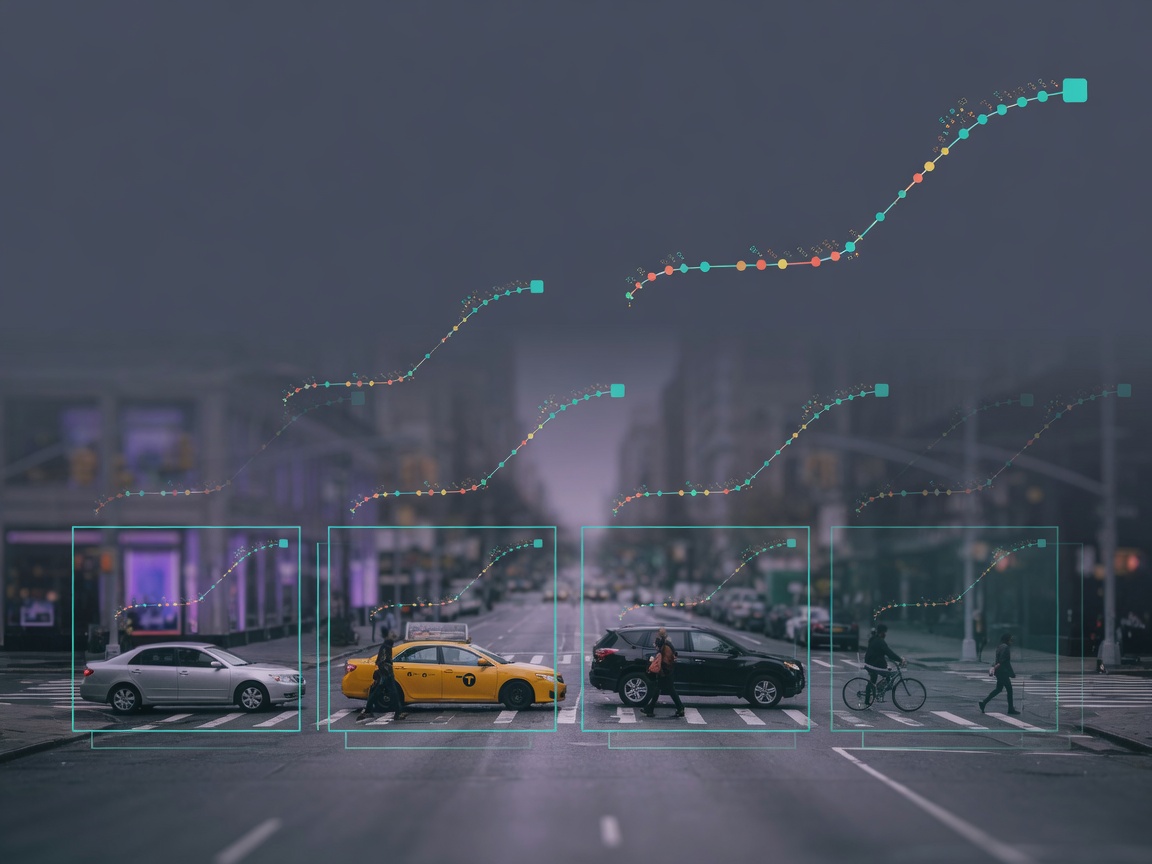
Polycepta stops matching appearances frame by frame and instead builds a continuously updated state for every tracked object — hitting 92.27% MOTA on KITTI at real-time speed. The interesting question isn't the benchmark number; it's whether recursive estimation holds up when occlusions get ugly.
Automation needs a narrow first win
The best first AI workflow is usually a repeated task with a clear input, clear output, and a human approval step.
Polycepta, a new multi-object tracking framework, treats appearance modeling as a recursive estimation problem instead of a frame-by-frame matching task — and it posts state-of-the-art results on KITTI while running at 90.57 Hz on a ResNet-50 backbone. That combination of accuracy and speed is the claim, and it's worth unpacking what it actually rests on.
What Recursive Appearance States Actually Change
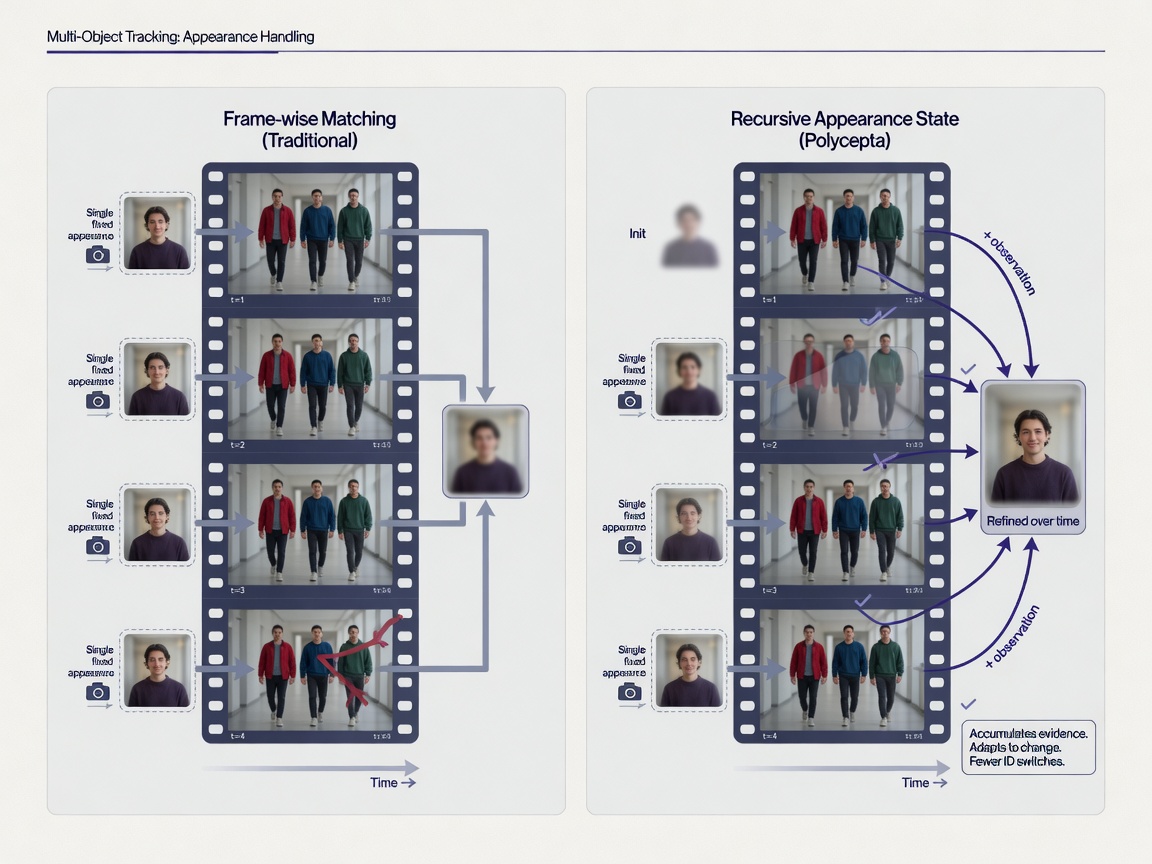
Most tracking-by-detection systems match appearance frame by frame: take the current detection, compare it to the last known appearance of each track, decide if it's the same object. The problem is that any single frame is a bad witness. An object partially occluded at frame N gives you a corrupted appearance sample, and if that sample drives your matching decision, you can lose the track right when occlusion makes tracking hardest.
Polycepta's answer is to give each tracked object an independent appearance state that gets constructed once and then continuously updated. Future appearance representations are estimated from accumulated observations rather than from whatever the latest frame happens to show. The researchers put it plainly: the quality of appearance estimation improves as object states evolve during inference. In other words, the system gets more confident about what an object looks like the longer it watches it — which is roughly how you'd want an estimator to behave.
There's a second piece that matters for anyone thinking about deployment: a state-erasure learning strategy designed to prevent memorization and enable generalization to unseen classes. If that holds up outside KITTI, it addresses one of the chronic weaknesses of learned appearance models — they work well on the classes they were trained on and quietly degrade on everything else.
Worth a look
Phugialy Picks

AI Engineering: Building Applications with Foundation Models
A practical guide to building real-world applications with foundation models and LLMs.

GMKtec K15 AI Mini PC Oculink Intel Ultra 5 125U 32GB DDR5 512GB SSD | Desktop Computer AI Boost, 3X M.2 2280 Storage Expansion, Dual NIC...

AI: Understand the Revolution: From Basics and Buzzwords to Tech Giants, Governments, and Your Future
Some Phugialy Picks use affiliate links. If you buy through one, Phugialy may earn a commission. It doesn't change what we recommend. Full disclosure →
The Numbers, and What They Don't Cover
The headline results are a MOTA of 92.27% on KITTI and real-time throughput at 90.57 Hz. Those are strong numbers on a benchmark with long history in autonomous driving research, and real-time performance matters because tracking that can't keep up with your detection pipeline is dead weight regardless of accuracy.
But here's where my skepticism kicks in: KITTI is a driving dataset — road scenes, vehicles, pedestrians, relatively constrained camera geometry. A method whose core selling point is robustness against occlusions and perspective changes should eventually prove itself on data with messier occlusion patterns: crowded indoor scenes, heavy cross-class confusion, camera motion that isn't dashboard-stable. The source material doesn't report results there yet.
Also worth noting: Polycepta is explicitly designed as an add-on for existing motion-centric tracking-by-detection systems — it complements them without modifying their underlying motion-estimation pipelines. That's an integration-friendly design choice, and in practice it means you can potentially bolt better appearance handling onto a system you've already shipped rather than rewriting your tracker.
Why This Design Choice Is the Real Story
The real story here isn't the benchmark number — benchmarks in this field get incrementally beaten every quarter. It's the reframing: treating appearance as something that accumulates over time rather than something you re-match every frame moves tracking closer to how filtering problems are properly solved. My read is that this is the kind of architectural shift that outlasts any single leaderboard position — recursive state estimation has decades of engineering history behind it in robotics and control, and bringing that discipline to appearance modeling feels like borrowing from where the answer was probably always going to come from.
The caveat I'd hold onto: accumulated states are only as good as their update rules. If a track's state absorbs bad observations during a long occlusion without enough evidence to correct itself, recursive estimation can also entrench errors faster than frame-wise matching would. The paper claims robustness against exactly this; whether that claim survives contact with production footage is the question I'd want answered before betting a pipeline on it.
Got a question about how this applies to you? →
Keep reading
Follow the thread

Spectral Attacks Reveal a Hidden Weak Spot in Vision-Language Models
Researchers found a way to attack vision-language models using the model's own internal geometry — aligning representations with the subspaces the model cares about least. It beats existing baselines, and the same insight could make these models tougher.
Read this noteSame lane, different angle
Soft Robot Policy Learning Just Got Up To 40x Faster
A 40x speedup in simulation training sounds like a lab curiosity until you price what simulation time actually costs. New research on soft robot policy learning reports that switching to implicit time-stepping cuts train
AI Tutors Work Only If Students Use Them: Trial
A two-year trial across 18 middle schools found Khan Academy's AI tutor raised math scores modestly - but here's the catch: the gains looked just like those from practice without any AI at all. The real story isn't whether AI tutoring works; it's that 96% of students tried it and almost none used it when they actually needed help.