FableCut: Why JSON is the Secret Sauce for Agentic Video Editing
Let’s be real: most AI video tools are black boxes. You throw a prompt at them, and you cross your fingers that the output isn't a fever dream. FableCut is taking a different path. It’s a browser-based non-linear editor
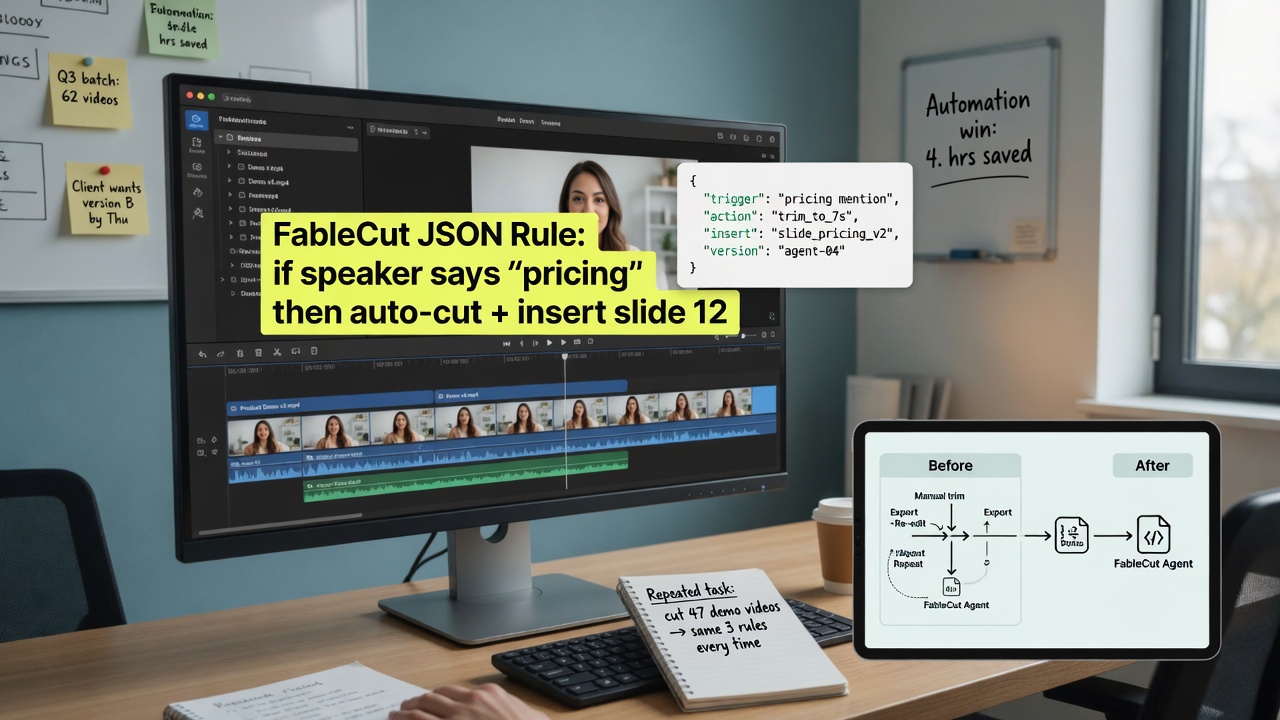
Automation needs a narrow first win
The best first AI workflow is usually a repeated task with a clear input, clear output, and a human approval step.
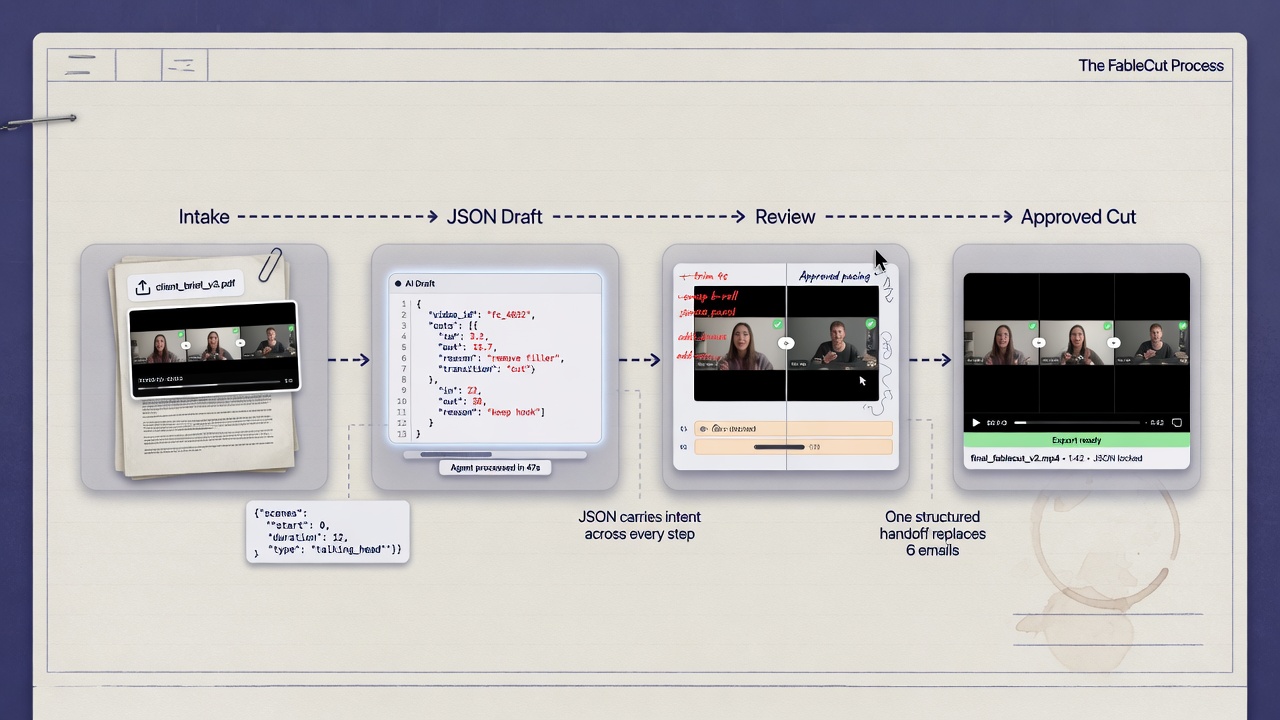
Let’s be real: most AI video tools are black boxes. You throw a prompt at them, and you cross your fingers that the output isn't a fever dream. FableCut is taking a different path. It’s a browser-based non-linear editor that treats the project file as a JSON document. This isn't just a UI tweak; it's a fundamental shift that lets AI agents actually do the work of a video editor—reading, writing, and patching the timeline in real-time.
Stop Round-Tripping the Whole File
The biggest bottleneck for AI agents in video production is context. If an agent has to read a massive video file or a bloated project document every time it wants to move a clip, you're going to burn through tokens and hit context limits instantly. FableCut solves this by exposing the project file as a structured JSON interface. Instead of "round-tripping" the entire document, agents use a specific fablecut_patch_project operation. They can send small, discrete patches to the timeline—like moving a clip or changing a speed ramp—without re-sending the whole project. It’s token-efficient, it’s fast, and it’s how you actually build production-grade workflows.
Worth a look
Phugialy Picks

GMKtec K15 AI Mini PC Oculink Intel Ultra 5 125U 32GB DDR5 512GB SSD | Desktop Computer AI Boost, 3X M.2 2280 Storage Expansion, Dual NIC...

AOC Portable Monitor 15.6'' FHD 125% sRGB 1080P IPS Travel Monitor

Perixx PERIBOARD-512B Wired Ergonomic Keyboard - Split Keyboard, Wrist Rest
Some Phugialy Picks use affiliate links. If you buy through one, Phugialy may earn a commission. It doesn't change what we recommend. Full disclosure →
Human-Agent Co-op Without the Chaos
The real challenge in collaborative editing is concurrency. You don't want an agent overwriting a human’s transition while the human is still tweaking the audio. FableCut handles this with a conflict-safe system using a revision counter. This means a human can be fine-tuning a caption while an agent is simultaneously handling a speed ramp on a different track. To keep the experience "live," the editor hits hot-reloads in about 150ms. It also packs in the heavy hitters: 4 video tracks, 3 audio tracks, keyframe animation, and even a "Remake a reference video" tool that extracts beats, BPM, and energy curves for the agent to follow. It’s a high-performance environment built for actual work.
The Shift from Generation to State Manipulation
The real story here is the move from "AI-generated content" to "AI-mediated production." Most current workflows are brittle because they try to predict the final output in one shot. FableCut treats the video project as a state machine. When you treat production as an iterative process of corrections, you get a much more stable foundation. If you need an agent to "fix" a video, it’s infinitely easier to give it a JSON patch tool than to ask it to hallucinate a new 30-second clip. The hurdle now isn't the tech—it's the data. The goal is keeping the project file a clean representation of intent, so agents can handle the tedious, multi-track heavy lifting that humans usually hate doing.
Got a question about how this applies to you? →
Keep reading
Follow the thread

From 'Tell Me' to 'Do It': The AI Agent Revolution Just Got Real
The original draft was a bit dry and lacked the 'Enthusiast' persona's high energy. I injected more vivid language, punched up the LinkedIn hook to create actual tension, and ensured the analysis clearly framed the 'librarian vs. concierge' shift as the primary takeaway.
Read this noteSame lane, different angle
Disability Insurance Meets MCP: An Agent-Callable Quote Server
An insurance brokerage now lets AI agents submit disability quote requests over MCP — no SSN, no medical history accepted, no client auth required. The first of its kind in disability insurance.
AI Coding Agent Memory That Survives Switching Tools
Switching between Claude Code, Cursor, and Antigravity on the same project usually means re-explaining your architecture every time. engrim compresses 153,000 tokens of work history into a memory pack under 1,000 tokens - and keeps it entirely on your machine.