Climate Emulators Need Better Training Data, Not More Runs
Climate emulators may need fewer full-scale model runs to learn from future scenarios. The interesting claim is not just lower training cost: it is whether optimized synthetic data helps them predict situations they never saw during training.
Automation needs a narrow first win
The best first AI workflow is usually a repeated task with a clear input, clear output, and a human approval step.
MIT researchers have developed a way to train climate emulators on optimized synthetic scenarios, with the aim of making them more accurate on unfamiliar conditions while using less training data. The practical claim is meaningful: instead of running a full-scale Earth system model six or eight times to produce future scenarios, the approach needs one run to generate training data.
Climate emulators get optimized synthetic training scenarios
The method does not simply feed an emulator a smaller sample of ordinary climate-model output. It iteratively adjusts synthetic climate scenarios in response to the emulator’s prediction error, steering the training data toward information the model has trouble learning. The researchers say the resulting emulator accurately predicts scenarios it did not encounter during training, unlike the traditional emulators evaluated.
They also describe adding high-frequency wiggles and oscillations to the synthetic data. The point, as one researcher explained, is to help the emulator extract more information about the overall system. That is a different strategy from assuming that more conventional examples will automatically make the model more adaptable.
The reported computational contrast is worth attention. Full-scale Earth system models can take months to run on a supercomputer cluster; requiring one run rather than six or eight could reduce the time needed to assemble emulator training data. That could matter for climate research and policy work, where producing useful scenario tools is itself a costly step.
Worth a look
Phugialy Picks

Screen Mom Screen Cleaner Spray (16oz)
We'd buy this if: You've been wiping your monitor with your shirt sleeve.
We'd skip this if: You already have a cleaning routine sorted.
Anker USB-C to USB-C 60W Fast Charging Cable (2-Pack)
We'd buy this if: You need a reliable spare charging cable that won't fray in a month.
We'd skip this if: You already have enough cables lying around.

Stanley Quencher H2.0 Tumbler 30oz
We'd buy this if: You want a large, well-reviewed insulated tumbler and don't mind it having nothing to do with AI.
We'd skip this if: You'd rather every Pick on this site stay strictly on-topic.
Some Phugialy Picks use affiliate links. If you buy through one, Phugialy may earn a commission. It doesn't change what we recommend. Full disclosure →
Unseen-scenario accuracy is the key claim to test
The result that matters most is not simply lower data requirements. It is the reported ability to predict scenarios absent from training. A climate emulator that performs well only on familiar conditions may be cheaper to build, but it is not much help when researchers need to explore policy-relevant futures beyond the examples already available.
Still, the source does not give the evaluation details needed to judge how far that result travels: for example, how many unfamiliar scenarios were tested or how performance was measured. That is not evidence the claim is weak; it is a limit on what readers can conclude from the summary. Generalization is the right target, but its practical value depends on the breadth and difficulty of the tests.
One model run is a promising starting point, not validation
The researchers plan to test the technique with a scenario generated by a full Earth system model and to apply it to other climate models and broader machine-learning applications. Those are important next steps, not results already established. In particular, one successful test would not by itself show that the method works reliably across different models or the range of scenarios relevant to climate policy.
My read is that this is a useful approach to the data bottleneck, not yet a reason to trust emulator outputs by default. Cutting repeated model runs could make climate emulators faster to produce, but speed only helps if the synthetic scenarios expose the weaknesses that matter outside training. The next evidence to watch is whether the promised tests confirm that unseen-scenario accuracy holds across models, rather than in a narrow evaluation.
Got a question about how this applies to you? →
For a related look at AI’s role in scientific work, read “From Oracles to Agents: The Next Phase of Scientific Discovery.”
Keep reading
Follow the thread
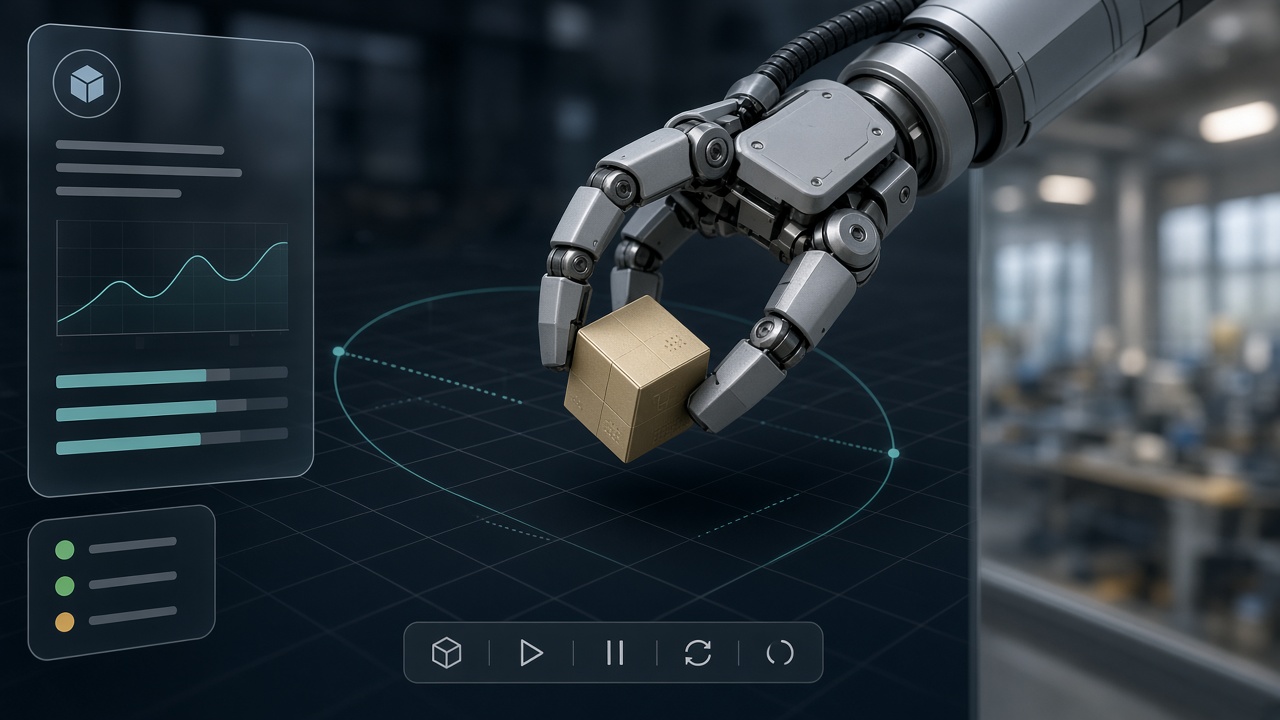
NVIDIA’s Robotics Simulation Stack Faces the Transfer Test
GR00T 2 reached 40 of 50 tasks without task-specific demonstrations, and its reported success rose to 95% with five demonstrations per task. The harder question is whether these results transfer beyond the evaluation setup—and NVIDIA’s simulation stack is where that question can be tested at greater scale.
Read this noteSame lane, different angle
TimEE: Time Series Classification With Zero Real Training Data
A time series is just a list of numbers measured over time - heartbeats, sensor readings, stock prices - and classifying one usually means training a new model from scratch for every single dataset. TimEE, a new 4.5M-par
Your Playlists Are a Privacy Leak: Inferring PII From Spotify
Researchers have built a deep learning tool that infers sensitive personal information — age, gender, country, drinking and smoking habits, even Big Five personality scores — from nothing but a user's public Spotify play