Can AI Romance Count as Cheating? Half of Americans Say Yes
Half of American adults say a partner's romance with an AI can count as cheating - and familiarity with these products makes judgments harsher, not softer. The loneliness numbers behind that split say more than the headline does.

Automation needs a narrow first win
The best first AI workflow is usually a repeated task with a clear input, clear output, and a human approval step.
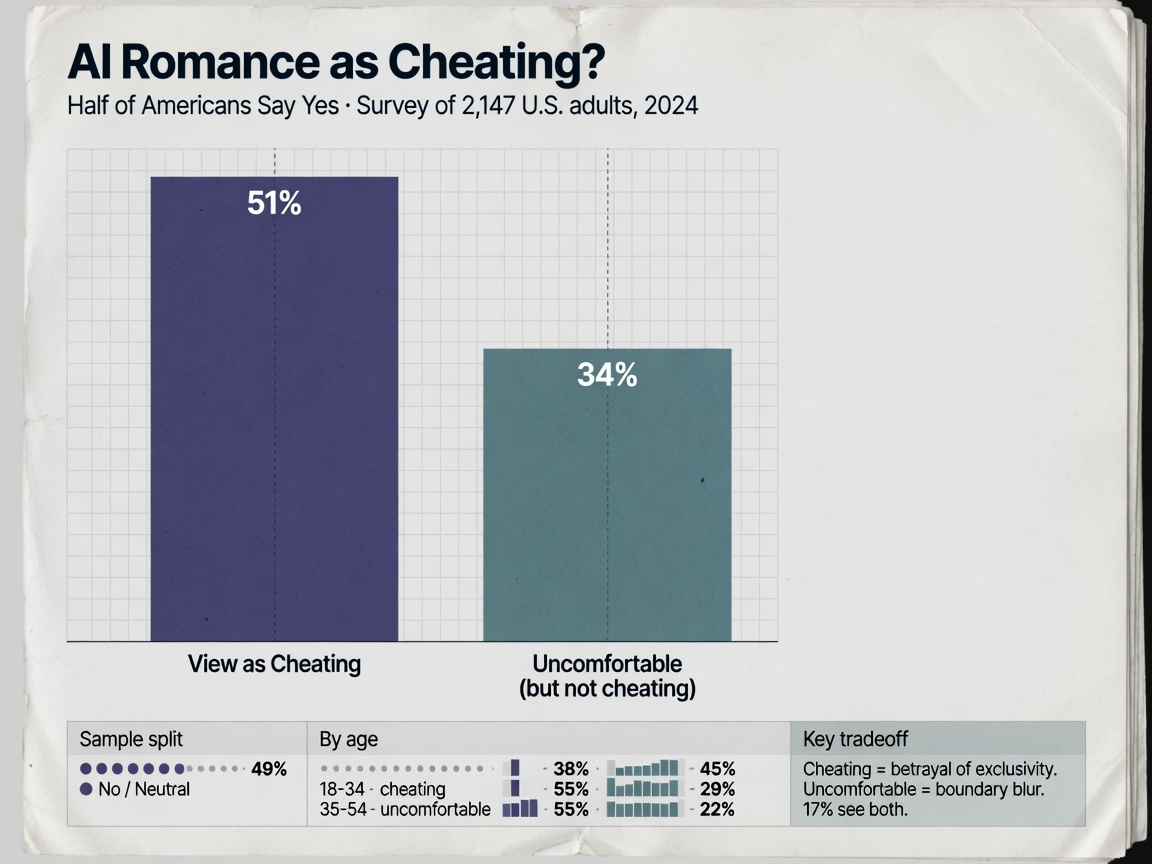
Half of American adults now say a partner's romantic relationship with an AI can count as cheating - and the people most familiar with these products are the harshest judges of them. That combination, from a new survey by AI Girlfriend Coach, is more interesting than the headline number suggests, because it cuts against the usual assumption that proximity breeds tolerance.
What The Numbers Actually Show
The survey found that 50.5% of respondents consider a partner's romantic or sexual relationship with an AI to be cheating. Another 21.2% stopped short of that word but said they would still be uncomfortable if a partner did it. Stack those together and roughly seven in ten Americans register some level of objection - only a minority are genuinely indifferent.
The demographic split is the part worth pausing on. Engaged and married respondents were nearly twice as likely as single ones to have used an AI girlfriend or boyfriend app: 30.7% versus 16.3%. The people with the most at stake in relationship fidelity are also the ones most likely to have tried these products firsthand.
On motivation, the data is unambiguous. 56.6% chose having someone to talk to or feeling less alone as their reason for using an AI companion; only 10.3% chose affection, romance or sex. Loneliness was the leading driver in every subgroup measured, not just among one demographic slice.
Phugialy Picks

AI Engineering: Building Applications with Foundation Models
A practical guide to building real-world applications with foundation models and LLMs.

GMKtec K15 AI Mini PC Oculink Intel Ultra 5 125U 32GB DDR5 512GB SSD | Desktop Computer AI Boost, 3X M.2 2280 Storage Expansion, Dual NIC...

AI: Understand the Revolution: From Basics and Buzzwords to Tech Giants, Governments, and Your Future
Some Phugialy Picks use affiliate links. If you buy through one, Phugialy may earn a commission. It doesn't change what we recommend. Full disclosure →
Why Familiarity Makes Judgments Harsher, Not Softer
The survey's most counterintuitive finding is that familiarity with AI products correlates with harsher judgments about whether these relationships count as cheating. The explanation offered is structural rather than moral: AI companions flirt, remember what they were told last week and raise it again unprompted, sustain relationships across months, and simulate intimacy convincingly enough that users describe grief when a model is retired.
In other words, once you have seen what these systems actually do up close, "it's just software" stops functioning as a defence - for the attachment itself and for how others judge it. The source article puts it plainly: the object of attachment being synthetic stops working as an excuse, which leaves people with firsthand experience applying the firmest rules.
That grief detail deserves more attention than it gets in discussions of AI companionship. Users mourning retired models is not a hypothetical about future attachment; it is already documented behavior, and it tells you something about how real these bonds feel from the inside regardless of what anyone calls them from the outside.
What This Actually Points To
The survey's practical conclusion is that couples will need to define their own boundaries around AI intimacy, because no universal rules exist yet. My read - and this is interpretation rather than something the data settles - is that this is less a social-values story than an accountability vacuum story. Traditional infidelity norms evolved around third parties who could be named; an AI companion that remembers and initiates sits in a category our existing vocabulary wasn't built for, which is exactly why respondents split between "cheating" and merely "uncomfortable" rather than converging on one answer.
The underappreciated risk here isn't moral judgment - it's that relationship agreements will get renegotiated one painful conversation at a time instead of through any shared norm, while product design decisions (memory persistence, unprompted check-ins) quietly set de facto boundaries no couple ever agreed to.

Got a question about how this applies to you? →
Keep reading
Follow the thread

Why Young Adults Don't Trust AI Executives
81 percent of young US adults say they don't trust major AI company executives to act responsibly on AI - and 60 percent want data center construction slowed down. The distrust is real; whether it carries any leverage is a different question.
Read this noteSame lane, different angle
VERA-MH Benchmark: Validating AI Chatbot Safety Testing
An LLM judge matched clinician consensus at 0.81 on mental health chatbot safety ratings — but only for one narrow domain. What VERA-MH validates is real; what people will assume it covers isn't.
37 An Hour To Train Your Replacement: Inside AI Training Jobs
A Ph.D. graduate was offered $37 an hour — eighteen times South Africa's minimum wage — to teach an AI system how he thinks. He walked away, but most won't.