AI Advertising Headlines That Beat Human Writers (Sometimes)
A reinforcement learning setup let masked language models generate product ad headlines that beat human-submitted ones on grammar and creative quality — without adding any inference latency. The mechanism behind that trade-free improvement is more interesting than the scoreboard.
Automation needs a narrow first win
The best first AI workflow is usually a repeated task with a clear input, clear output, and a human approval step.
An e-commerce headline generator that beats human writers on grammar and creative quality sounds like hype, but the research behind it is refreshingly concrete: researchers applied reinforcement learning policy gradient methods to Transformer-based masked language models (MLMs) to produce product advertising headlines for retail listings — and the results held up in quality audits, not just benchmark scores.
Why Masked Language Models Needed Reinforcement Learning
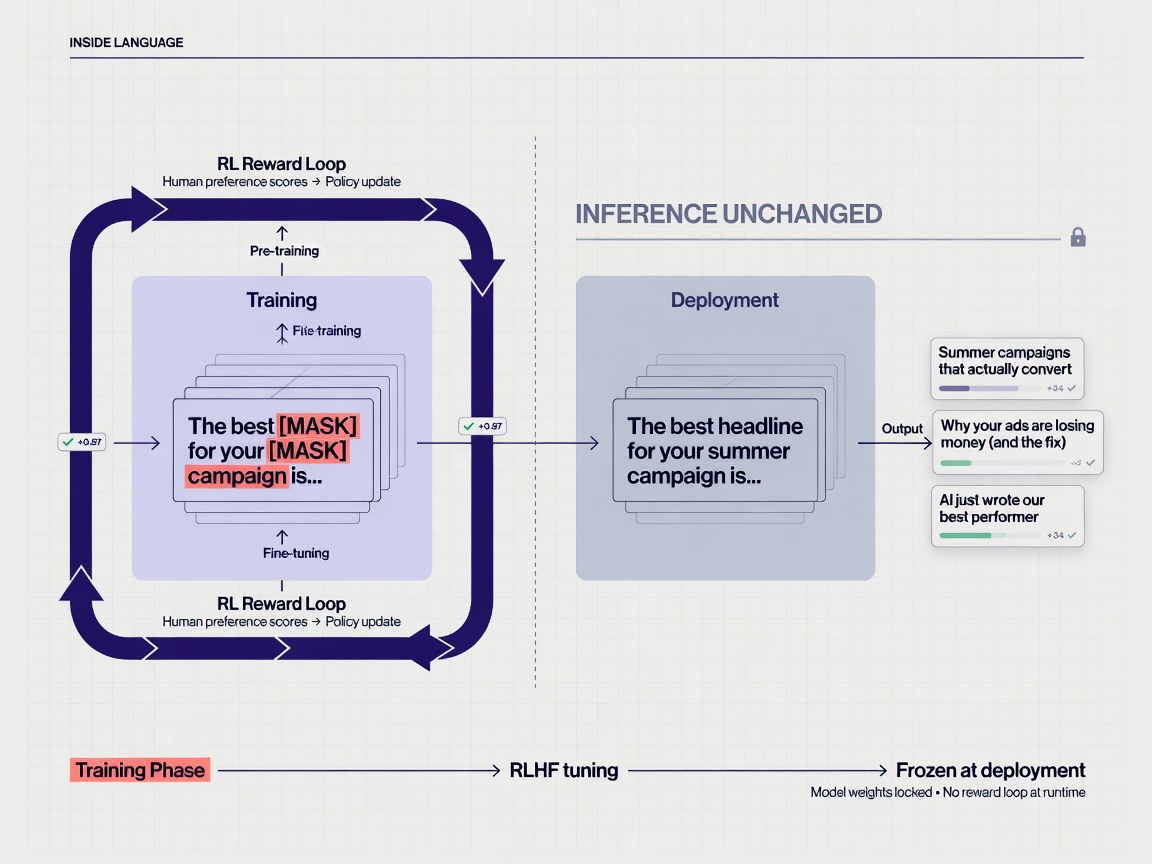
Masked language models are the family of models that learn by hiding words in a sentence and guessing them from context. That training makes them excellent at filling in plausible text, but it doesn't directly optimize for what an advertiser actually wants: headlines that are grammatical, creative, and genuinely attractive to shoppers.
The researchers' solution was to train the MLM with reinforcement learning, specifically policy gradient methods, so the model could be optimized directly on headline quality metrics. This is the part most explanations stop at "they used RL" — but the detail that actually matters is what it lets you avoid. Because the reinforcement learning happens during training rather than at inference time, the system gets better headline quality without changing the inference setup or adding latency. The model you deploy behaves exactly like any other Transformer at run time; all the extra work was paid for upfront.
There's also a practical wrinkle worth noticing: the model jointly conditions on multiple products a seller wants to advertise at once, rather than writing one headline per item in isolation. That matters because real retail listings aren't single-product problems — sellers advertise bundles of related items, and a good headline has to capture the information in those retail attributes while staying different and uniquely attractive.
Worth a look
Phugialy Picks

AI Engineering: Building Applications with Foundation Models
A practical guide to building real-world applications with foundation models and LLMs.

GMKtec K15 AI Mini PC Oculink Intel Ultra 5 125U 32GB DDR5 512GB SSD | Desktop Computer AI Boost, 3X M.2 2280 Storage Expansion, Dual NIC...

AI: Understand the Revolution: From Basics and Buzzwords to Tech Giants, Governments, and Your Future
Some Phugialy Picks use affiliate links. If you buy through one, Phugialy may earn a commission. It doesn't change what we recommend. Full disclosure →
What The Numbers Actually Show
Against existing Transformer and LSTM + RL methods, the system won on both overlap metrics and quality audits. More strikingly, when compared against headlines submitted by humans, the model-generated versions came out ahead specifically on grammar and creative quality.
It's easy to conflate "beats humans" with "humans are obsolete here," but the comparison is narrower than that. Human-submitted headlines weren't beaten on every dimension — the source material specifies grammar and creative quality as the areas where the model pulled ahead. That's still a meaningful result, because those are precisely the qualities that make a headline worth clicking, but it's a claim about two dimensions of headline quality audited in this study, not a blanket verdict on human copywriting.
Where This Actually Points
The real story here isn't "AI writes better ads." It's that reinforcement learning turned out to be a clean way to push a pre-trained language model toward task-specific quality goals without paying for it at inference time — and the researchers note this approach can be applied to other natural language generation tasks like summarization and translation.
My read: that last point is the underappreciated one. Headline generation is almost a toy-scale demonstration of something bigger — if you can directly optimize quality metrics on an MLM without touching its runtime behavior, you have a recipe applicable wherever "generate text that scores well on things we can measure" applies. The catch is buried in that phrase: it only works as well as your quality metrics do. Grammar and creativity were audited here; whether those audits transfer cleanly to summarization or translation is exactly what future work will have to prove.
Got a question about how this applies to you? →
Keep reading
Follow the thread

Agon: Two Models Grading Each Other Replace Process Labels
Two models grade each other's work and double GRPO's pass@1 on math and coding benchmarks — with zero process labels and no reward model. The catch shows up when you try to ship it.
Read this noteSame lane, different angle
Soft Robot Policy Learning Just Got Up To 40x Faster
A 40x speedup in simulation training sounds like a lab curiosity until you price what simulation time actually costs. New research on soft robot policy learning reports that switching to implicit time-stepping cuts train
Soft Robot Policy Learning Gets Up To 40x Faster
Soft robot policies just trained up to 40x faster in contact-heavy tasks - no new hardware required. The fix was making each simulation step structurally cheaper instead of buying more compute.