Why Solving PDEs via Tensor Factorization Matters for Manifold Learning
Intrinsic Green’s Learning (IGL) tackles high-dimensional data by modeling target functions as solutions to linear partial differential equations (PDEs). Instead of treating a model as a black-box mapping, IGL assumes th
Automation needs a narrow first win
The best first AI workflow is usually a repeated task with a clear input, clear output, and a human approval step.
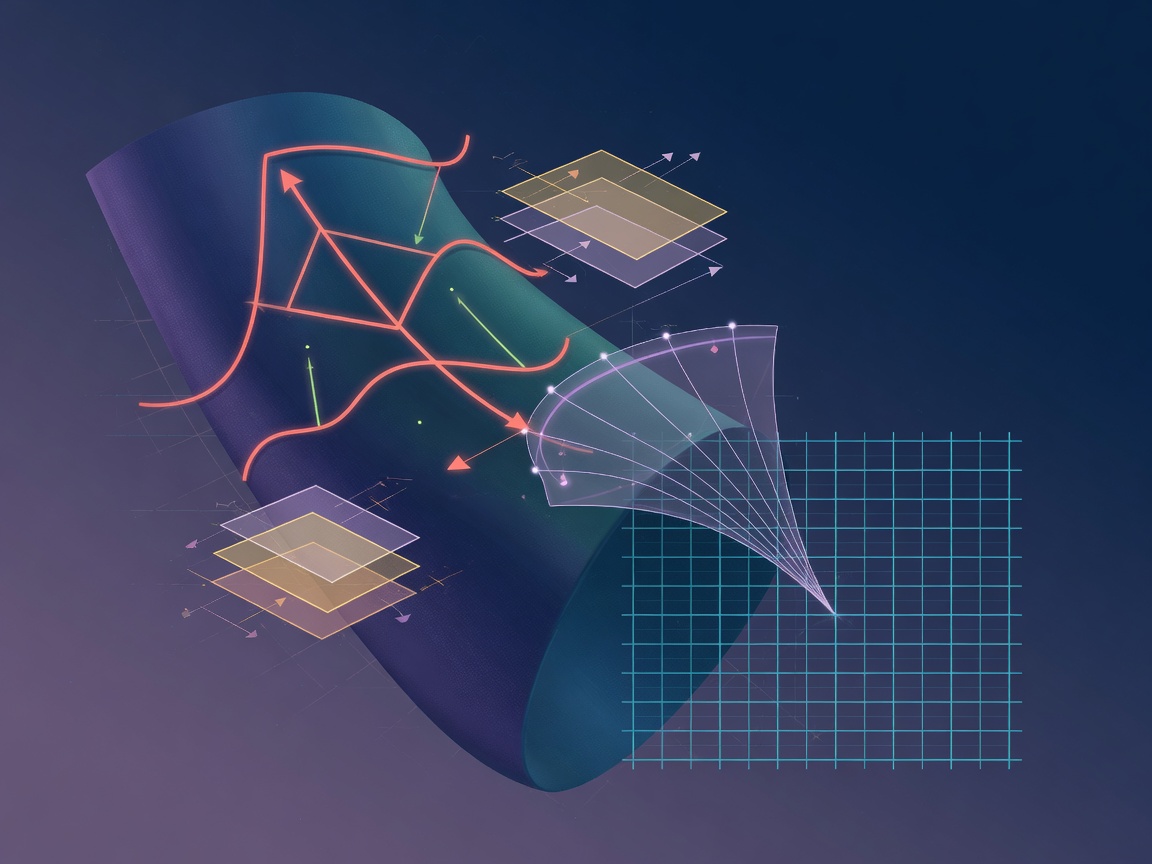
Intrinsic Green’s Learning (IGL) tackles high-dimensional data by modeling target functions as solutions to linear partial differential equations (PDEs). Instead of treating a model as a black-box mapping, IGL assumes the data lies on a low-dimensional manifold where the target function $u$ is governed by an operator $L$ and a source term $f$. By framing the learning problem as finding these components, the framework attempts to capture the underlying physics or geometry of the data rather than just interpolating points.
Breaking the Dimensional Collapse
Manifold learning often hits a wall with "dimensional collapse," where an encoder maps high-dimensional input into a collapsed, useless subspace. IGL solves this through a two-stage training architecture that separates coordinate discovery from source fitting. In Stage 1, an encoder $\Psi$ discovers a coordinate chart on the low-dimensional manifold. In Stage 2, the model solves for source weights and kernel scales.
By solving Stage 2 to optimality at each step of the outer Stage 1 loop, the gradient passed back to the encoder only reflects how well the current coordinates serve the fitting problem. This is a pragmatic design choice: it prevents the encoder from trying to optimize the entire complexity of the source term and the geometry simultaneously. Additionally, IGL uses a Group Lasso penalty and learnable gates to automatically discover the intrinsic dimension, driving inactive coordinates to zero during training.
Worth a look
Phugialy Picks

AI Engineering: Building Applications with Foundation Models
A practical guide to building real-world applications with foundation models and LLMs.

GMKtec K15 AI Mini PC Oculink Intel Ultra 5 125U 32GB DDR5 512GB SSD | Desktop Computer AI Boost, 3X M.2 2280 Storage Expansion, Dual NIC...

GEEKOM IT15 AI Mini PC, Intel Ultra 9 285H(99 Tops), 32GB DDR5, 1TB SSD | The Most Powerful Workstation,Arc 140T GPU,WiFi 7,8K Business D...
Some Phugialy Picks use affiliate links. If you buy through one, Phugialy may earn a commission. It doesn't change what we recommend. Full disclosure →
Scaling via Fubini’s Theorem and Tensor Decomposition
The computational bottleneck for solving PDEs in high dimensions is usually the integration step. IGL bypasses this by using tensor decomposition (specifically CP decomposition) on both the source term and the Green’s function. This allows the framework to apply Fubini’s theorem, factorizing a $d$-dimensional integral into $d$ independent 1D integrals.
This structure provides specific inductive biases. The choice of operator $L$ dictates the behavior: the Laplacian enforces smoothness, the Helmholtz operator enforces locality, and fractional operators allow for long-range correlations. Because integration is a stable operation compared to differentiation, this approach offers a smoother inductive bias than Physics-Informed Neural Networks (PINNs), which rely on residual minimization. Furthermore, by allowing for tensor ranks $K > 1$, IGL generalizes Generalized Additive Models (GAMs), enabling the representation of non-additive interactions like products or XOR patterns that a simple additive model would miss.
The Practical Reality of Low-Rank Assumptions
Let’s be clear about the limitations: IGL relies on the assumption that the source term and Green’s function actually admit low-rank tensor factorizations. It is not a drop-in replacement for generic deep learning models; it is a specialized tool. If the underlying physics of your data are high-rank or do not follow a PDE structure, the model will fail to generalize because the architectural prior is too restrictive.
In practice, IGL is best positioned as a geometric regularizer or a parallel head—like the ResIGL architecture—rather than a standalone solver. It excels when you have reason to believe the data follows a structured manifold, but it won't outperform a standard MLP on unstructured, high-entropy noise. The real story here is that IGL trades off general-purpose flexibility for sample efficiency and interpretability in specific geometric contexts.
Got a question about how this applies to you? →
Keep reading
Follow the thread

AI Tutors Work Only If Students Use Them: Trial
A two-year trial across 18 middle schools found Khan Academy's AI tutor raised math scores modestly - but here's the catch: the gains looked just like those from practice without any AI at all. The real story isn't whether AI tutoring works; it's that 96% of students tried it and almost none used it when they actually needed help.
Read this noteSame lane, different angle
Spectral Attacks Reveal a Hidden Weak Spot in Vision-Language Models
Researchers found a way to attack vision-language models using the model's own internal geometry — aligning representations with the subspaces the model cares about least. It beats existing baselines, and the same insight could make these models tougher.
SPEAR Turns Any Unreal Project Into an Embodied AI Simulator
A new open-source library exposes over 14,000 Unreal Engine functions to Python at no wrapper cost — turning any UE project into candidate training infrastructure for embodied AI at 73 fps photorealistic rendering.