The Unit Economics Gap in the AI Boom
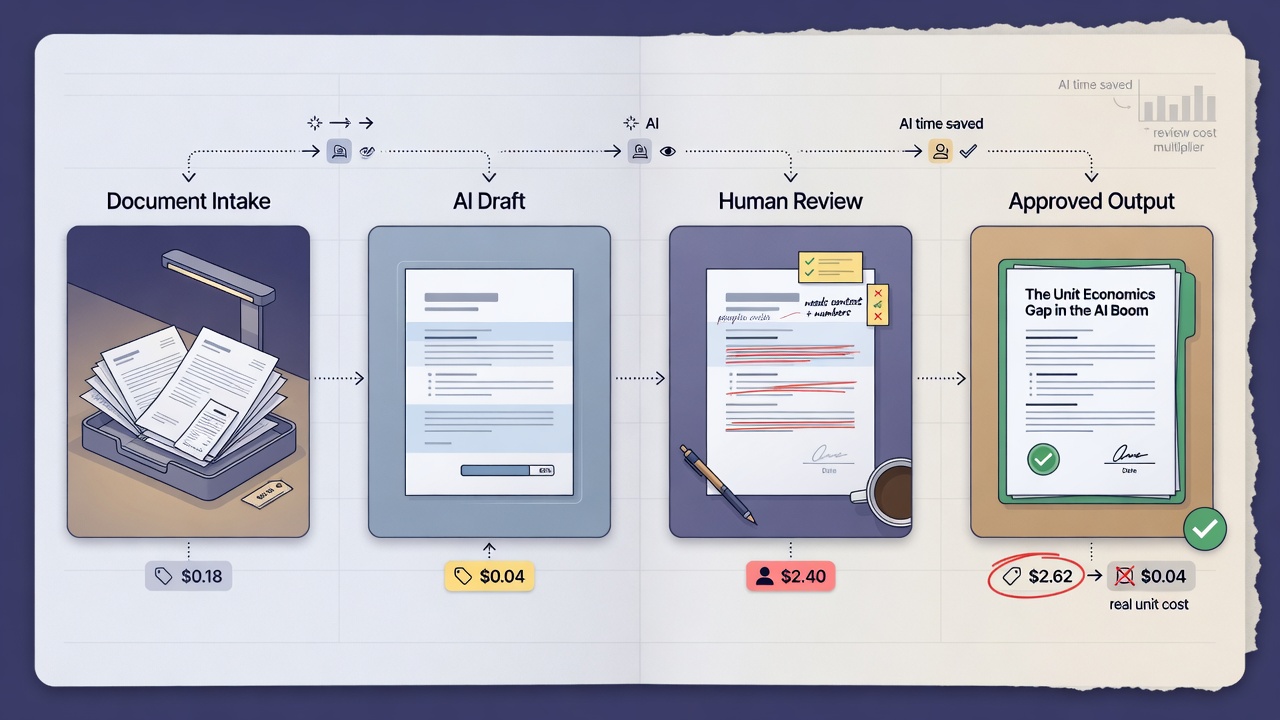
The current AI landscape is defined by a fundamental mismatch between the variable cost of generating intelligence and the fixed-price models used to sell it. While hyperscalers and startups pour billions into infrastruc

Automation needs a narrow first win
The best first AI workflow is usually a repeated task with a clear input, clear output, and a human approval step.
The current AI landscape is defined by a fundamental mismatch between the variable cost of generating intelligence and the fixed-price models used to sell it. While hyperscalers and startups pour billions into infrastructure, the underlying economics of Large Language Models (LLMs) are increasingly at odds with traditional software sales models.
The High Marginal Cost of Intelligence: Why SaaS Models are Failing AI
LLM costs are metered by tokens, regardless of the quality or utility of the output. However, most AI startups—including Perplexity, Cursor, and GitHub Copilot—currently operate on subscription models with vague usage limits. This allows users to consume hundreds or thousands of dollars worth of tokens on low-cost monthly plans, creating a situation where many of these companies are currently unprofitable. The core issue is that the market hasn't yet adjusted to the reality that AI is a high-marginal-cost service. Unlike traditional SaaS, where the cost of one more user is negligible once the software is built, AI requires constant, expensive compute for every interaction.
Worth a look
Phugialy Picks

AI Engineering: Building Applications with Foundation Models
A practical guide to building real-world applications with foundation models and LLMs.

GMKtec K15 AI Mini PC Oculink Intel Ultra 5 125U 32GB DDR5 512GB SSD | Desktop Computer AI Boost, 3X M.2 2280 Storage Expansion, Dual NIC...

GEEKOM IT15 AI Mini PC, Intel Ultra 9 285H(99 Tops), 32GB DDR5, 1TB SSD | The Most Powerful Workstation,Arc 140T GPU,WiFi 7,8K Business D...
Some Phugialy Picks use affiliate links. If you buy through one, Phugialy may earn a commission. It doesn't change what we recommend. Full disclosure →
Infrastructure Debt and the Consumer Hardware Ripple Effect
The scale of capital expenditure required to sustain this growth is creating systemic financial risks. Hyperscalers have spent over $1 trillion in capex since 2022 and are projected to spend north of $650 billion on AI infrastructure this year alone. This demand is not localized to the cloud; it has already driven up DRAM prices, impacting the cost of consumer hardware like Macs and iPhones. Furthermore, the heavy reliance on debt for data center construction—exemplified by Oracle’s $340 billion+ bet and hundreds of billions in debt—creates a precarious environment for investors and pension funds. If the demand story is as much of a mirage as some suggest, these debt loads could become a major liability.
From Growth at All Costs to a Utility Pricing Reality
The real story here isn't just the technological advancement, but what these figures signal about the next phase of the AI market: a forced move toward monetization maturity. With 89% of all AI revenues concentrated in just two players—Anthropic and OpenAI—the "growth at all costs" era is hitting a ceiling. OpenAI’s $20.9 billion loss on $13.07 billion in revenue for 2025 is a stark reminder of the current imbalance. We are approaching a crossroads: either the industry moves toward a "utility" pricing model where users pay for what they actually consume, or only the largest players with the deepest pockets can survive the transition to profitability. The winners won't just be those with the best models, but those who can solve the broken economics of intelligence.
Got a question about how this applies to you? →
Keep reading
Follow the thread

AI Tutors Work Only If Students Use Them: Trial
A two-year trial across 18 middle schools found Khan Academy's AI tutor raised math scores modestly - but here's the catch: the gains looked just like those from practice without any AI at all. The real story isn't whether AI tutoring works; it's that 96% of students tried it and almost none used it when they actually needed help.
Read this noteSame lane, different angle
Spectral Attacks Reveal a Hidden Weak Spot in Vision-Language Models
Researchers found a way to attack vision-language models using the model's own internal geometry — aligning representations with the subspaces the model cares about least. It beats existing baselines, and the same insight could make these models tougher.
SPEAR Turns Any Unreal Project Into an Embodied AI Simulator
A new open-source library exposes over 14,000 Unreal Engine functions to Python at no wrapper cost — turning any UE project into candidate training infrastructure for embodied AI at 73 fps photorealistic rendering.