Run AI Agents From Your Phone: AgentsDock Makes It Real
You can now run AI agents like Claude Code and Codex from your phone — not a stripped-down preview, but full terminal access, code editing, and inline results with plots and rendered videos. That's the pitch behind Agent
Automation needs a narrow first win
The best first AI workflow is usually a repeated task with a clear input, clear output, and a human approval step.
You can now run AI agents like Claude Code and Codex from your phone — not a stripped-down preview, but full terminal access, code editing, and inline results with plots and rendered videos. That's the pitch behind AgentsDock, a newly launched platform for running and monitoring AI agents from any device, and it's worth getting genuinely excited about.
What AgentsDock Actually Does
The core capability is simple to describe: AgentsDock lets you chat with multiple agents — Claude Code, Codex, and more — side by side, and connect to multiple servers at once. Your lab workstation, a Mac mini, a rented GPU box: you can switch between them anytime, from the same interface.
Under the hood, you get real terminal access via persistent tmux sessions from any device, plus the ability to view and edit code on remote machines with syntax highlighting. Setup takes a few simple commands, with Tailscale and tmux as optional supported tools. There's also a desktop client for connecting Claude and Codex across machines.
The part that surprised me most: agents return plots, images, and rendered rollouts inline in the chat. One early user put it perfectly: "Vibe coding from my phone, anywhere. I can check how my model training is going in whatever spare minutes I have — and it sends back the images and videos." Another described it as looking like "Termius, Claude, Codex and Cursor created a robot baby," which is honestly the most accurate product description I've read in a while.
Worth a look
Phugialy Picks

AI Engineering: Building Applications with Foundation Models
A practical guide to building real-world applications with foundation models and LLMs.

GMKtec K15 AI Mini PC Oculink Intel Ultra 5 125U 32GB DDR5 512GB SSD | Desktop Computer AI Boost, 3X M.2 2280 Storage Expansion, Dual NIC...

AI: Understand the Revolution: From Basics and Buzzwords to Tech Giants, Governments, and Your Future
Some Phugialy Picks use affiliate links. If you buy through one, Phugialy may earn a commission. It doesn't change what we recommend. Full disclosure →
Why Running AI Agents From Your Phone Changes the Rhythm of Work
Here's what I think is the quietly bigger implication. Training runs and agent tasks don't happen in tidy hour-long blocks — they churn away in the background while you're on a commute, in a waiting room, or eating lunch. Until now, those spare minutes were dead time unless you happened to be at your desk.
What this actually points to is a shift in how researchers and developers supervise long-running work. If checking on a training run takes thirty seconds from your phone, you check far more often. More frequent, lighter-touch supervision means catching problems earlier, steering agents mid-task, and squeezing value out of time that used to be lost. The headline feature is mobile access; the downstream possibility is a fundamentally tighter feedback loop between you and your machines.
The Multi-Server Angle Nobody's Talking About Enough
The other underappreciated piece: server switching. Most people's compute is scattered — a workstation in the lab, a mini at home, rented GPUs in the cloud. A tool that treats all of them as one switchable surface removes the constant context-juggling between SSH sessions and browser tabs.
Give this a year, and I'd expect mobile-first agent supervision to feel as normal as checking CI pipelines from your phone does today. The tools are arriving; the workflow habit will follow. If you've ever wanted your agents to work the same hours you don't have to, this is the direction things are heading.
Got a question about how this applies to you? →
Keep reading
Follow the thread
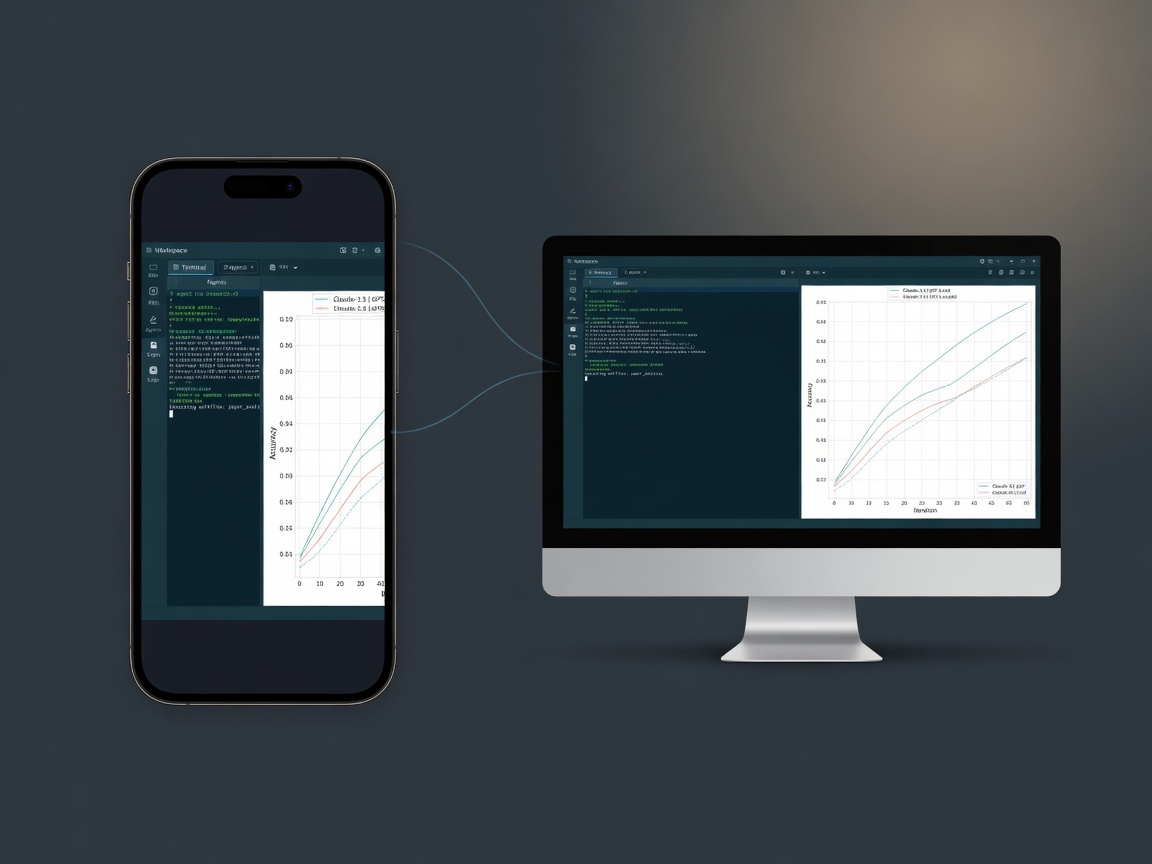
AgentsDock: One Workspace for Agentic AI Research
AgentsDock 1.0 puts Claude Code, Codex, and Cursor in one workspace reachable from your phone - with training plots showing up inline in chat instead of behind an SSH login.
Read this noteSame lane, different angle
Why Most Enterprise AI Agents Never Reach Production
Two out of three enterprise AI agents never reach production — and the reason isn't model quality. It's that the agent doesn't know what your data means.
Automated PoC Generation Fixes AI Bug Reports
AnyPoC turns LLM bug reports into executable proof-of-concept tests — rejecting 9.7x more false positives than naive validation. The architecture behind why one agent grading its own homework fails.