Hybrid Quantum-Classical Architectures: Solving Time Series Invariance with Path Signatures
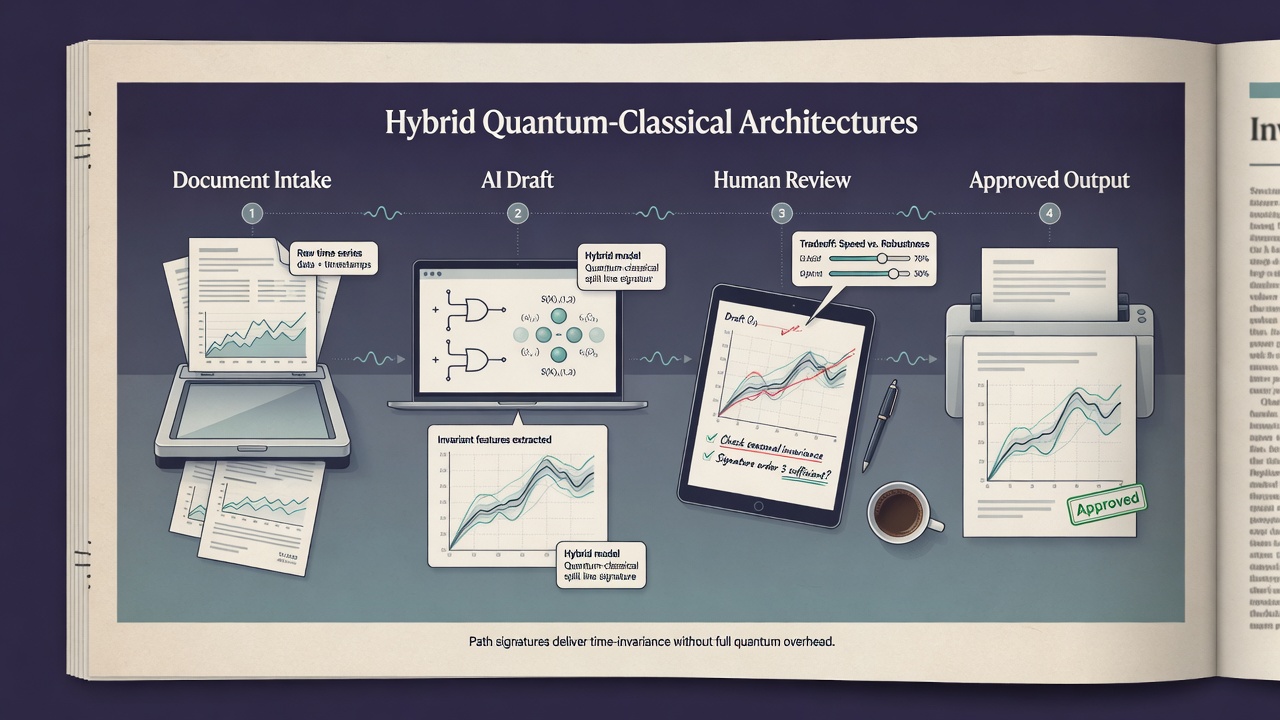
Time series classification often hits a wall when dealing with time reparametrization invariance—the property where the underlying shape of a movement or signal matters more than the exact speed at which it occurs. To ad

Automation needs a narrow first win
The best first AI workflow is usually a repeated task with a clear input, clear output, and a human approval step.
Time series classification often hits a wall when dealing with time reparametrization invariance—the property where the underlying shape of a movement or signal matters more than the exact speed at which it occurs. To address this, a new hybrid architecture combines rough path theory, specifically path signatures, with quantum neural networks.
Solving for Invariance without the Computational Overhead
Rough path theory provides a mathematical framework to convert irregular paths into feature vectors that remain consistent even if the input speed varies. The signature transform is the standard tool for this, capturing the geometric and algebraic structure of a path in a way that is inherently invariant to reparametrization. However, explicitly computing truncated signatures is a computational bottleneck as dimensionality grows.
This architecture bypasses that overhead by using signature kernels. By utilizing kernels, the model captures the necessary features without the brute-force calculation of raw transformations. It shifts the computational burden from the initial path transformation to the efficiency of the kernel solver. This is a pragmatic engineering move: it makes high-dimensional feature extraction tractable by focusing on the solver's performance rather than the complexity of the signature itself.
Worth a look
Phugialy Picks

AI Engineering: Building Applications with Foundation Models
A practical guide to building real-world applications with foundation models and LLMs.

GMKtec K15 AI Mini PC Oculink Intel Ultra 5 125U 32GB DDR5 512GB SSD | Desktop Computer AI Boost, 3X M.2 2280 Storage Expansion, Dual NIC...

GEEKOM IT15 AI Mini PC, Intel Ultra 9 285H(99 Tops), 32GB DDR5, 1TB SSD | The Most Powerful Workstation,Arc 140T GPU,WiFi 7,8K Business D...
Some Phugialy Picks use affiliate links. If you buy through one, Phugialy may earn a commission. It doesn't change what we recommend. Full disclosure →
The Quantum-Classical Handshake
This model doesn't try to force everything onto quantum hardware. It employs a hybrid approach where the heavy lifting of solving linear equations is handled by either a classical routine for kernel PDEs or a Variational Quantum Linear Solver (VQLS). Once the features are processed through these solvers, the framework feeds them into Quantum Convolutional Neural Networks (QCNNs) for the final classification task.
This modularity is significant. It allows for targeted hardware deployment: using classical methods where they are reliable and quantum solvers where they might offer a distinct advantage in handling the kernel's linear systems. It represents a move toward a more nuanced deployment of quantum resources rather than a generic "quantum-first" approach that often ignores the limitations of current hardware.
Where the Paper Ends and Production Begins
The real story here isn't the MNIST stroke sequence result; it's the feasibility of scaling this to non-trivial, noisy data. The researchers validated this on a binary classification task, which is a standard starting point but doesn't reflect the complexity of real-world sensor logs or high-frequency financial data.
The part worth being skeptical of is whether the quantum advantage in the VQLS actually holds up against highly optimized classical solvers when the data isn't perfectly clean. In practice, we have a mathematically sound way to handle reparametrization invariance, but we still haven't seen how this architecture handles the "messy" data where the signature transform might produce too much noise for a QCNN to filter effectively. It is a promising framework for research, but the transition from a stroke sequence to a production pipeline is where the engineering hurdles will likely outweigh the theoretical gains.
Got a question about how this applies to you? →
Keep reading
Follow the thread
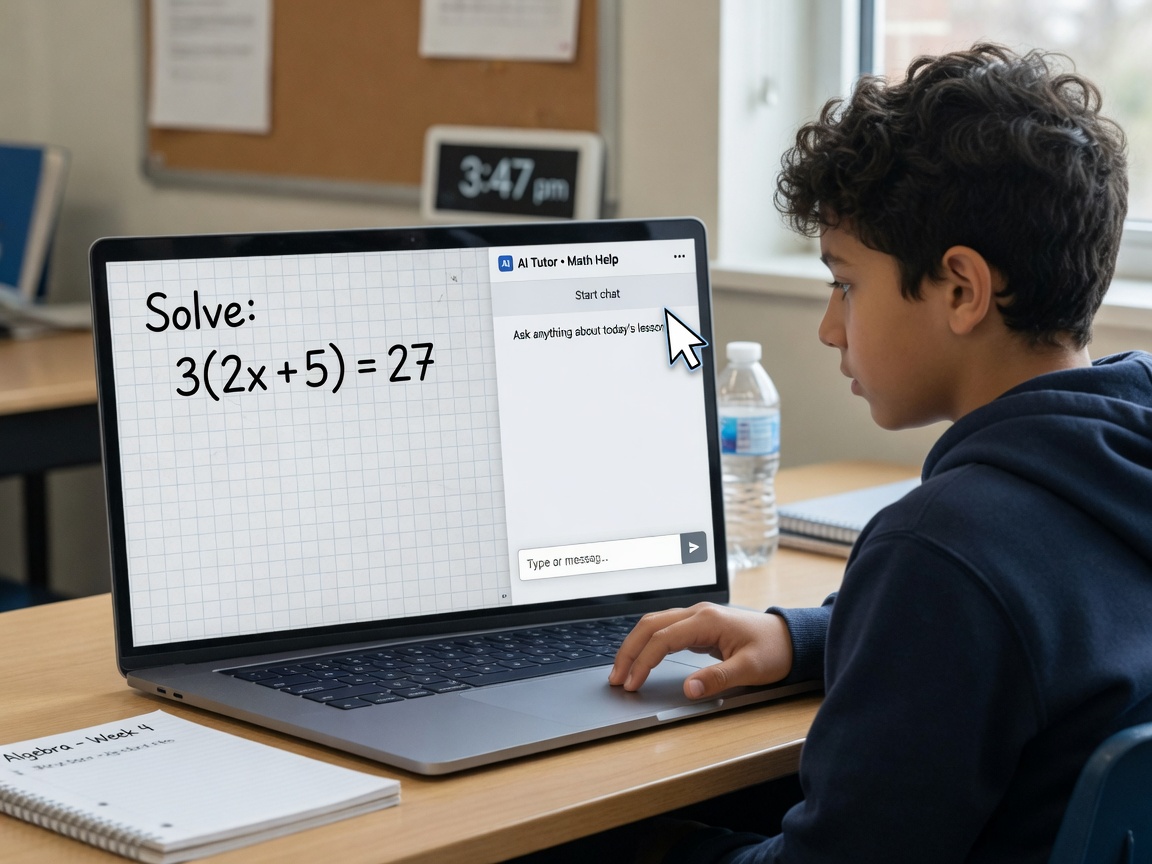
AI Tutors Work Only If Students Use Them: Trial
A two-year trial across 18 middle schools found Khan Academy's AI tutor raised math scores modestly - but here's the catch: the gains looked just like those from practice without any AI at all. The real story isn't whether AI tutoring works; it's that 96% of students tried it and almost none used it when they actually needed help.
Read this noteSame lane, different angle
Spectral Attacks Reveal a Hidden Weak Spot in Vision-Language Models
Researchers found a way to attack vision-language models using the model's own internal geometry — aligning representations with the subspaces the model cares about least. It beats existing baselines, and the same insight could make these models tougher.
SPEAR Turns Any Unreal Project Into an Embodied AI Simulator
A new open-source library exposes over 14,000 Unreal Engine functions to Python at no wrapper cost — turning any UE project into candidate training infrastructure for embodied AI at 73 fps photorealistic rendering.