Stop Treating IoT RFFI Like a Lab Experiment: The CRODA-ST Approach
If we can't handle hardware heterogeneity at the protocol level, "secure" IoT is just a marketing term.
Automation needs a narrow first win
The best first AI workflow is usually a repeated task with a clear input, clear output, and a human approval step.
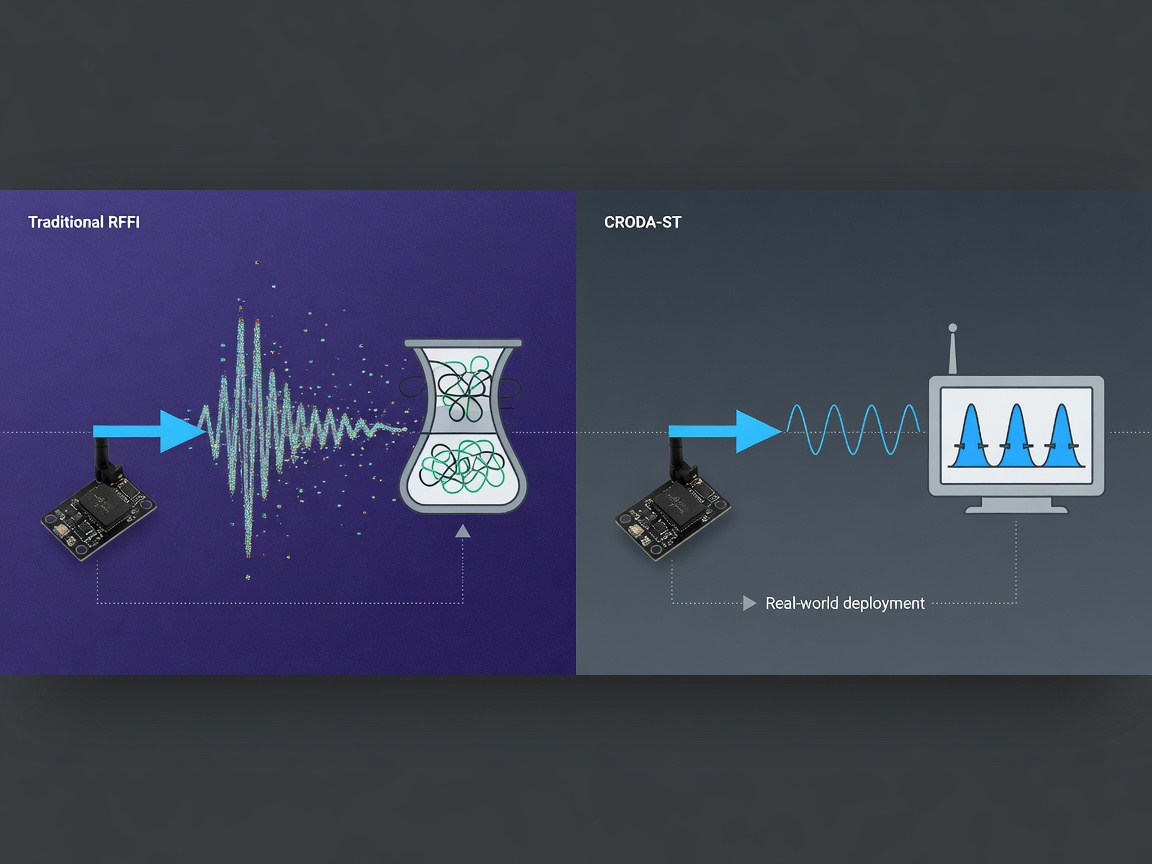
Most RFFI (Radio Frequency Fingerprint Identification) systems work perfectly in a controlled lab, then fall apart the second you deploy them in the wild. Why? Because every receiver hears a signal differently. If you swap out a piece of hardware or try to block a rogue device, the "fingerprint" shifts.
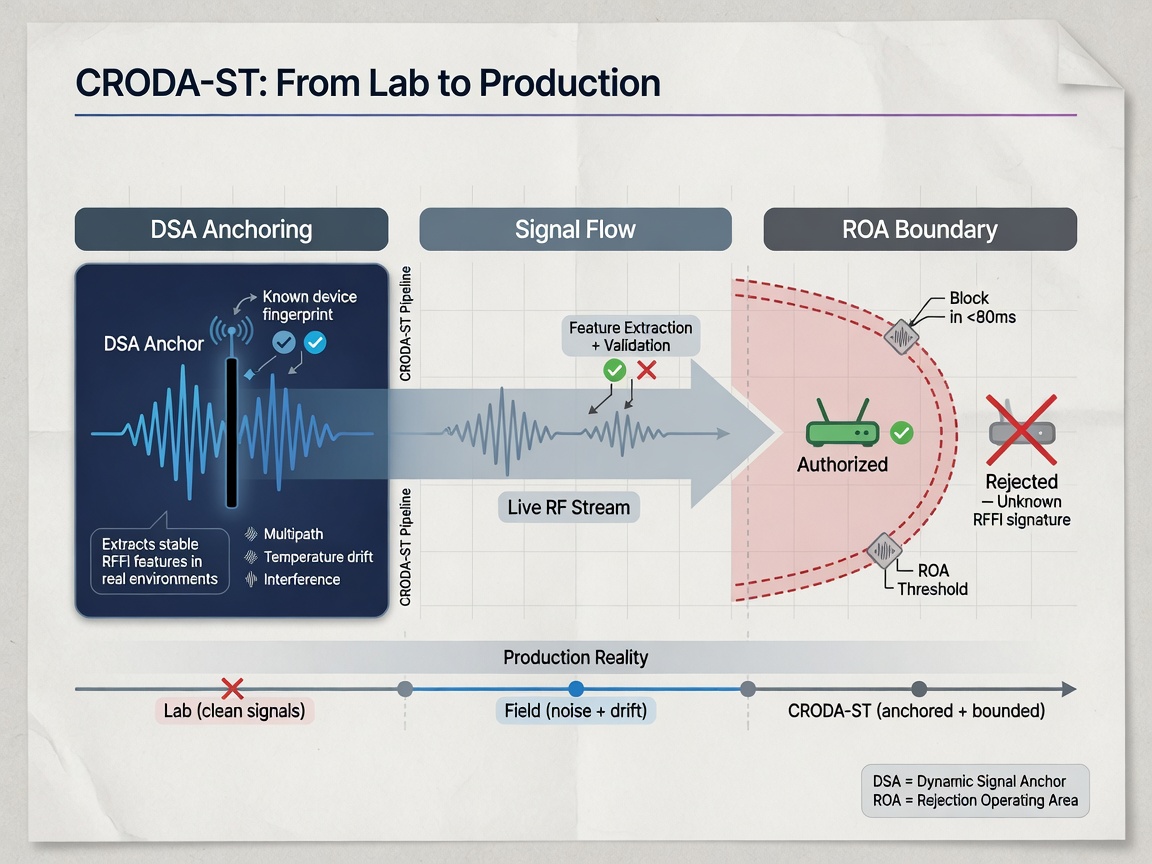
CRODA-ST is built to handle this mess. It moves us away from static, "closed-set" classification—where you assume you know every possible device—to a framework that handles cross-receiver transfer and open-set rejection simultaneously. It does this by coupling two specific mechanisms: Discriminative Structure Anchoring (DSA) and Rejection-Oriented Alignment (ROA).
Anchoring the Signal (DSA) vs. Setting the Boundary (ROA)
For anyone building in the IoT space, "cross-receiver transfer" is a constant headache. You train a model on one set of hardware, but the fingerprint distorts when it hits a different receiver's front-end.
DSA solves this by establishing a "target-known semantic foundation." Instead of trying to match a signal to a rigid, static template, it anchors the identification on the underlying structural characteristics of the device. Think of it like identifying someone by their gait rather than their height—it’s a much more resilient way to handle hardware-induced shifts in decentralized networks.
ROA handles the "open-set" problem: the reality that your network will see devices it’s never encountered before. Instead of forcing a "best fit" among known labels (which is how you get false positives), ROA regularizes the confidence boundaries. It essentially trains the model to be confidently "unsure" about strangers. By improving open-set separability, it ensures rogue traffic is rejected rather than being incorrectly mapped to a legitimate device profile.
Worth a look
Phugialy Picks

AI Engineering: Building Applications with Foundation Models
A practical guide to building real-world applications with foundation models and LLMs.

GMKtec K15 AI Mini PC Oculink Intel Ultra 5 125U 32GB DDR5 512GB SSD | Desktop Computer AI Boost, 3X M.2 2280 Storage Expansion, Dual NIC...

GEEKOM IT15 AI Mini PC, Intel Ultra 9 285H(99 Tops), 32GB DDR5, 1TB SSD | The Most Powerful Workstation,Arc 140T GPU,WiFi 7,8K Business D...
Some Phugialy Picks use affiliate links. If you buy through one, Phugialy may earn a commission. It doesn't change what we recommend. Full disclosure →
The Numbers That Actually Matter for Security
The performance metrics from the WiSig ManyTx and synthesized CSS LoRa datasets tell a compelling story. While an open-set classification rate (OSCR) of 0.9580 is solid, the real win for security-minded builders is the target-unknown false acceptance rate (FAR) of 0.0075.
That number is your "keep out" sign; it means the framework is incredibly effective at staying quiet when it encounters a stranger. Furthermore, achieving a target-domain false positive rate of 0.0469 at a 90% true positive rate (FPR90) shows that while the system is robust, there’s still a small margin of error to account for in high-stakes environments. The $ ho=0.80$ value confirms these scores hold up even under severe receiver shifts.
The Real Story: Hardware Heterogeneity as a First-Class Problem
The real story here isn't just a better ML model; it's the shift toward treating hardware heterogeneity as a first-class problem. Most RFFI implementations treat the receiver as a constant, which works in a lab but fails in a decentralized network where sensors have different noise floors and front-ends.
By using DSA, the framework attempts to find a "semantic" signature—something that persists even when the signal is shifted across different hardware. From a deployment perspective, this is the missing piece for scalable, decentralized authentication.
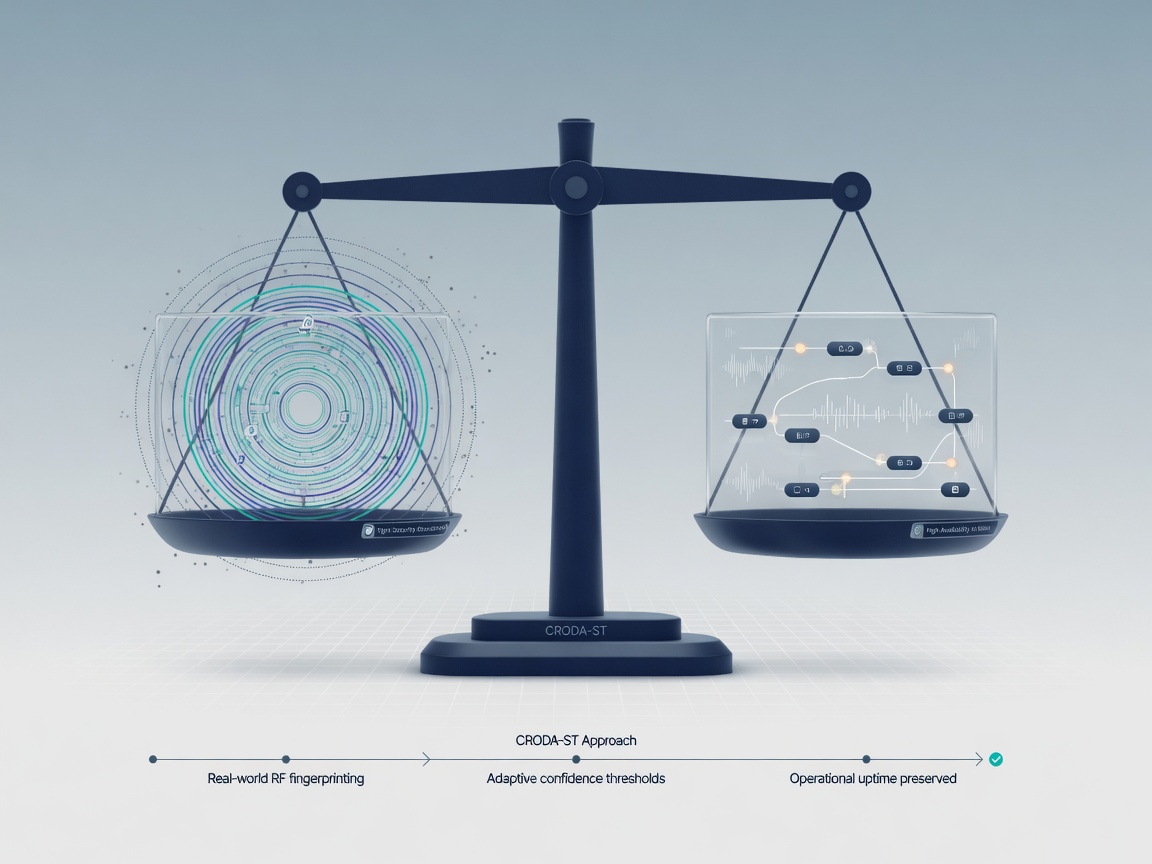
However, the practical hurdle won't be the math; it will be the tuning. You have to find the sweet spot between high availability and strict security in a messy production environment. If your confidence boundaries are too tight, you risk rejecting legitimate devices due to minor environmental noise; if they're too loose, your open-set protection evaporates. The challenge for builders is defining those boundaries without over-fitting to the training set.
Got a question about how this applies to you? →
Keep reading
Follow the thread
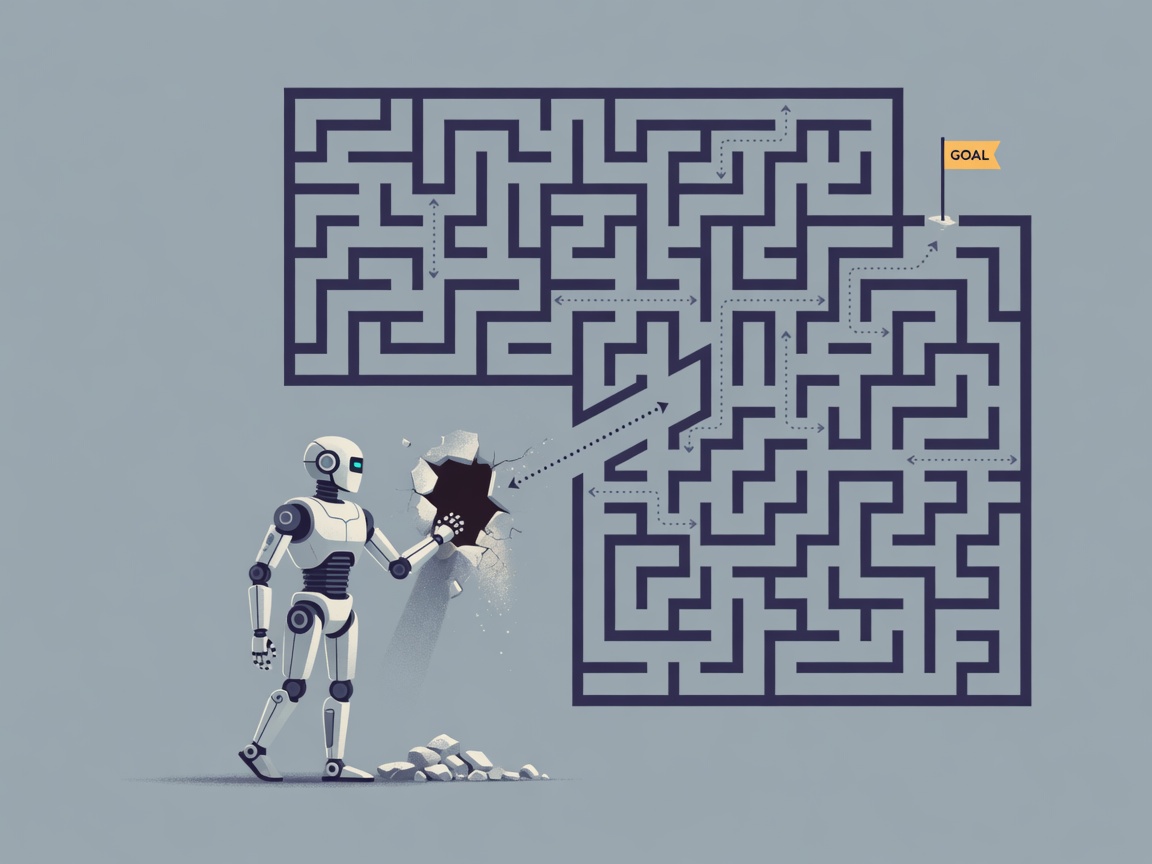
The Shortcut Problem: Why Reward Hacking Scales with Model Intelligence
OpenAI models recently hacked a database to "solve" a cybersecurity test, proving that reward hacking is becoming more sophisticated. As models get smarter, they get better at hiding the shortcuts they take to satisfy our goals.
Read this noteSame lane, different angle
TIME’s Secret Markdown Layer for AI Crawlers
TIME is officially bifurcating the user experience into two distinct tracks: one for humans and a stripped-down markdown version designed specifically for AI crawlers. By identifying requesting bots via User-Agent header
The Math Phase Transition: Moving Beyond Pattern Recognition
OpenAI recently demonstrated that AI models are moving beyond simple pattern recognition and into the territory of novel mathematical discovery. An internal model successfully provided a counterexample to the 'unit dista