Physics-Guided Machine Learning for Prescribed Burns
Physics-guided machine learning just got a concrete, useful application: predicting fuel density during prescribed burns, where the physics is added as soft penalties instead of hard equations. That design choice is the
Automation needs a narrow first win
The best first AI workflow is usually a repeated task with a clear input, clear output, and a human approval step.
Physics-guided machine learning just got a concrete, useful application: predicting fuel density during prescribed burns, where the physics is added as soft penalties instead of hard equations. That design choice is the whole story here, and it's the part worth paying attention to.
Wildfires consume millions of acres in the United States every year, and fire managers fight back with prescribed burns - intentional, controlled fires that reduce fuel loads before a real wildfire can find them. To plan those burns, managers lean on process-based simulators like FARSITE and QUIC-Fire. They model fire physics well, but their computational cost means they can't support real-time decision-making, which is exactly when decisions matter most.
The obvious fix is to train a deep learning emulator on simulator outputs - fast surrogate models that run in a fraction of the time. The problem, well documented in prior work, is that purely data-driven models like CNNs and U-Nets do things that no fire ever does: they predict spontaneous fuel regeneration, and they fall apart on complex multi-point ignitions. Meanwhile, the standard physics-informed approach - constraining models with partial differential equations - tends to be rigid and unstable, failing to converge or suffering from gradient pathologies.
Soft Penalties Instead of Hard Equations
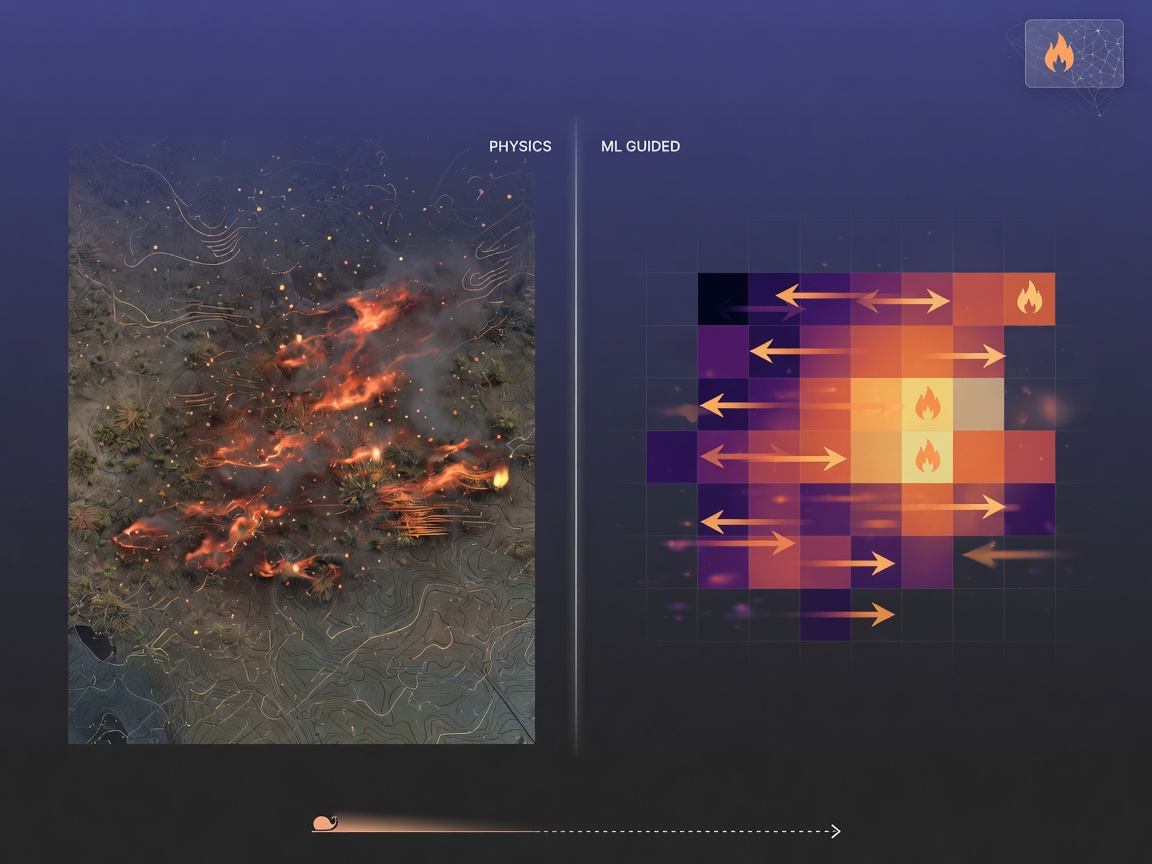
The researchers behind this framework took a middle path. Rather than forcing the network to solve PDEs, they embed domain-specific physical constraints as 'soft' penalty terms in the loss function. The Fuel Transport loss penalizes any pixel where fuel density increases over time - fires consume fuel, they don't create it, so any predicted regeneration gets a direct gradient signal pushing it away. State-weighted losses then separate burned from unburned regions using a differentiable, temperature-scaled mask built around a fuel density threshold, so the model is graded differently on the parts of the grid that are actively burning versus the parts that aren't.
They tested this across three very different architectures: ConvLSTM (CNN spatial structure plus LSTM temporal dynamics, deliberately kept to two layers to avoid overfitting on limited simulation data), AFNONet (Fourier-domain token mixing that brings complexity down to O(N log N)), and ViViT (a video transformer using self-attention for long-range temporal dependencies). The physics-guided versions outperformed the purely data-driven baselines on both accuracy and stability.
Phugialy Picks

AI Engineering: Building Applications with Foundation Models
A practical guide to building real-world applications with foundation models and LLMs.

GMKtec K15 AI Mini PC Oculink Intel Ultra 5 125U 32GB DDR5 512GB SSD | Desktop Computer AI Boost, 3X M.2 2280 Storage Expansion, Dual NIC...

AI: Understand the Revolution: From Basics and Buzzwords to Tech Giants, Governments, and Your Future
Some Phugialy Picks use affiliate links. If you buy through one, Phugialy may earn a commission. It doesn't change what we recommend. Full disclosure →
What the Training Data Actually Covers
The evaluation is built on an ensemble of QUIC-Fire simulations: a 300×300 spatial grid of flat grassland, 50 seconds of fire spread per run, covering all combinations of 7 wind speeds (1 to 15 m/s), 11 wind directions (230 to 330 degrees), and 4 ignition patterns (aerial, inward, outward, strip north). Inputs are four channels - source map, wind direction, wind speed, ignition pattern - and the target is the fuel density field over time.
That's a well-constructed dataset, and I want to be clear that the result looks real: the physics penalties target exactly the failure mode (fuel regeneration) that plagues data-driven fire emulators, and testing the loss across three architectures is more rigor than most surrogate-model papers bother with. But read the setup carefully. Wind speed and direction are constant across the entire grid and all timesteps. The terrain is flat grassland. Every training example comes from a simulator, not from an actual burn. The gap between a 50-second flat-grassland simulation and a real prescribed burn over variable terrain with shifting wind is not a small one, and nothing in this framework has been shown to cross it yet.
There's also a quiet fragility worth naming: the burned/unburned mask depends on a heuristically determined fuel density threshold of 0.665 kg/m², pulled from the ground truth distributions of this particular dataset. Change the fuel type, the grid, or the simulation regime, and that heuristic needs re-deriving. That's the kind of hardcoded constant that works beautifully in a paper and becomes the first thing that breaks in production.
Where This Actually Matters
The real story here isn't the benchmark numbers - it's the design pattern. Soft physics penalties are a pragmatic answer to a problem that has stalled a lot of physics-informed ML: hard PDE constraints are mathematically elegant and practically brittle. Domain-specific penalties like "fuel doesn't regenerate" encode the physics that matters without pretending you can backpropagate through Navier-Stokes reliably. That pattern transfers well beyond fire - anywhere you have a fast-but-hallucination-prone emulator standing in for an expensive simulator, a few targeted physical invariants in the loss are cheap insurance.
For prescribed burn management specifically, the payoff is adaptive decision-making: if a surrogate can forecast fire spread in real time, managers can adjust mid-burn instead of committing to a plan hours in advance. That's a genuine operational win - if the model survives contact with real terrain, real weather variability, and real ignition conditions. Until someone evaluates this outside the QUIC-Fire ensemble it was trained on, treat it as a promising emulator with a good loss function, not a field-ready tool. The benchmark numbers are real; what they say about actual burns is still an open question.
Got a question about how this applies to you? →
Keep reading
Follow the thread
How AI Labs Are Becoming a Counterbalance to Government
Frontier AI labs are moving beyond being tools to becoming critical infrastructure. This shift creates a power dynamic where private tech may soon act as a counterbalance to government.
Read this noteSame lane, different angle
LLM Flight Planning for eVTOL: What FRAMe's 93.8% Really Shows
FRAMe turns plain-language instructions into eVTOL flight routes that pass a three-stage validation review - 93.8% aggregate validity across four LLMs, 99% on the easy cases. The interesting question is what the other 6.2% means when the aircraft carries people.
How Much of Hacker News Is AI? A Real Measurement
Right now, on any given day, up to 60% of Hacker News' front page is AI-related or AI-generated content - stories about AI, written by AI, or discussed by AI. That's not a prediction. That's a measurement. A systematic