LLM Flight Planning for eVTOL: What FRAMe's 93.8% Really Shows
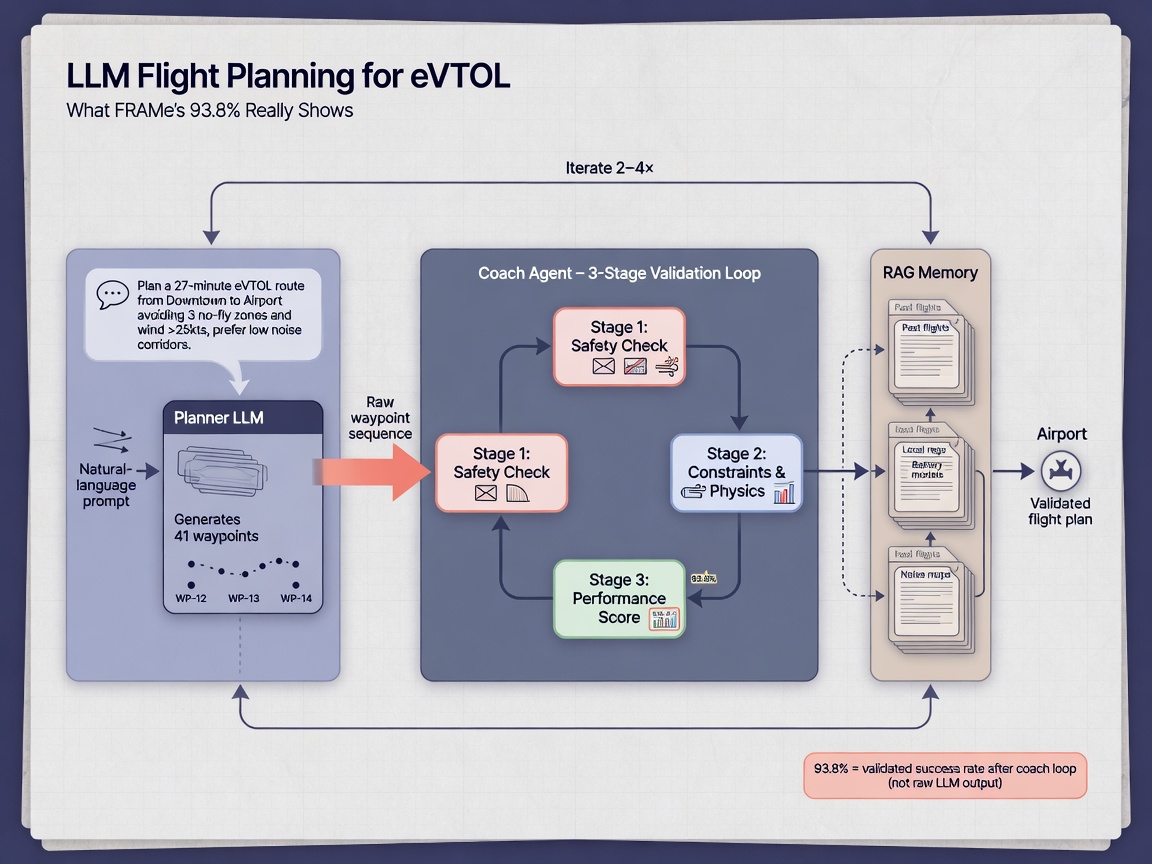
FRAMe turns plain-language instructions into eVTOL flight routes that pass a three-stage validation review - 93.8% aggregate validity across four LLMs, 99% on the easy cases. The interesting question is what the other 6.2% means when the aircraft carries people.

Automation needs a narrow first win
The best first AI workflow is usually a repeated task with a clear input, clear output, and a human approval step.
LLM flight planning just got a concrete benchmark: FRAMe, an end-to-end system that turns natural language instructions into actual eVTOL flight routes, hitting up to 93.8% aggregate validity across four LLMs and 99% on Easy scenarios with the strongest planner. That's the number worth staring at, because it's not a demo of a chatbot talking about flight - it's a pipeline producing waypoints that pass a three-stage review.
What FRAMe Actually Is Under The Hood
The architecture is three pieces. A planner LLM serves as the route planner, transforming textual prompts into sequences of geographic waypoints. A RAG-based memory module grounds the model's reasoning by supplying relevant context from prior planning experiences and their evaluations - so the system learns from its own past plans, not just from the prompt in front of it. And a multi-modal coach agent validates each generated plan through a three-stage review: geometric validation, preference alignment evaluation, and optional operator feedback.
The source article frames this as bridging the gap between human pilot intent and autonomous flight operation, which the authors call critical for real-world eVTOL deployment. Functionally, that means an operator says what they want in plain language, and the system outputs routes that respect no-fly zones while aligning with human preferences.
Phugialy Picks

AI Engineering: Building Applications with Foundation Models
A practical guide to building real-world applications with foundation models and LLMs.

GMKtec K15 AI Mini PC Oculink Intel Ultra 5 125U 32GB DDR5 512GB SSD | Desktop Computer AI Boost, 3X M.2 2280 Storage Expansion, Dual NIC...

AI: Understand the Revolution: From Basics and Buzzwords to Tech Giants, Governments, and Your Future
Some Phugialy Picks use affiliate links. If you buy through one, Phugialy may earn a commission. It doesn't change what we recommend. Full disclosure →
How They Measured It Without Annotators
The evaluation approach is the part I'd steal for other domains. Instead of paying humans to score outputs, FRAMe uses an annotator-free quantitative framework built on three measurable preference objectives: minimizing flight distance, minimizing waypoint count, and maximizing polygon clearance. Every plan gets scored against concrete, checkable criteria rather than vibes.
That's a practical pattern. If you've ever tried to evaluate LLM outputs for a domain where 'good' is subjective, the lesson here is to decompose the preference into objectives a script can verify, then let the coach agent do the pass/fail. It's the same move as writing assertions before you let a model near production traffic.
The Gap Between 93.8% And A Real Airspace
The obvious caveat: 93.8% aggregate validity means roughly one plan in sixteen fails validation even before you leave the benchmark. On Easy scenarios the strongest planner hits 99%, which tells you the difficulty curve is real - the messy middle cases are where validity erodes. In aviation, the failure mode isn't 'the plan is slightly suboptimal,' it's 'the plan is unsafe,' so the coach agent's geometric validation isn't a nice-to-have, it's the load-bearing component. The LLM proposes; the validator disposes.
What this actually points to, in my read, is a template for LLM-driven planning in any constrained physical or spatial domain - drone delivery, robotics navigation, logistics routing. The recipe is: planner LLM plus retrieval from past evaluated plans plus a deterministic multi-stage validator plus decomposed preference objectives. The part worth trying yourself is the RAG memory loop - grounding a planner in its own prior evaluated attempts is cheap to prototype and directly addresses the 'model forgets what worked last time' problem. The part that will get annoying at real scale is operator feedback: the three-stage review includes optional human input, and in production that loop becomes the bottleneck, not the model. The Advanced Air Mobility market is growing, and this paper is a credible signal that LLMs can carry human-centric mission planning - but the 6.2% of invalid plans are exactly the cases that matter most when the aircraft is carrying people.
Got a question about how this applies to you? →
For a related look at keeping LLM outputs honest in high-stakes domains, see "Engineering Truth in High-Stakes Document AI".
Keep reading
Follow the thread

How AI Labs Are Becoming a Counterbalance to Government
Frontier AI labs are moving beyond being tools to becoming critical infrastructure. This shift creates a power dynamic where private tech may soon act as a counterbalance to government.
Read this noteSame lane, different angle
Physics-Guided Machine Learning for Prescribed Burns
Physics-guided machine learning just got a concrete, useful application: predicting fuel density during prescribed burns, where the physics is added as soft penalties instead of hard equations. That design choice is the
How Much of Hacker News Is AI? A Real Measurement
Right now, on any given day, up to 60% of Hacker News' front page is AI-related or AI-generated content - stories about AI, written by AI, or discussed by AI. That's not a prediction. That's a measurement. A systematic