NVIDIA GPU Demand Raises Questions About Who Can Pay
A reported GPU sale means less if the buyer’s ability to purchase depends on financing from the seller. A new report alleges NVIDIA invested in some of the companies that would buy its GPUs, raising a useful question for anyone planning AI infrastructure: how much demand stands on its own?

Automation needs a narrow first win
The best first AI workflow is usually a repeated task with a clear input, clear output, and a human approval step.
The reported NVIDIA GPU demand story is less about a single investment than about whether buyers can pay for the hardware without help from its seller. A Wall Street Journal report alleges NVIDIA invested in AI startups and small cloud providers that would then buy NVIDIA GPUs and build data centers; these are reported allegations, not established findings.
What the NVIDIA GPU demand allegations describe
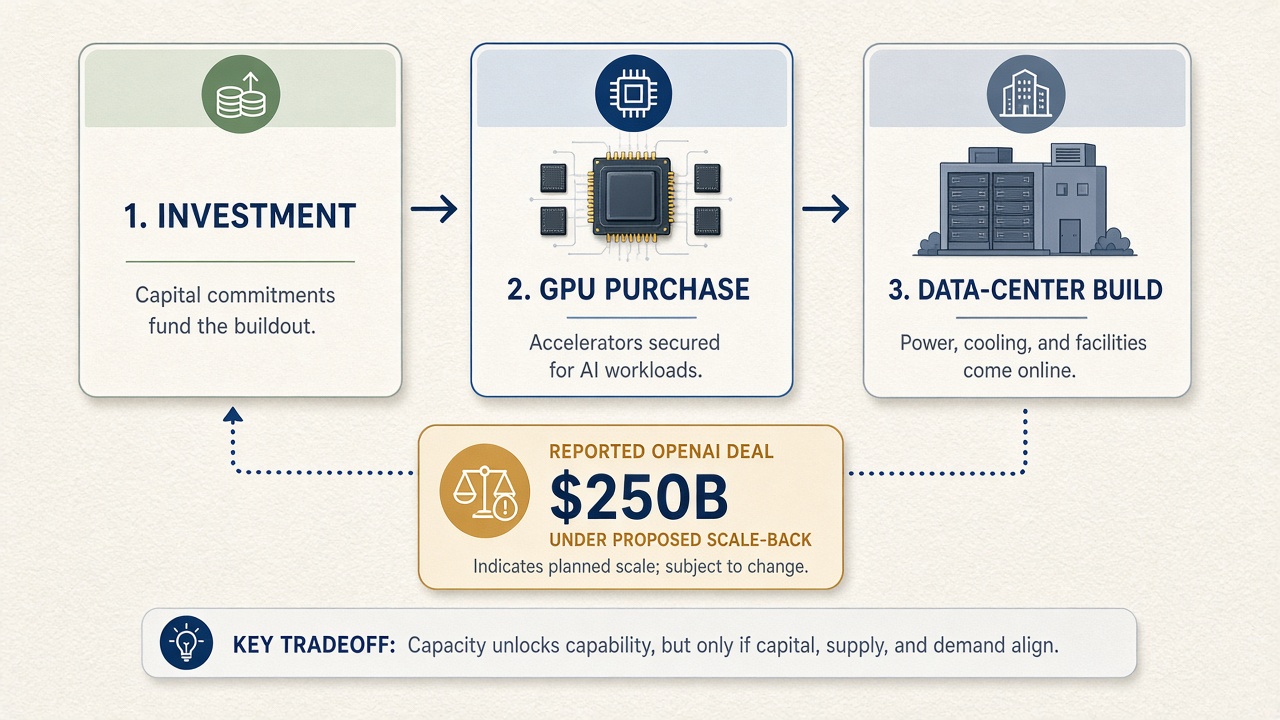
The report’s account links three things: NVIDIA investments, purchases of its GPUs by the recipients, and data-center construction. It alleges the investments helped sustain the appearance of demand and move excess semiconductor supply from TSMC. It also says some small cloud providers could not afford the GPUs NVIDIA was investing to sell them.
That last point is the practical hinge. A customer’s purchase is not necessarily evidence of durable demand if the customer’s ability to buy depends on financing from the supplier. But the available account does not establish how much supply moved this way, how many transactions were involved, or whether investment was decisive in any particular purchase. The allegation raises a question about demand quality; it does not answer it.
Worth a look
Phugialy Picks

ASUS TUF Gaming GeForce RTX 5070 12GB GDDR7 OC Edition Graphics Card

AI Engineering: Building Applications with Foundation Models
A practical guide to building real-world applications with foundation models and LLMs.

GMKtec K15 AI Mini PC Oculink Intel Ultra 5 125U 32GB DDR5 512GB SSD | Desktop Computer AI Boost, 3X M.2 2280 Storage Expansion, Dual NIC...
Some Phugialy Picks use affiliate links. If you buy through one, Phugialy may earn a commission. It doesn't change what we recommend. Full disclosure →
Circular financing changes how I’d read a GPU sale
The report also says CFO Colette Kress urged a reduction in circular financing agreements, including a proposed scale-back of NVIDIA’s $250 billion deal with OpenAI. That is a substantial reported figure, but it should not be treated as proof that the alleged arrangements occurred as described or that a specific amount of demand was artificial.
My read is that the useful distinction is between shipment demand and independently funded demand. If a buyer needs capital tied to the hardware vendor to place an order, that order may still put GPUs into a data center, but it tells an infrastructure planner less about how broadly customers can sustain purchases on their own. That is an interpretation of the reported structure, not a finding about NVIDIA’s books.
What infrastructure buyers should verify
For a team planning capacity, the report is a reason to ask how demand is being financed—not a reason to assume GPUs will be easy to obtain or that demand is fabricated. A financing relationship can affect how much confidence to place in a customer’s expansion plans, but the source material does not establish a direct effect on availability, pricing, or any particular buyer’s access.
I would want to see whether reported purchases and data-center plans continue when financing is reduced, and whether the small cloud providers involved can support the hardware costs themselves. Those are the checks that separate a durable customer base from purchases supported by a capital loop. Until there is clearer evidence, the disciplined move is to treat the report as a diligence prompt, not a forecast: verify the buyer’s funding and commitments before using headline demand as a planning assumption.
Holiday picks
Thanksgiving: early shopping
Start early: products for hosting, travel and home, plus the gear you have been watching.

Audio
Big purchaseSony WH-1000XM5 Premium Noise Cancelling Wireless Headphones
View on Amazon (opens in a new tab): Sony WH-1000XM5 Premium Noise Cancelling Wireless HeadphonesPrices change daily. Check today's price on Amazon.

Home & Kitchen
De'Longhi Magnifica Duo Automatic Espresso Machine, Milk Frother, Silver
View on Amazon (opens in a new tab): De'Longhi Magnifica Duo Automatic Espresso Machine, Milk Frother, SilverPrices change daily. Check today's price on Amazon.

Home & Kitchen
eufy C28 Robot Vacuum Cleaner and Mop for pet hair, 15,000 Pa
View on Amazon (opens in a new tab): eufy C28 Robot Vacuum Cleaner and Mop for pet hair, 15,000 PaPrices change daily. Check today's price on Amazon.
We earn from qualifying purchases made through these links, at no extra cost to you, as an Amazon Associate and through other affiliate programs. Disclosure. See all Thanksgiving picks
Got a question about how this applies to you? →
Keep reading
Follow the thread

Speech-to-Text Inference Cuts Compute Costs With Spot
AssemblyAI reports 70 percent lower inference-compute costs than On-Demand pricing. The useful part to study is how Amazon SQS turns Spot interruptions into recoverable jobs—and what to measure before expecting the same savings.
Read this noteSame lane, different angle
AI Data Center Financing Could Put Pensions at Risk
The AI data-center buildout has a financing chain that can reach retirement savings. The weak link to watch is whether the new capacity gets used enough to support the investment behind it.
NVIDIA’s Robotics Simulation Stack Faces the Transfer Test
GR00T 2 reached 40 of 50 tasks without task-specific demonstrations, and its reported success rose to 95% with five demonstrations per task. The harder question is whether these results transfer beyond the evaluation setup—and NVIDIA’s simulation stack is where that question can be tested at greater scale.