Anthropic’s Multi-Chip Compute Strategy Has a Catch
Anthropic says Claude now runs across four major chip families, and that Mythos got it running on AMD in three days. The bigger claim is that software could make each unit of compute go further—but the roadshow does not yet quantify the commercial payoff.

Automation needs a narrow first win
The best first AI workflow is usually a repeated task with a clear input, clear output, and a human approval step.
Anthropic’s multi-chip compute strategy could reduce how much Claude’s growth depends on any one chip family—but the roadshow’s strongest evidence is portability, not lower cost or faster training. The company says it trains and serves Claude across AWS Trainium, Google TPUs, NVIDIA GPUs, and AMD GPUs.
Four chip families broaden Anthropic’s options
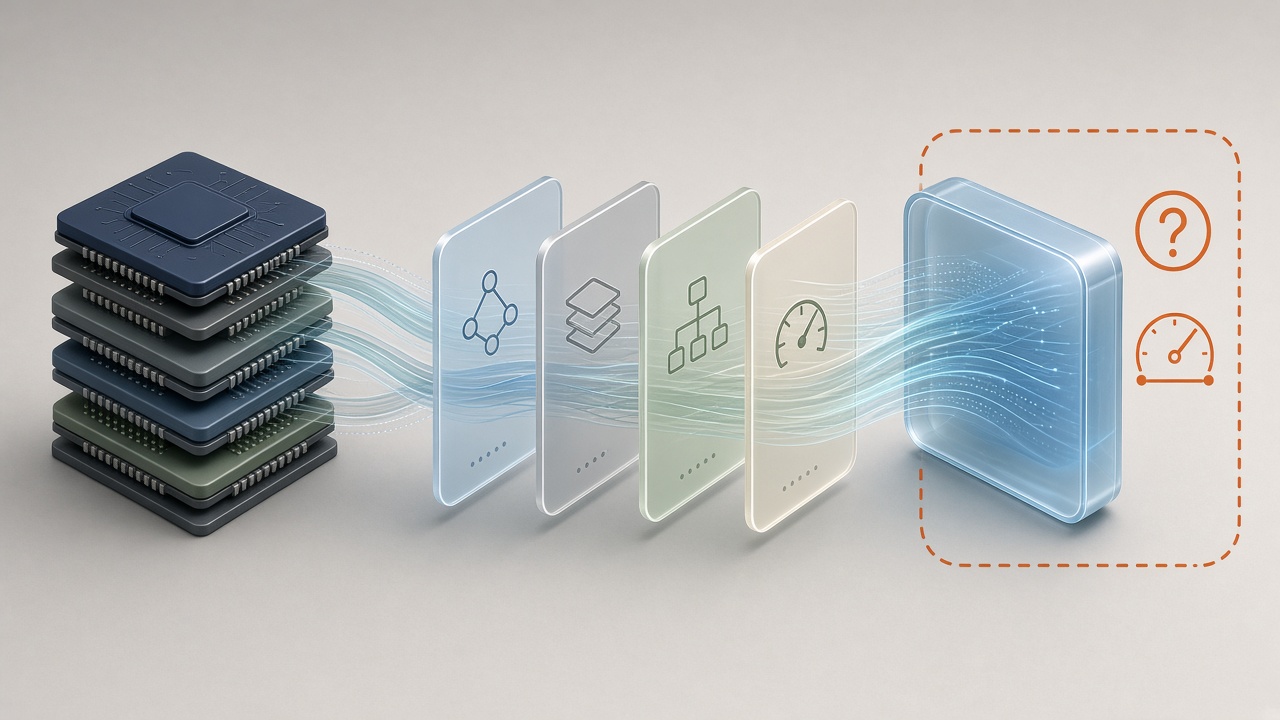
The practical claim is that Claude can run across four major chip families. Co-founder Tom Brown says Anthropic’s Mythos model ported or wrote almost all the kernels needed to get Claude running on AMD in three days, with basically no human intervention. That is a notable demonstration of how software work can ease movement between hardware platforms, if the account holds up beyond this example.
The commercial implication is not that Anthropic can simply swap chips without friction. The source gives no comparative prices, performance figures, or evidence that every model workload transfers equally well. But supporting multiple platforms plausibly gives the company more options when allocating compute and negotiating supply. It may also broaden the set of chip providers with a reason to compete for Anthropic’s workloads. Those are potential advantages, not demonstrated savings.
Worth a look
Phugialy Picks

AI Engineering: Building Applications with Foundation Models
A practical guide to building real-world applications with foundation models and LLMs.

GMKtec K15 AI Mini PC Oculink Intel Ultra 5 125U 32GB DDR5 512GB SSD | Desktop Computer AI Boost, 3X M.2 2280 Storage Expansion, Dual NIC...

2084 and the AI Revolution, Updated and Expanded Edition: How Artificial Intelligence Informs Our Future
Some Phugialy Picks use affiliate links. If you buy through one, Phugialy may earn a commission. It doesn't change what we recommend. Full disclosure →
Compute multipliers change the scaling argument
Anthropic also describes effective compute as physical capacity multiplied by discovered compute multipliers. Its point is that these multipliers build on one another: each new one can increase the effect of those found earlier. The roadshow presents this as a way for effective compute to grow beyond what raw hardware capacity alone would suggest.
That framing matters because it shifts the strategic question from only how many chips a company can secure to how much useful work it can extract from them. In my view, that is the more consequential claim. Hardware diversity is a hedge against dependence on a single platform; compounding improvements in compute efficiency could change how much capacity Anthropic needs for a given workload. The source does not quantify the resulting cost or performance impact, so the commercial value remains unproven.
The next test is repeatable progress, not a demo
The video goes further, suggesting Claude could eventually discover compute multipliers by itself as recursive self-improvement advances. That is a future possibility, not a capability established by the AMD example. Porting kernels in three days is evidence for a particular coding task; it does not, on its own, show that a model can reliably find and compound new efficiency gains.
For competitors and customers, the key question is whether these claims translate into measurable, repeatable improvements across workloads and chip families. If they do, Anthropic could gain more effective capacity from both hardware choice and better software. If not, the multi-chip strategy still offers optionality, but the case for a compounding compute advantage is weaker. The thing to watch is evidence that multiplier gains persist as workloads and hardware change—not just another striking demonstration.
Holiday picks
Thanksgiving: early shopping
Start early: products for hosting, travel and home, plus the gear you have been watching.

AI Hardware
Big purchaseGMKtec K13 AI Mini PC Intel Core Ultra 7 256V 16GB LPDDR5X 1TB SSD
View on Amazon (opens in a new tab): GMKtec K13 AI Mini PC Intel Core Ultra 7 256V 16GB LPDDR5X 1TB SSDPrices change daily. Check today's price on Amazon.

Home & Kitchen
eufy C28 Robot Vacuum Cleaner and Mop for pet hair, 15,000 Pa
View on Amazon (opens in a new tab): eufy C28 Robot Vacuum Cleaner and Mop for pet hair, 15,000 PaPrices change daily. Check today's price on Amazon.
 New this week
Home & Kitchen
Keurig K-Elite Single Serve K-Cup Pod Coffee Maker, Brushed Silver
View on Amazon (opens in a new tab): Keurig K-Elite Single Serve K-Cup Pod Coffee Maker, Brushed SilverPrices change daily. Check today's price on Amazon.
We earn from qualifying purchases made through these links, at no extra cost to you, as an Amazon Associate and through other affiliate programs. Disclosure. See all Thanksgiving picks
Got a question about how this applies to you? →
For a related look at the limits of scaling compute by brute force, read “The Quadratic Wall: Why Brute-Force AI is Hitting a Ceiling.”
Keep reading
Follow the thread

YouTube Copyright Claims Need a Clear Human Appeal Path
Media Nov Records says it runs 500 YouTube channels and sells automated copyright tools. In one reported case, a musician’s cover of a public-domain folk song was removed, and her counterclaims did not resolve the dispute.
Read this noteSame lane, different angle
Speech-to-Text Inference Cuts Compute Costs With Spot
AssemblyAI reports 70 percent lower inference-compute costs than On-Demand pricing. The useful part to study is how Amazon SQS turns Spot interruptions into recoverable jobs—and what to measure before expecting the same savings.
Offline AI for Small Businesses: A Local Advantage
Fastagger is building AI around the constraints many products treat as edge cases: low-cost phones and unreliable internet. Auni’s integration into M-Pesa gives it a route to merchants, but sustained use—not sign-ups—will determine whether that distribution turns into a business.